![[decorative]](https://mixagame.com/wp-content/uploads/2025/10/cropped-mixagame-redwhite-logo-1024x256-1.png)
Somewhere in the last eighteen months, the RPG stopped being just a genre. Instead, it became the center of gravity for PC gaming.
That is not a marketing line. It is simply what 2026 looks like. A French studio of thirty people and a dog outsold games with nine figure budgets. Meanwhile, a free to play action RPG became the title hardcore players and total newcomers argue about in the same Discord server. And a decade old live service game finally earned the praise its launch reviews withheld. So 2026 did not crown one dominant RPG. Instead, it produced a genre eating itself alive in the best possible way. Subgenres collided, budgets scrambled to catch up, and players ended up spoiled for choice. In fact, ranking these games feels almost unfair to whichever one lands at number six.
This is not a simple top ten. Rather, it looks at what separates the RPGs worth your hours from the ones riding a familiar label. Three questions guide it, and they matter more than any star rating. First, does the game reward the time you put in? Second, does it hold up to a second or third playthrough? Third, does what you pay match what you get? Every game below earns its spot on at least two of those fronts. The best of them nail all three.
The year the underdog won everything
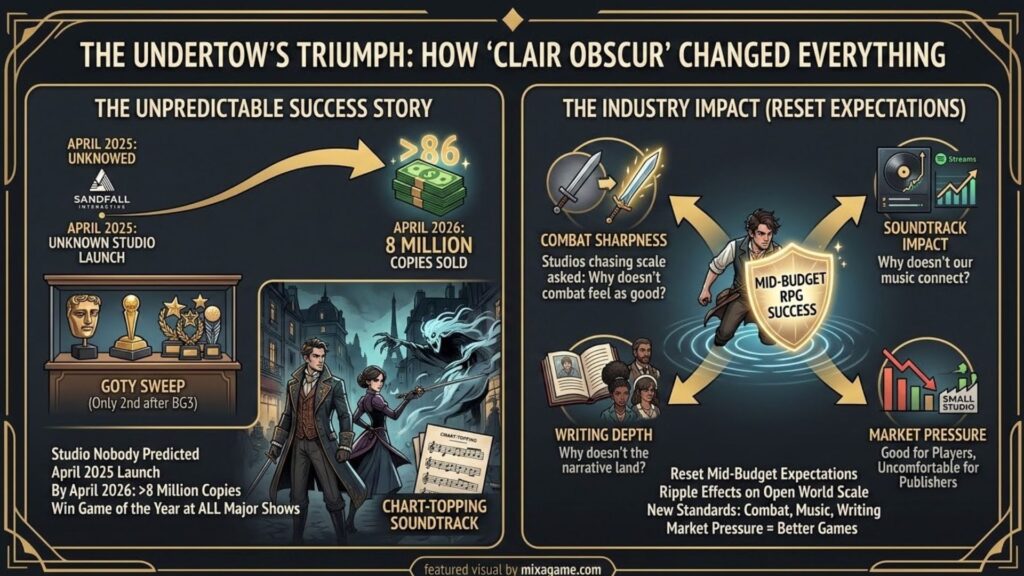
Start with the story nobody in the industry predicted. Clair Obscur: Expedition 33 launched in April 2025 from Sandfall Interactive. Nobody had heard of the studio a year earlier. Yet by its first anniversary in April 2026, it had sold over eight million copies. Along the way, it became only the second game after Baldur’s Gate 3 to win Game of the Year at every major awards show. That run included the BAFTAs, the Game Awards, and a string of ceremonies most single player RPGs never reach. And it did all of this as a turn based, JRPG inspired game with a French Belle Époque setting. On paper, that hook should have been a hard sell.
The reason this matters for a 2026 ranking is not nostalgia. Rather, Clair Obscur reset expectations for what a mid budget RPG can do. As a result, the ripple effects show up everywhere else on this list. Studios that chased open world scale for five years now face hard questions. Why does their combat not feel as sharp? Why does their soundtrack not chart? Why does their writing not land? That pressure is good for players, even when it stings for publishers.
How we are ranking these RPGs
Every game here earns its place on PC first. After all, that is where mouse precision, mod support, and hardware flexibility change how an RPG plays. Three criteria then carry the most weight.
First, depth measures how much a game rewards sustained play rather than spectacle. A title that dazzles in a trailer but gives you nothing to chew on ranks below a smaller game with real systems. Second, replayability covers New Game Plus, build variety, and whether a second run feels different. Finally, value weighs base price, expansion cost, and hours of content against what you paid. So free to play titles with real depth get full credit here, rather than a penalty for costing nothing upfront.
| Game | Subgenre | 2026 status | What it does best |
|---|---|---|---|
| Baldur’s Gate 3 | CRPG | Fully released, ongoing patches | Reactive storytelling at scale |
| Elden Ring (Shadow of the Erdtree) | Action RPG / open world | Fully released | Discovery and mechanical mastery |
| Clair Obscur: Expedition 33 | JRPG inspired | Fully released, 8M+ sold | Turn based combat with real time tension |
| Path of Exile 2 | Action RPG | Early access, 1.0 targeted late 2026 | Build complexity, free to play |
| Diablo IV: Lord of Hatred | Action RPG | Released April 28, 2026 | Endgame structure and class variety |
| Nioh 3 | Soulslike | Fully released | Dual stance combat precision |
| Kingdom Come: Deliverance 2 | Open world RPG | Fully released | Historical simulation depth |
| Hades II | Roguelike action RPG | Fully released, all platforms | Run based replayability |
The picks that actually matter
Elden Ring, with Shadow of the Erdtree, still sets the bar for what an open world can hide. The base campaign runs eighty to a hundred and twenty hours for a thorough first pass. On top of that, the Erdtree expansion adds thirty to fifty hours dense enough to rival the base game. What keeps it near the top three years on is build variety. Faith, arcane bleed, pure strength, sorcery, and every hybrid feel like distinct games on the same map. Meanwhile, the modding scene keeps raising that ceiling. And on PC, the game now runs comfortably at 1440p on mid range hardware after years of patches.
Baldur’s Gate 3 remains the most complete RPG of the past decade. In fact, nothing since has matched the density of its reactivity. Every class, origin, and companion gets a fully voiced arc across all three acts. Better still, Larian’s ongoing support means the 2026 version holds more content than the 2023 launch. And the four player co op is still the best in the genre. It lets a full party make consequential choices together, rather than just split loot.
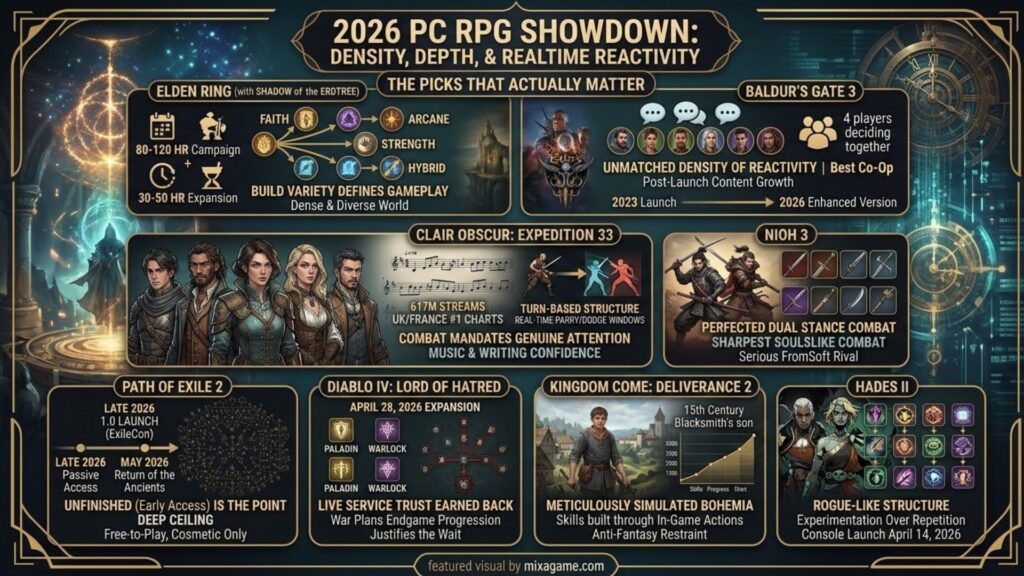
Clair Obscur: Expedition 33 earns its own paragraph beyond the underdog story, because the game is simply that good. Its combat layers real time parry and dodge windows onto a turn based structure. That sounds like a gimmick. In practice, though, it forces real attention during what other turn based RPGs treat as downtime. The soundtrack, composed largely by Lorien Testard, has passed 617 million streams. It also hit number one on album charts in the UK and France. In short, a game’s identity travels far when the writing and the music are this confident.
Path of Exile 2 is still technically unfinished, and that is almost the point. Grinding Gear Games has been open about a 1.0 launch in late 2026, likely tied to ExileCon in November. Before that, the May 2026 Return of the Ancients update arrived as the last major early access patch. Even now, the passive skill tree runs into thousands of nodes. And the game stays entirely free to play, with cosmetic only monetization. So for players who want a depth ceiling with no time limit and no entry cost, nothing else on PC comes close.
Diablo IV: Lord of Hatred is the clearest case of a live service game earning back trust the hard way. The expansion launched April 28, 2026. It brought the Paladin and Warlock classes, a full skill tree overhaul, and a new endgame built around War Plans. In practice, War Plans let players sequence their own progression rather than bounce between disconnected activities. It will not convert someone who quit Diablo IV back in 2023. But for anyone who watched the game improve patch by patch, this is the version that finally justifies the wait.
Nioh 3 answers a question that has circled PC action RPGs for years. Namely, what happens when Team Ninja stops chasing Elden Ring and perfects its own dual stance combat? The result is widely seen as the sharpest soulslike combat available right now. In fact, outlets have started calling it a serious rival to FromSoftware, rather than an imitation.
Kingdom Come: Deliverance 2 is the anti fantasy pick, and it earns its spot through restraint. There is no magic here, and no chosen one narrative. Instead, you get a meticulously simulated fifteenth century Bohemia. There, your influence comes entirely from skills you build through in game actions, not predetermined heroism.
Hades II finally reached players beyond its early access base in 2026. It launched on PlayStation 5 and Xbox Series X/S on April 14, after debuting elsewhere the previous September. Because the structure is roguelike, every run feels different. And the boon system rewards experimentation across dozens of hours, without the repetition that trips up most action RPGs.
Honorable mentions worth your attention
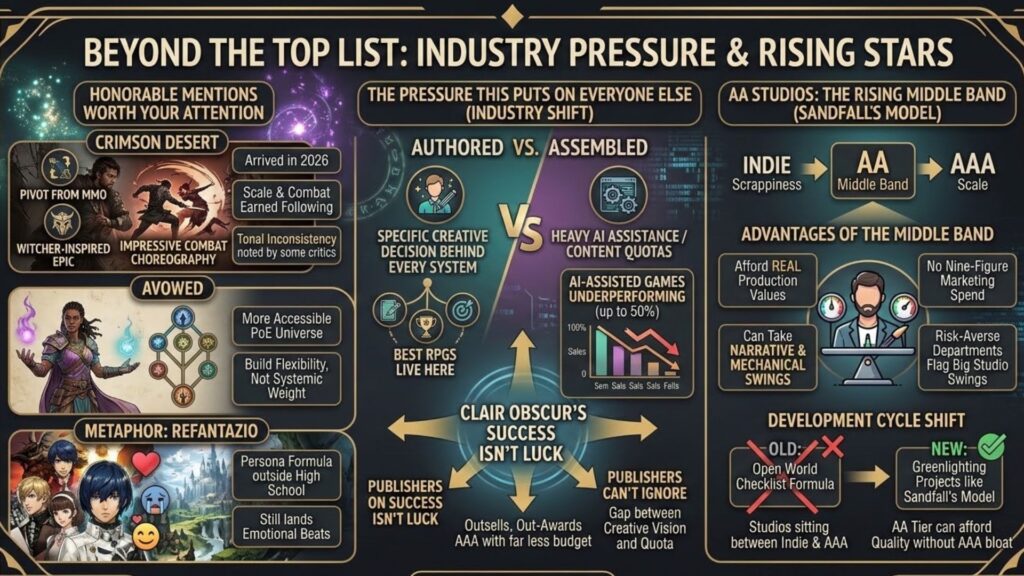
Crimson Desert arrived in 2026 as Pearl Abyss’s pivot from a planned MMO into a single player, Witcher inspired epic. Some critics flagged tonal inconsistency. Even so, the scale and combat choreography earned it a real following. Avowed, meanwhile, is the more accessible way into the Pillars of Eternity universe. It offers build flexibility without the systemic weight of a full CRPG. And Metaphor: ReFantazio keeps proving a simple point. Atlus can take the Persona formula out of high school and still land the emotional beats that made the series a phenomenon.
The pressure this puts on everyone else
It is worth sitting with what Clair Obscur’s success does to the rest of the industry. After all, the effect is not confined to one studio’s next project. When a modest budget game outsells and out awards titles backed by ten times the spend, publishers cannot write it off as luck. And 2026 sales data reinforced the pattern in less flattering ways too. For example, reports tracking games built with heavy generative AI assistance showed sales down by as much as fifty percent against comparable titles.
That suggests players are getting sharper. In short, they can tell a game with genuine creative vision from one assembled to hit a content quota. That gap between authored and assembled is where most of this year’s best RPGs live. And it is no accident that the titles topping this list feel like the product of specific creative decisions, system by system.
This also explains why 2026 was such a strong year for AA budgeted projects. That tier sits between indie scrappiness and AAA scale. Studios there can afford real production values without justifying a nine figure marketing spend. As a result, they can take a narrative or mechanical swing that a bigger studio’s finance department would kill. So expect more of this next cycle, not less. Publishers are already greenlighting projects that look like Sandfall’s model, and less like the open world checklist that ruled the previous decade.
The soulslike arms race has a new contender
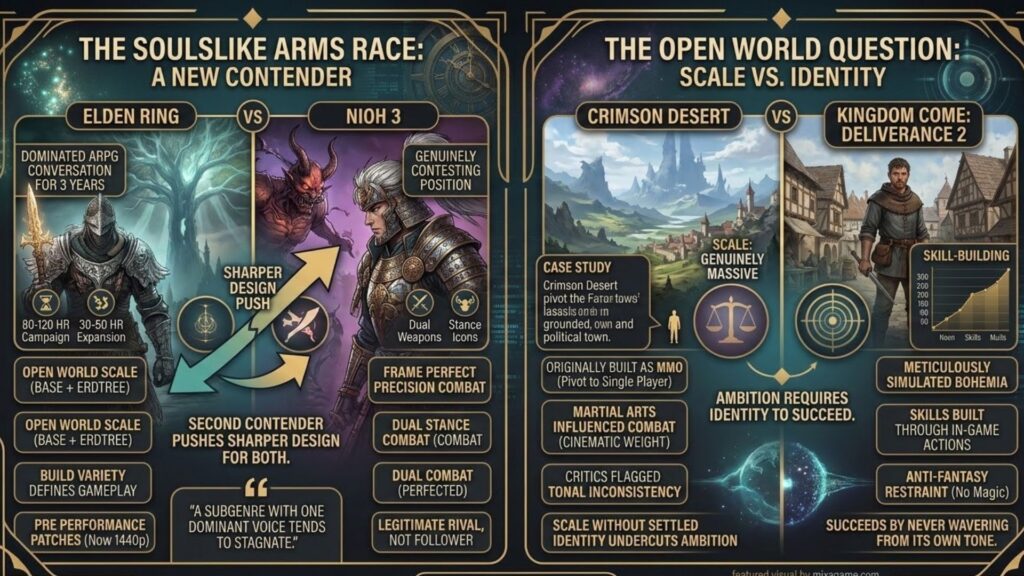
Elden Ring has dominated the action RPG conversation for three years. In 2026, though, the first real challenger arrived. It chose to contest that spot rather than imitate it. Team Ninja’s Nioh 3 leaned into its own strengths, dual stance combat and frame perfect precision, instead of chasing FromSoftware’s open world scale. As a result, the comparisons treat it as a legitimate rival, not a follower. That distinction matters for where the genre goes next. A subgenre with one dominant voice tends to stagnate. With a second serious contender, though, both studios get pushed toward sharper design.
The open world question nobody has fully answered yet
Crimson Desert’s 2026 launch shows how far ambition alone can carry a game. Pearl Abyss first built the project as an MMO. Then it pivoted to a single player, Witcher inspired structure. That pivot shows in both directions. The scale is genuinely massive, and the martial arts combat has real cinematic weight. Still, several critics flagged a clash between its grounded political story and its bursts of pure fantasy spectacle. So it is a reminder that scale without a settled identity can undercut an ambitious project. By contrast, Kingdom Come: Deliverance 2 succeeds precisely because it never wavers from its tone.
Choosing the right RPG for how you actually play
Do you want an RPG with no ceiling and no entry cost? Then Path of Exile 2 and Elden Ring are the answers. One is free and endlessly build driven. The other is a one time purchase that keeps paying off. Do you want a story that reacts to every choice? Baldur’s Gate 3 and Clair Obscur: Expedition 33 are still unmatched. Each proves, in very different ways, that writing quality moves units as reliably as marketing does. And if you want genuine depth on a smaller time budget, Hades II and Nioh 3 both reward mastery, without demanding hundreds of hours.
For a closer look at where each subgenre stands right now, the satellite guides in this series break down the best action RPGs, JRPGs, open world RPGs, and the AA and indie titles quietly outperforming games ten times their budget.
So which of these earns a spot on your hard drive first? And which one do you think is still underrated heading into the back half of 2026?