![[decorative]](https://mixagame.com/wp-content/uploads/2025/10/cropped-mixagame-redwhite-logo-1024x256-1.png)
Nobody agrees on what makes an action RPG feel good. And that disagreement is exactly why the genre keeps getting better.
Ask a Path of Exile veteran, and they will talk about passive tree density and gem synergies until you regret asking. Ask a Nioh player, and it is all stance transitions and frame data. Ask someone who just wants to lose a Saturday to Diablo, and they will describe the sound a legendary drop makes. All three are describing action RPGs. And in 2026, all three are eating better than they have in years.
PC changes the calculus here in ways that go beyond bragging rights. For certain build archetypes, mouse precision affects targeting and ability activation in ways a controller simply cannot. Meanwhile, high refresh rate monitors make fast combat read as genuinely responsive, not just fast. And the modding scene around the biggest titles extends their lifespan well past the original roadmap. So every game below was judged on PC specifically, not on a console port with a mouse plugged in as an afterthought.
What actually separates a great action RPG from a good one
The trap with this subgenre is conflating spectacle with depth. A boss fight covered in particle effects is not automatically a good boss fight. The action RPGs that hold up over dozens of hours share one quality. Their systems keep revealing new layers well after the tutorial ends. Better still, the skill ceiling stays high. As a result, a player at hour ten and a player at hour two hundred have genuinely different experiences with the same toolkit.
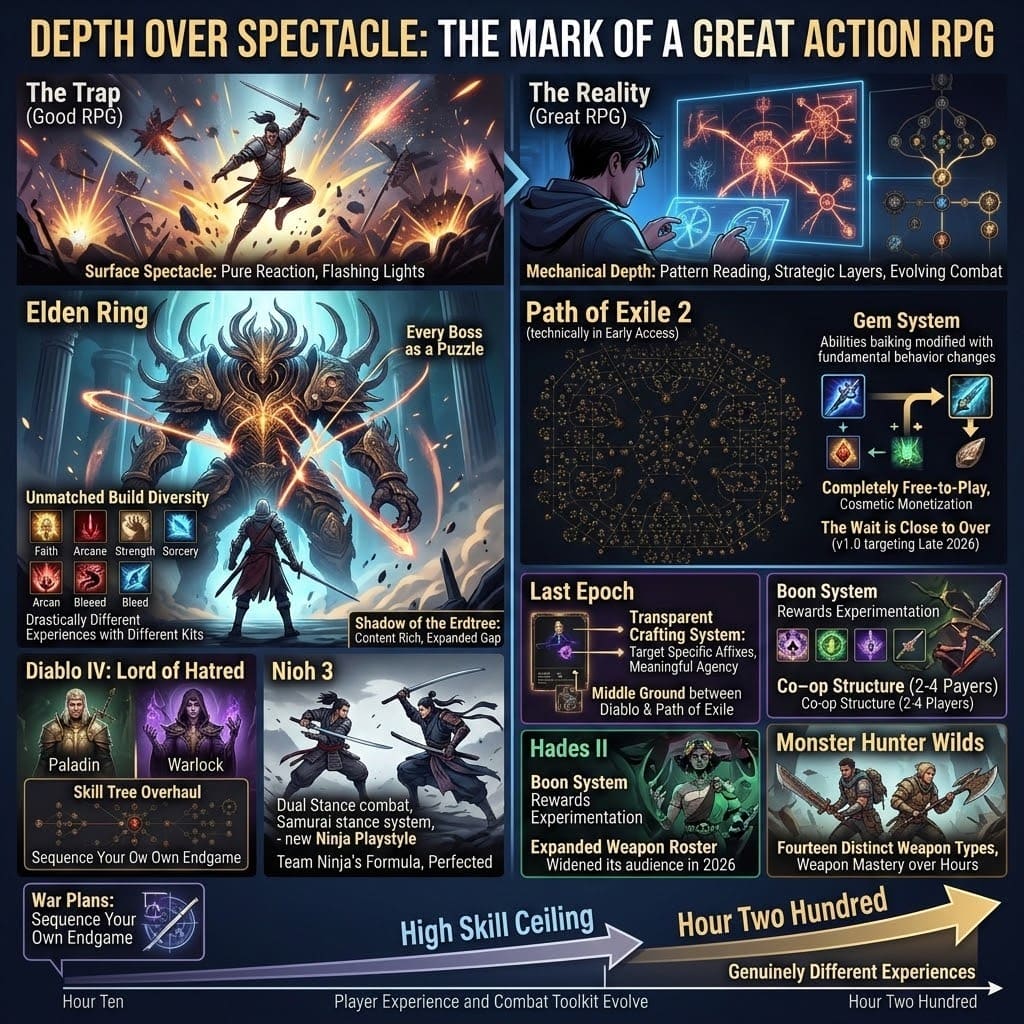
Elden Ring is still the reference point, and three years on that has not changed. What keeps it there is not nostalgia. Every boss encounter works like a puzzle that punishes pure reaction and rewards pattern reading. Meanwhile, build diversity does the rest. Faith, arcane bleed, pure strength, and sorcery all play so differently that a second run barely resembles the first. Shadow of the Erdtree only widened that gap. It adds thirty to fifty hours dense enough to rival the base campaign. And after steady performance patches, a mid range GPU now handles 1440p comfortably.
Path of Exile 2 sits in a strange, enviable spot for an unfinished game. It is already one of the deepest action RPGs around, yet still technically in early access. Grinding Gear Games shipped the Return of the Ancients update at the end of May 2026. The studio framed it as its largest update, and as the final major patch before the full 1.0 release. That launch is targeted for late 2026, around ExileCon in November. Even now, the passive skill tree runs into thousands of nodes. And the gem system changes how abilities behave, not just their numbers. Best of all, it stays free to play with cosmetic only monetization. So if you have been waiting for a finished product, the wait is nearly over.
Diablo IV: Lord of Hatred is the expansion that finally makes the long term case for this game. Released April 28, 2026, it added the Paladin and Warlock classes and a full skill tree overhaul. It also introduced a new endgame framework called War Plans. In practice, War Plans let you sequence five endgame activities in any order, rather than bounce randomly between disconnected content. On top of that, the level cap rose to 70, a proper loot filter arrived, and a rare event called Echoing Hatred rounds things out. Critics have called it the moment the franchise’s third act finally clicks. It will not win back everyone who bounced off the 2023 launch. But for players who watched the cadence improve, this is the version worth returning for.
Nioh 3 answers what happens when a studio stops chasing another developer’s formula and perfects its own. Team Ninja’s dual stance combat now adds a new Ninja playstyle on top of the existing Samurai stances. As a result, many call it some of the sharpest action combat shipping on any platform. In fact, it is precise enough that comparisons to Elden Ring read less like flattery and more like a genuine rivalry.
Last Epoch sits between Diablo’s accessibility and Path of Exile’s spreadsheet complexity. And that middle ground is exactly why it has built such a loyal following. Its crafting system remains the most transparent in the genre. Instead of gambling on random drops, you can target specific affixes. So it is the strongest PC pick for anyone who wants real crafting agency without a wiki open on a second monitor.
Hades II widened its audience significantly in 2026. It launched on PlayStation 5 and Xbox Series X/S on April 14, after its September 2025 debut on PC and Switch. Supergiant’s boon system rewards experimentation run after run. And the expanded weapon roster keeps build variety fresh far longer than most roguelikes manage.
Monster Hunter Wilds remains one of the most accessible entries in its franchise. Even so, it keeps the weapon mastery systems longtime fans expect. Fourteen distinct weapon types each carry a moveset that takes real hours to learn. And the co op structure for two to four players makes it one of the strongest cooperative action RPGs on PC.
Building a setup that actually matches these games
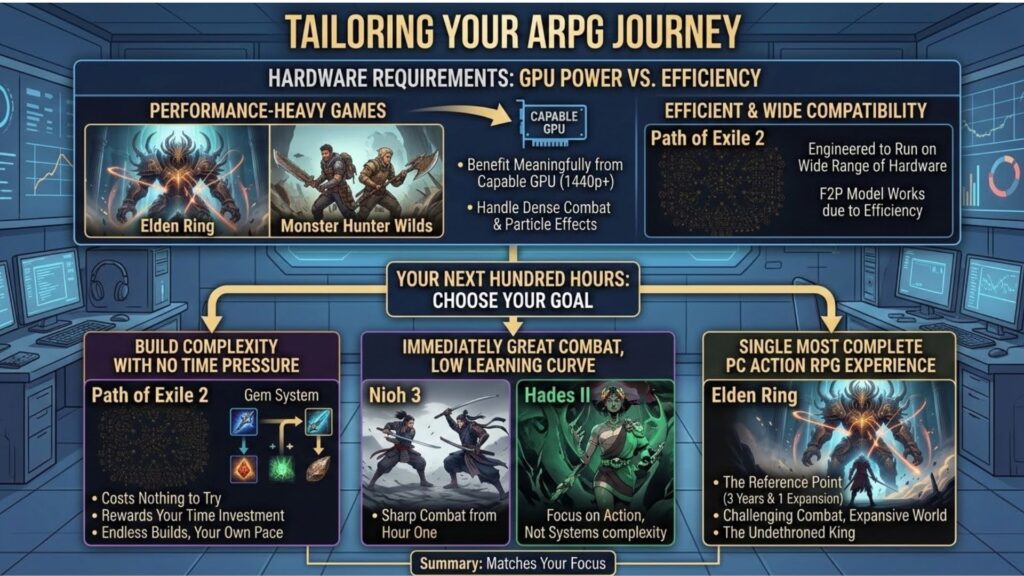
Most titles here are not particularly demanding, with two clear exceptions. Elden Ring and Monster Hunter Wilds both benefit from a capable GPU at 1440p or higher. That is especially true in dense combat, with many enemies and particle effects on screen. Path of Exile 2, by contrast, is engineered to run on a wide range of hardware. And that is part of why its free to play model works so well.
Which one should actually get your next hundred hours
Do you want build complexity with no time pressure? Then Path of Exile 2 costs nothing to try and rewards whatever time you give it. Do you want combat that feels great right away, without a steep learning curve? Nioh 3 and Hades II both deliver within their first few hours. And if you want the single most complete action RPG on PC, Elden Ring still has not been dethroned, three years and one expansion later.
So which combat system has kept you playing the longest? The methodical precision of a soulslike, or the chaotic momentum of a loot driven ARPG?