![[decorative]](https://mixagame.com/wp-content/uploads/2025/10/cropped-mixagame-redwhite-logo-1024x256-1.png)
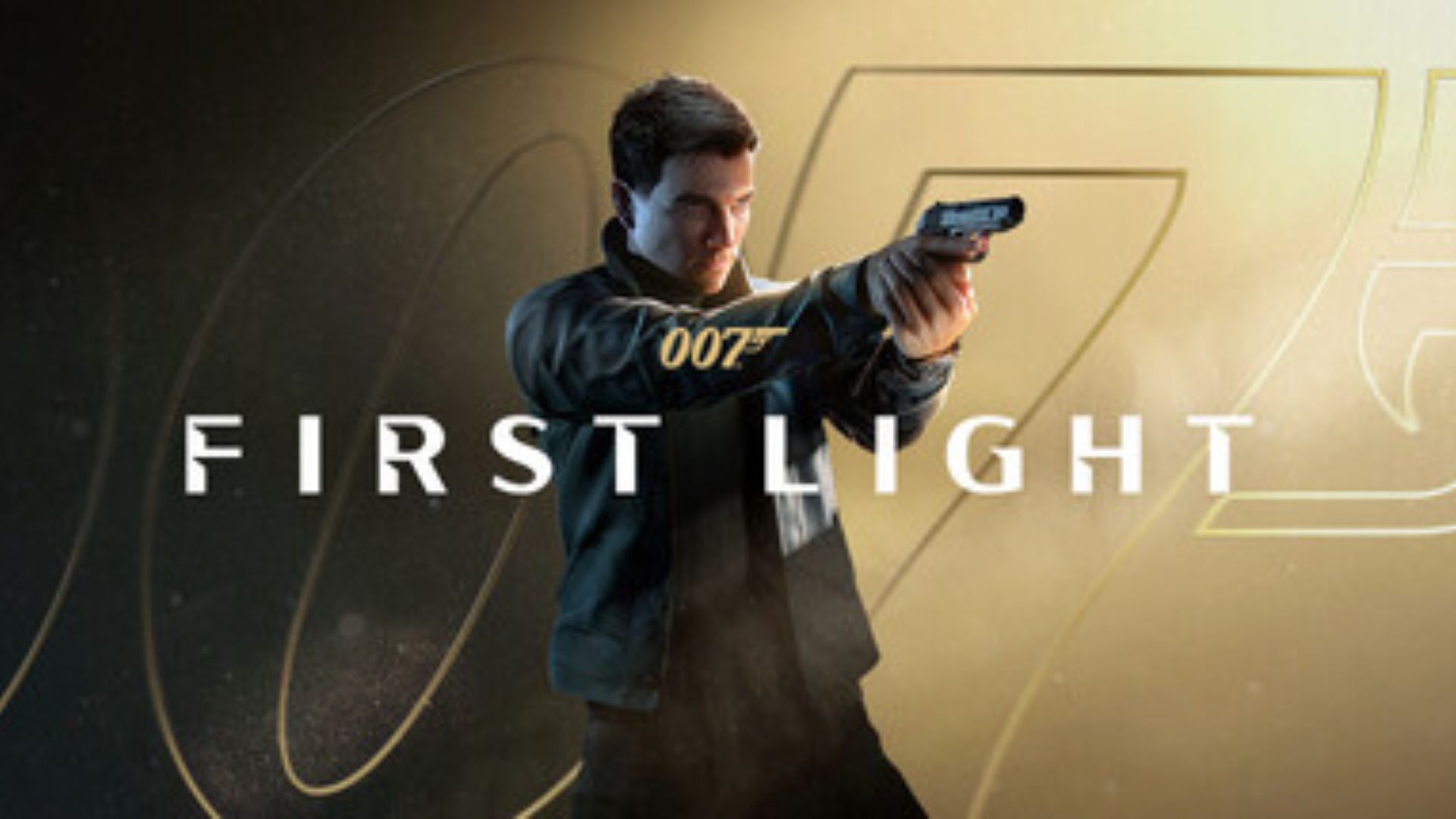
For nearly fourteen years, James Bond sat in gaming’s lost property office. Since 007 Legends stumbled out the door in 2012 and Activision quietly handed back the license, the world’s most bankable secret agent had no home on our screens. A generation of players grew up, bought three console cycles, and never once got to press a trigger as 007. So when IO Interactive, the Danish studio that turned bald assassin Agent 47 into a cult icon, finally shipped 007 First Light on May 27, 2026, it wasn’t just launching a game. It was closing a wound that had been open since the Obama administration.
And it landed. An 88 on Metacritic across PS5 and Xbox, 1.5 million copies gone in the first 24 hours, IO Interactive’s fastest-selling title ever. On paper, that’s a clean win. But the story worth telling here isn’t the score. It’s what this game reveals about where blockbuster PC gaming actually sits in 2026, and about the quiet gamble IO took by making Bond young, clumsy, and human again.
A younger Bond, and why that choice does the heavy lifting
Most origin stories fail because they explain things nobody asked about. We didn’t need to know how Bond learned to order a martini. What First Light understands, and this is the smart part, is that an origin is only interesting if the hero is allowed to be bad at the job first.
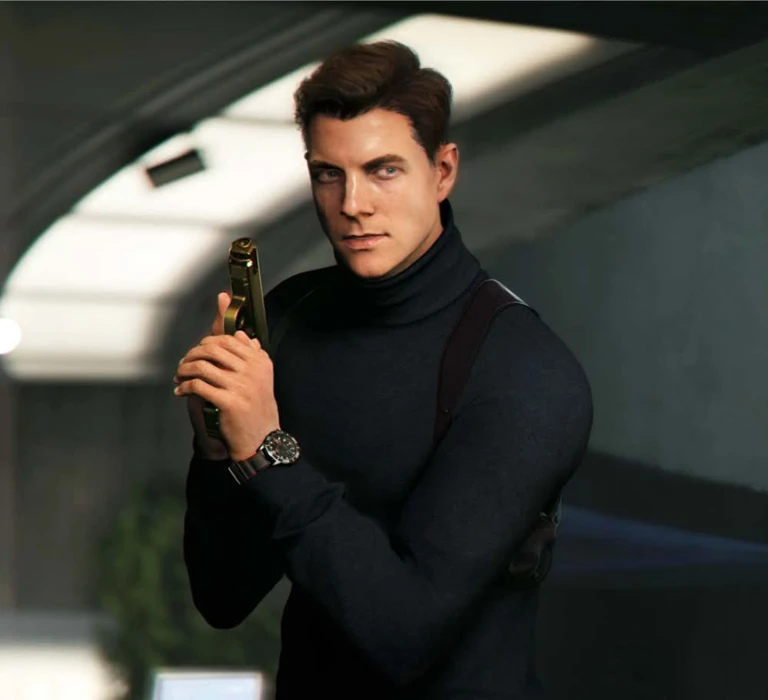
The Bond you meet here is 26, a Royal Navy air crewman yanked into MI6’s freshly revived 00-Programme. Patrick Gibson, whom PC and console players might recognize from Dexter: Original Sin, plays him as stubborn, mistake-prone, and quick to make enemies of the people he needs. GameSpot’s review nailed the appeal in a single line, calling the game “Youth in Revolt,” and that framing sticks because the friction is the point. This Bond gets under the skin of his irritable handler, John Greenway, played with real weight by Lennie James of The Walking Dead. He fumbles. He improvises. And he hasn’t earned the swagger yet, so watching him grope toward it carries an emotional charge that a fully-formed superspy never could.
Eurogamer’s Rick Lane, no easy grader, went so far as to call it perhaps the most empathetic Bond ever written, and praised the script as the sharpest AAA writing since Marvel’s Guardians of the Galaxy. That’s a serious claim for a genre that usually treats dialogue as connective tissue between explosions. When a studio spends over $100 million and still remembers that character comes first, you notice.
The Hitman DNA, and the discipline to hide it
Here’s the trap IO had to avoid. James Bond literally inspired Hitman back in 2000. So the obvious fear was that First Light would just be Hitman wearing a tuxedo and a wig. A reskin. Same sandbox, same disguises, different hair.
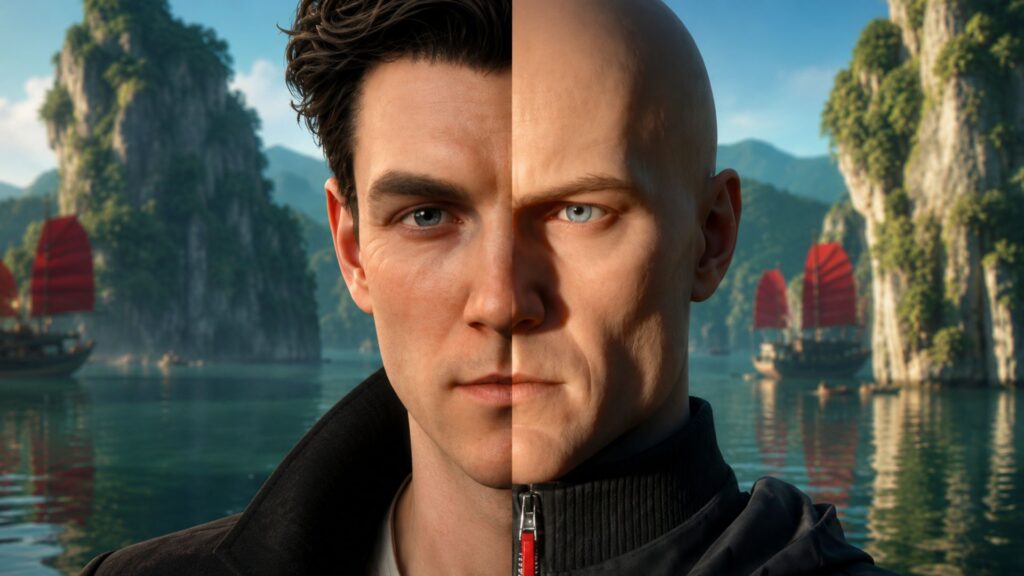
The team clearly knew this, because they lean into the shared blood exactly where it helps and cut it loose everywhere else. Bond can talk his way past guards because he’s a charming young man good at pretending he belongs. He occasionally slips into a disguise. Several missions would feel right at home in the World of Assassination trilogy, all social engineering and multiple routes from point A to point B. The Q-Watch even resurrects the “detective vision” trick that Batman: Arkham Asylum popularized back in 2009, letting Bond scan enemies through walls and tag interaction points.
But when the cover blows, the game becomes something Hitman never was. Melee combat is the standout, and it’s genuinely inventive. You can slide across a surface to stagger a guard, kick the gun from his hands, catch it midair, and put a round in his leg to drop him for a finisher. Guns run dry fast on purpose, so you’re constantly scavenging weapons off the dead and, when a magazine empties, hurling the pistol itself at someone’s face. Combine that with slow-motion focus aiming, enemies who actually flank you, and generous destructibility, and firefights turn frenetic in the best way. Those iconic Bond set pieces that once starred Connery, Brosnan, and Craig are all here, except the best ones aren’t scripted. They emerge from your own panicked creativity, which is a far harder thing to design and a far better thing to play.
Not everything survives the transition. The driving sections are the weak link, rigid and straight-line despite the variety of vehicles, and it’s telling that the one place First Light stumbles is a genre staple rather than an IO specialty. A Bond game without car chases is unthinkable, yet these are the moments where you feel the seams.
The PC story nobody at the launch party wanted to discuss
This is where a PC-focused lens changes the picture, because First Light is two very different games depending on the logo on your graphics card.
IO Interactive supercharged its proprietary Glacier engine in partnership with Nvidia, and the collaboration runs deep. This is the first game to ship with native support for up to 6x frame generation via DLSS 4.5, complete with Dynamic Multi Frame Generation that only kicks in when needed. On an RTX 50-series card, it’s a showcase. Frame generation implementation this clean is rare, and character rendering, skin shading, and cinematic lighting genuinely dazzle.
Then there’s everyone else. AMD owners get FSR 3.1.5, an outdated upscaler baked directly into the executable so it can’t be swapped out, with no frame generation despite the tech supporting it. Intel’s XeSS is shut out entirely. The reaction on forums like ResetEra was immediate and sharp, with multiple players refunding on the spot rather than accept second-class treatment. One user’s line captured the mood exactly, calling it disrespectful to the consumer. When a game this polished ships with vendor treatment this lopsided, it stops being a technical footnote and becomes a statement about who these Nvidia-sponsored blockbusters are really built for.
The optimization quirks pile on top. There are no graphics presets at all, just a wall of individual sliders, and the “set to default” button pushes everything to minimum rather than a sensible baseline. Worse, the settings barely scale. TechPowerUp found that dropping from Ultra all the way to Low only claws back 28 percent of your frame rate, which defeats the entire purpose of letting weaker hardware breathe. HDR switches itself off on every restart. Ray tracing is software-based only for now, with proper path tracing and DLSS Ray Reconstruction promised in a summer 2026 update.
| Platform / GPU tier | Realistic experience at launch |
| RTX 50-series | Showcase: DLSS 4.5, up to 6x frame gen, clean image |
| RTX 40-series | Strong: RTX 4070 holds 85 to 95 FPS at 1440p High, RT off |
| RTX 30-series | Workable: RTX 3060 needs 1080p and tuned settings for 60 FPS |
| AMD Radeon | Compromised: FSR 3.1.5 only, no frame gen, no override |
| Intel Arc | No XeSS support at all |
So the honest PC verdict is split. If you own current-gen Nvidia hardware, this is one of the best-looking rasterized games on the platform. If you don’t, you’re paying full price to be treated like an afterthought, and that tension is going to define how the PC community remembers this launch long after the review scores fade.
What it means for the ecosystem
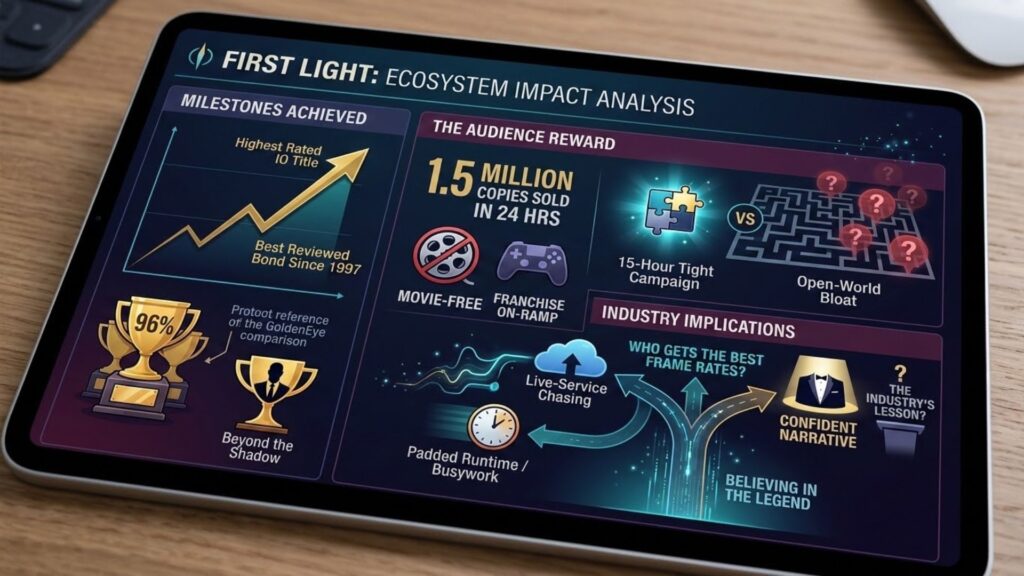
Zoom out and First Light looks like three things happening at once. It’s the best-reviewed Bond game since GoldenEye 007 hit 96 back in 1997, which is a milestone no reasonable person predicted a year ago. It’s IO Interactive’s highest-rated title ever, finally pulling the studio out of Agent 47’s shadow and proving it can carry a narrative-driven action game, not just a stealth sandbox. And it’s a fresh, movie-free on-ramp for a franchise that had gone dark on screens since No Time to Die in 2021, with Amazon MGM now steering the ship.
There’s a lesson buried in the sales numbers too. In an era where publishers keep chasing live-service revenue and open-world bloat, a roughly 15-hour, tightly authored single-player campaign moved a million and a half copies in a day. Audiences didn’t punish IO for making something finite and confident. They rewarded it. That should give every studio currently padding runtime with busywork something to think about.
The game isn’t flawless. The antagonists underwhelm some critics, the pacing crawls in the opening hours, and the PC platform politics leave a genuinely sour aftertaste. But First Light does the one thing an origin story absolutely has to do. It makes you believe in the person before the legend. By the credits, Gibson isn’t the guy from Dexter anymore. He’s Bond, and it’s hard to picture anyone else in the tuxedo.
Fourteen years is a long time to keep a spy in the cold. The bigger question now isn’t whether IO earned the number, because it clearly did. It’s whether the industry learned the right lesson from how they did it, or just the convenient one about who gets the best frame rates. Which version of that story do you think the next big blockbuster will tell?