![[decorative]](https://mixagame.com/wp-content/uploads/2025/10/cropped-mixagame-redwhite-logo-1024x256-1.png)
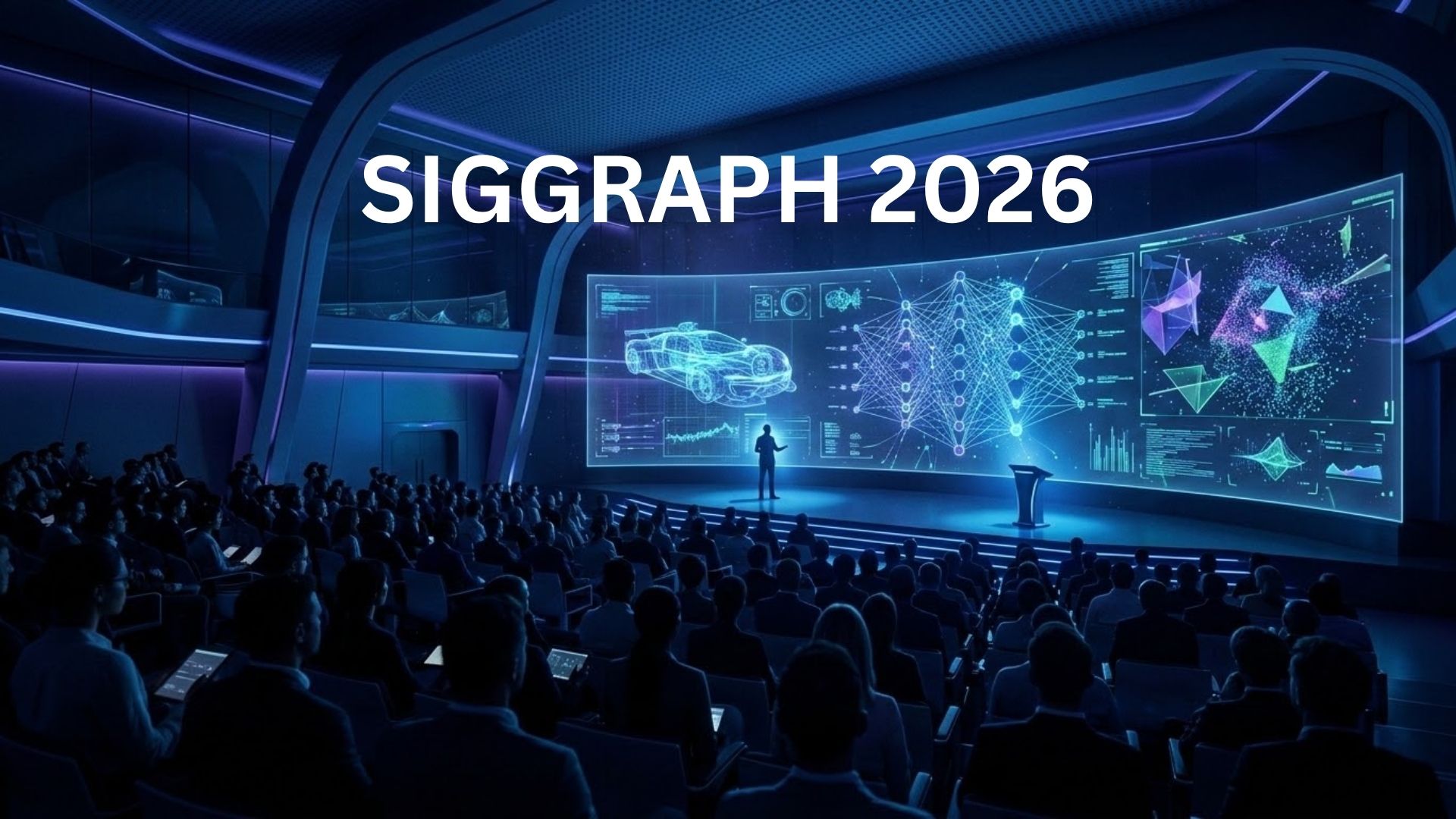
What SIGGRAPH actually is, and why gamers should care
Most players have never heard of ACM SIGGRAPH. But they have absolutely seen its output. Real-time ray tracing, the rendering techniques behind modern open-world lighting, the physics simulations that make cloth and hair behave convincingly, the AI-driven animation systems now appearing in AAA titles: every one of these technologies passed through SIGGRAPH before it ever reached a consumer GPU.
Conference Chair Chris Redmann put it plainly in the official announcement: “We are seeing breakthroughs transform everything from robotics and astronomy to architecture, film, and gaming. The most significant progress often occurs when a solution in one discipline sparks a revolution in another.”
That cross-disciplinary contamination is exactly what makes SIGGRAPH relevant to gaming. A physics simulation technique developed for aerospace visualization becomes the foundation for better destructible environments. A machine learning method designed for medical imaging ends up powering AI-driven NPC behavior. This is how gaming graphics actually advance: not through in-house R&D alone, but through the steady absorption of research that originates elsewhere.
The 2026 program and what stands out
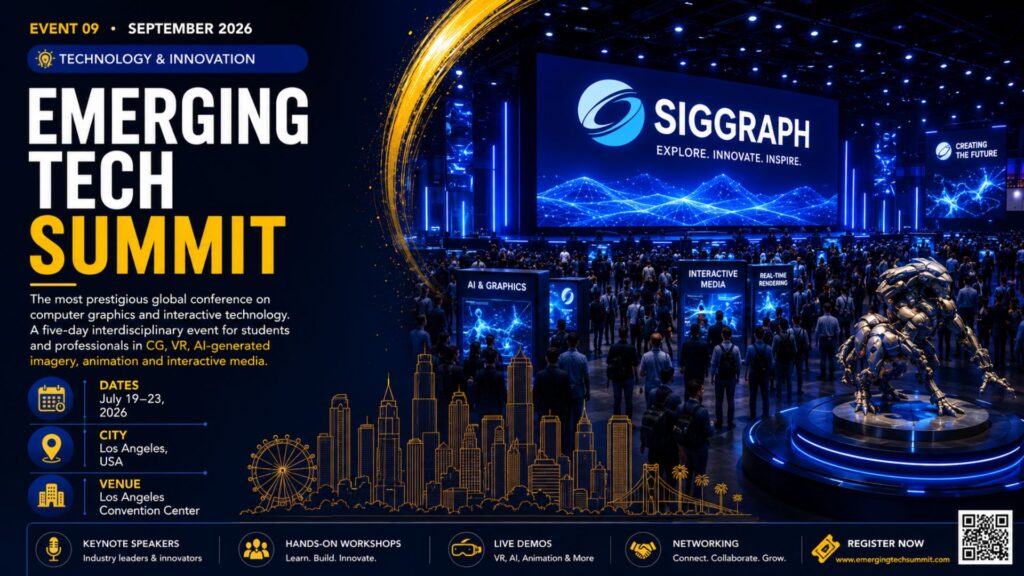
The 2026 conference program spans Real-Time Live!, the Computer Animation Festival, the Games Summit, the Immersive Pavilion, Spatial Storytelling, Emerging Technologies exhibits, and a full Technical Papers track covering peer-reviewed advances in rendering, simulation, and machine learning for graphics.
For PC gaming specifically, two sessions deserve attention. First, Natalya Tatarchuk’s presentation in “Advances in Real-Time Rendering in Games” (Parts 1 and 2) is among the most industry-relevant talks on the schedule. Tatarchuk is a graphics engineer whose work has directly influenced real-time rendering pipelines across multiple generations of hardware. When she speaks at SIGGRAPH, studios listen.
Second, the Khronos Group sessions covering Vulkan, Slang, OpenXR, and AI integration are worth tracking. Slang, the open-source shading language, is becoming an increasingly important tool in GPU-accelerated graphics development, and this year’s SIGGRAPH features a hands-on course teaching attendees to build and train MLPs directly in Slang shaders, leveraging GPU tensor cores for neural materials. In plainer terms: this is where developers learn to bake AI directly into the rendering layer. The games that feel visually different in 2028 will trace part of that difference back to sessions like this one.
A record year for technical research
SIGGRAPH 2026 Technical Papers received more than 1,120 submissions, a milestone number across the conference’s 53-year history. The themes emerging from the accepted papers include generative image modeling, Monte Carlo solvers, and 3D vectorization. These are not abstract academic concerns. Generative image modeling is already appearing in texture generation tools used by indie studios. Monte Carlo methods drive global illumination in path tracers. 3D vectorization matters for procedural environment generation.
The pipeline from SIGGRAPH paper to shipping game feature typically runs two to five years. That means the research debuting this July in Los Angeles is a reasonable preview of what PC gaming rendering will look like around 2028 to 2030.
Los Angeles as context
SIGGRAPH returns to Los Angeles for the first time since 2023, and the choice of city is not incidental. Southern California is one of the densest concentrations of game studios, VFX houses, and graphics research institutions in the world. USC and UCLA both run active computer graphics programs. Major studios, including many whose work runs on the same engines and rendering pipelines discussed at SIGGRAPH, are within driving distance of the convention center.
That proximity encourages informal conversations that do not make it onto the official schedule. The hallway exchanges between a researcher presenting a new denoising algorithm and an engineer from a major game studio are often where the real technology transfer begins.
| Program | Relevance to Gaming |
|---|---|
| Real-Time Live! | Live demos of cutting-edge real-time graphics tech |
| Games Summit | Production and research sessions for game developers |
| Technical Papers | Peer-reviewed rendering and AI research |
| Emerging Technologies | Interactive prototypes and new hardware |
| Immersive Pavilion | XR and spatial computing experiences |
| Computer Animation Festival | Game cinematics and real-time graphics showcases |
Why this year feels different
In past editions, the AI discussion at SIGGRAPH was largely theoretical: interesting papers, promising prototypes, questions about production readiness. In 2026, that conversation has shifted. The conference now frames itself explicitly around AI, robotics, immersive experiences, simulation, animation, and cutting-edge innovations in real time as its core program pillars.
The games industry arrived at a similar moment simultaneously. Neural upscaling became standard. AI-assisted animation tools are now shipping in commercial game engines. Generative audio and texture systems are appearing in indie workflows. SIGGRAPH 2026 is not ahead of the curve on any of this. It is the place where the curve gets measured, defined, and handed to the people who will push it further.
Registration is open at the official SIGGRAPH 2026 site, and the full schedule is live for anyone who wants to plan ahead.
The real question for the gaming community is not whether SIGGRAPH matters. It clearly does. The more interesting question is how much longer game developers can afford to treat it as a background event rather than a must-attend fixture on the annual calendar.