![[decorative]](https://mixagame.com/wp-content/uploads/2025/10/cropped-mixagame-redwhite-logo-1024x256-1.png)
Somebody at a major publisher is currently explaining to a nervous board why a thirty person studio just outsold their tentpole release. Honestly, they should get used to that conversation.
That is not hyperbole anymore. Clair Obscur: Expedition 33 crossed eight million copies sold within a year of launch, on a fraction of a typical AAA budget. And it did so while winning Game of the Year at every major awards show it was eligible for. That result has quietly become the industry’s favorite cautionary tale. In 2026, the pattern only got stronger. Free from console certification cycles and nine figure marketing spends, small and mid sized studios keep taking risks that big publishers will not greenlight. And this year, those risks paid off in ways the industry can no longer dismiss as a fluke.
Why smaller studios keep winning this argument
The AA and indie space has one structural advantage no marketing budget can replicate. Simply put, nothing has to get watered down for a mass market focus group. Disco Elysium could never have been pitched inside a AAA meeting. Yet it remains one of the most acclaimed RPGs ever made. That same freedom makes the games below worth your attention. Not because they are cheaper, but because they were allowed to be strange in ways that actually serve the story.
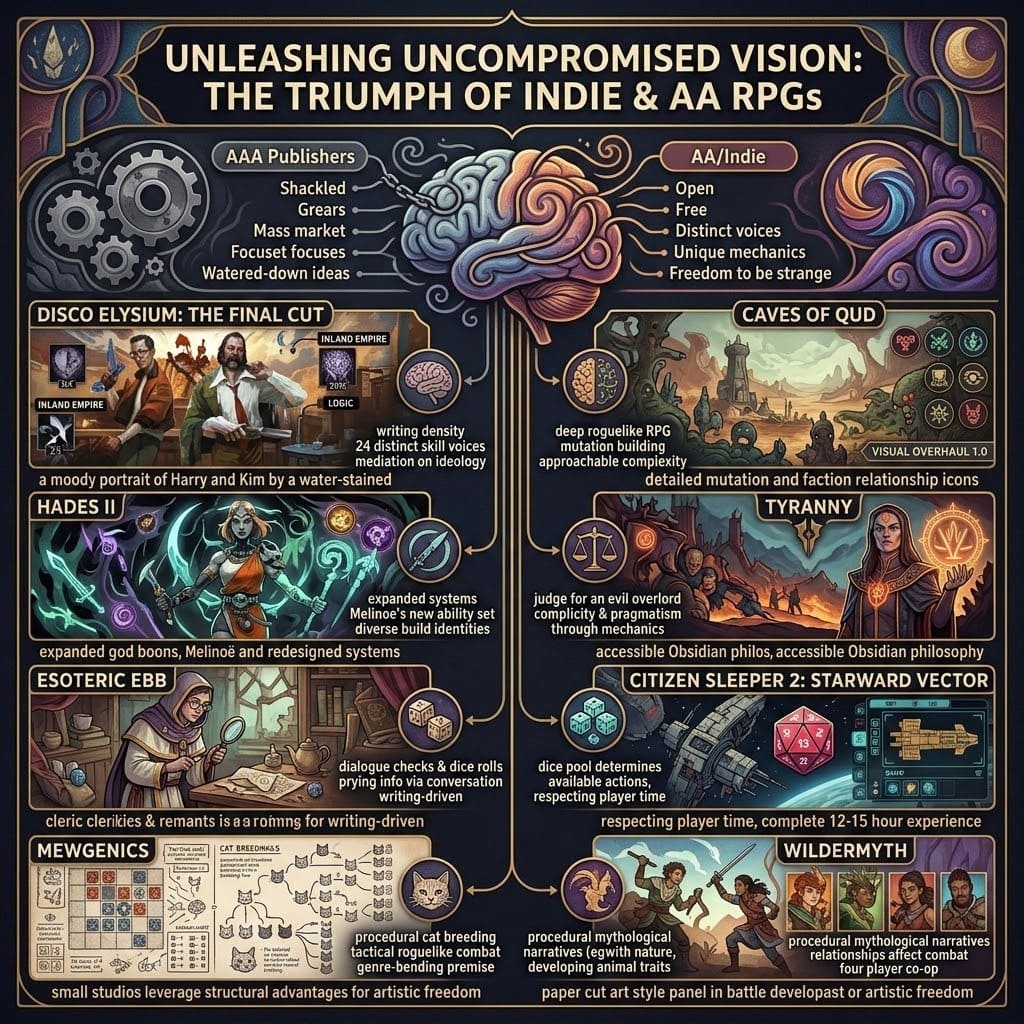
Disco Elysium: The Final Cut is still the high water mark for what writing alone can do in this genre. Every object, character, and detail carries a literary depth AAA studios rarely attempt. And your character is defined entirely by how you spread points across twenty four skills, each with its own internal voice. There is almost no traditional combat. Instead, a detective story gradually becomes a meditation on ideology, failure, and the specific kind of hope that survives both.
Hades II spent its early access period proving it was already better than most finished action RPGs. Then its full console launch in April 2026 widened that audience further. Supergiant expanded every system from the original. It also introduced Melinoë, a protagonist with an entirely new ability set. And the redesigned boon system creates more distinct build identities, run to run, than the first game ever managed.
Esoteric Ebb is the CRPG that finally scratched the itch Disco Elysium left behind. You play a cleric investigating a tea shop explosion, five days before a world’s first ever election. The whole game is built around prying information out of people, through dialogue choices and dice backed skill checks. Multiple 2026 rankings call it the standout CRPG of the year. Above all, that is because the writing is strong enough to carry a game with almost no combat.
Mewgenics is the strangest success story of the year, and arguably the most instructive. Thirteen years in development, it mixes procedural cat breeding with tactical roguelike combat. And it sold a million copies in its first week. That is not a niche curiosity result. Rather, it is a genre bending premise executed well enough to outsell games with conventional marketing. In short, it is exactly the kind of bet a risk averse publisher would have killed in a pitch meeting.
Caves of Qud remains the deepest roguelike RPG on PC, and one of the most unusual games in any genre. Its world is procedurally generated. Yet it sits on a foundation of detailed lore, faction relationships, and mutation based character building. Better still, its 1.0 release brought a visual and interface overhaul. As a result, a notoriously dense game became far more approachable, without sanding down what made it distinctive.
Tyranny stays criminally underrated years after release. You play a Fatebinder, a judge and enforcer for an already victorious evil overlord. Through mechanics rather than dialogue trees alone, the game asks real questions about complicity and pragmatism. And at twenty five to thirty five hours, it is a far easier entry into Obsidian’s design philosophy than most of the studio’s work.
Citizen Sleeper 2: Starward Vector builds its entire structure around a dice pool system. Crucially, your rolls determine which actions are available, not just whether an action succeeds. That subtle distinction changes how every decision feels. Set on a derelict space station, it also respects your time. As a result, it delivers a complete, exceptionally written experience in twelve to fifteen hours.
Wildermyth generates mythological narratives procedurally for your party. Characters can merge with nature, develop part animal traits, or form relationships that directly affect how they fight. Meanwhile, its distinctive paper cut art style makes it instantly recognizable. And four player co op extends its replayability well past a single campaign.
The pattern underneath all of it
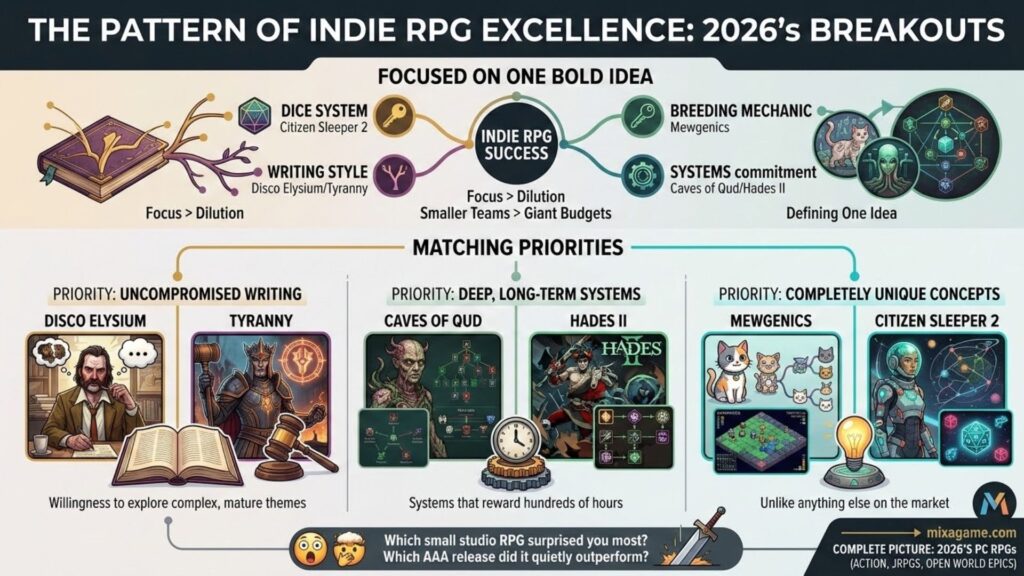
None of these games are competing with AAA budgets. And none of them need to. What they share is a willingness to let one idea define the whole experience. A writing style. A breeding mechanic. A dice system. Instead of diluting that idea across a dozen half finished systems, they commit to it. That focus is why smaller studios keep punching above their weight. And it is why 2026’s biggest RPG story belongs to a thirty person team, not a publisher with a nine figure budget.
Finding the right one for your priorities
Do you chase writing above everything else? Then Disco Elysium and Tyranny both deliver it without compromise. Do you want systems deep enough to lose a hundred hours in? Caves of Qud and Hades II both reward that commitment. And if you want something that resembles nothing else on the market, Mewgenics and Citizen Sleeper 2 both earn that on their own terms.
For the complete picture of where PC RPGs stand across every subgenre in 2026, the full ranking on mixagame.com covers the best action RPGs, JRPGs, and open world epics competing for the same hours these smaller titles are winning.
Which small studio RPG surprised you the most this year, and which AAA release do you think it quietly outperformed?