![[decorative]](https://mixagame.com/wp-content/uploads/2025/10/cropped-mixagame-redwhite-logo-1024x256-1.png)
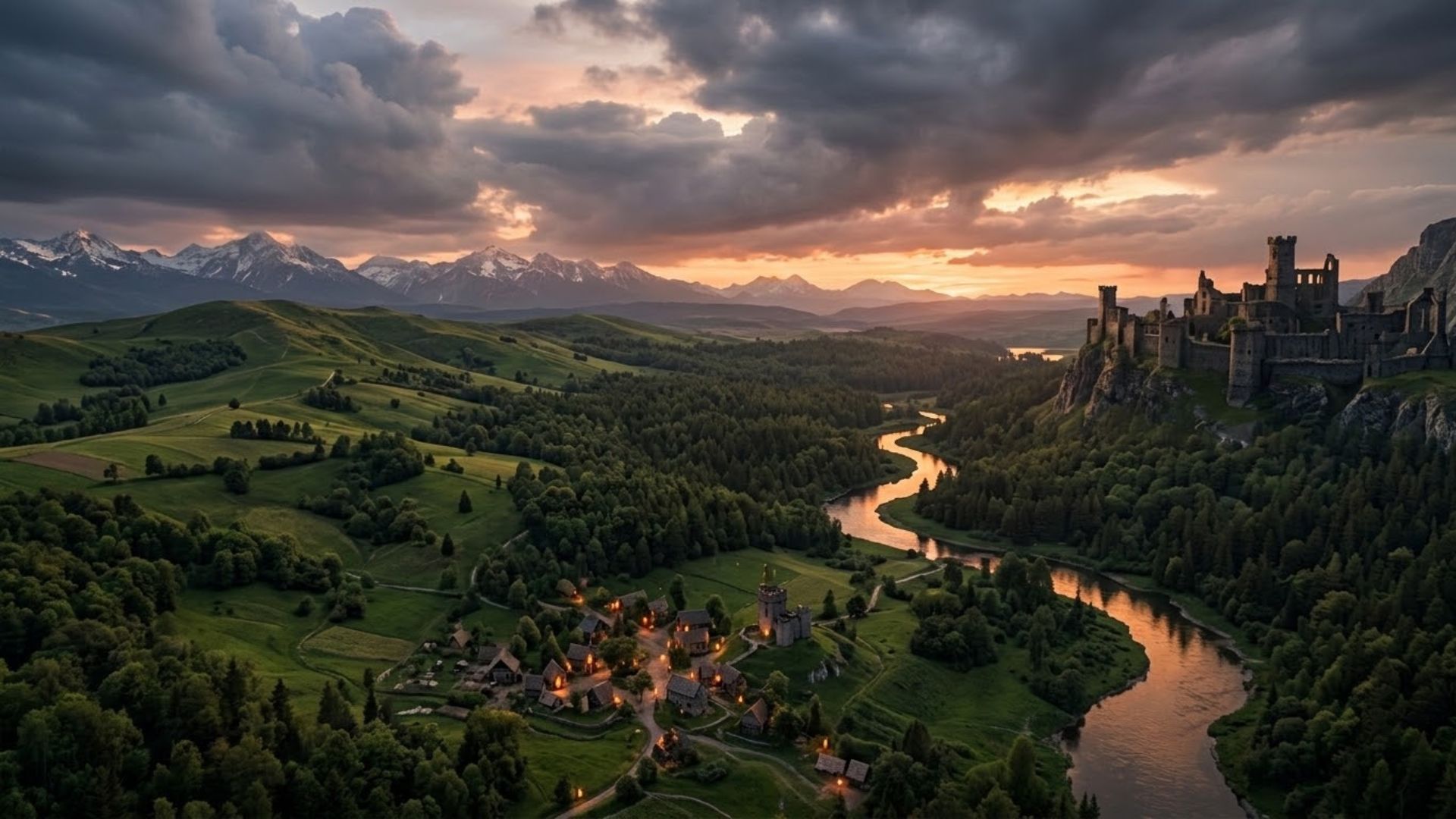
Bigger is not the flex it used to be. And 2026’s open world RPGs are the proof.
For most of the last decade, open world games competed on square kilometers and marker density. Fill the map, keep players busy, call it content. That approach is finally running out of road. Partly, players have gotten better at spotting padding. And partly, a few studios have shown what a world built to reward curiosity can do. So the best open world RPGs on PC right now are not the biggest ones. Instead, they are the ones where getting lost actually means something.
What separates a great open world from a mediocre one
The most common failure mode in this genre is filling space with activity instead of content. Map markers, repeated encounters, and scattered collectibles create the impression of scale. Yet they give players no reason to care about what they find. The games that hold up do the opposite. They use their size to tell stories through the environment itself. As a result, exploration feels like discovery rather than checklist management.
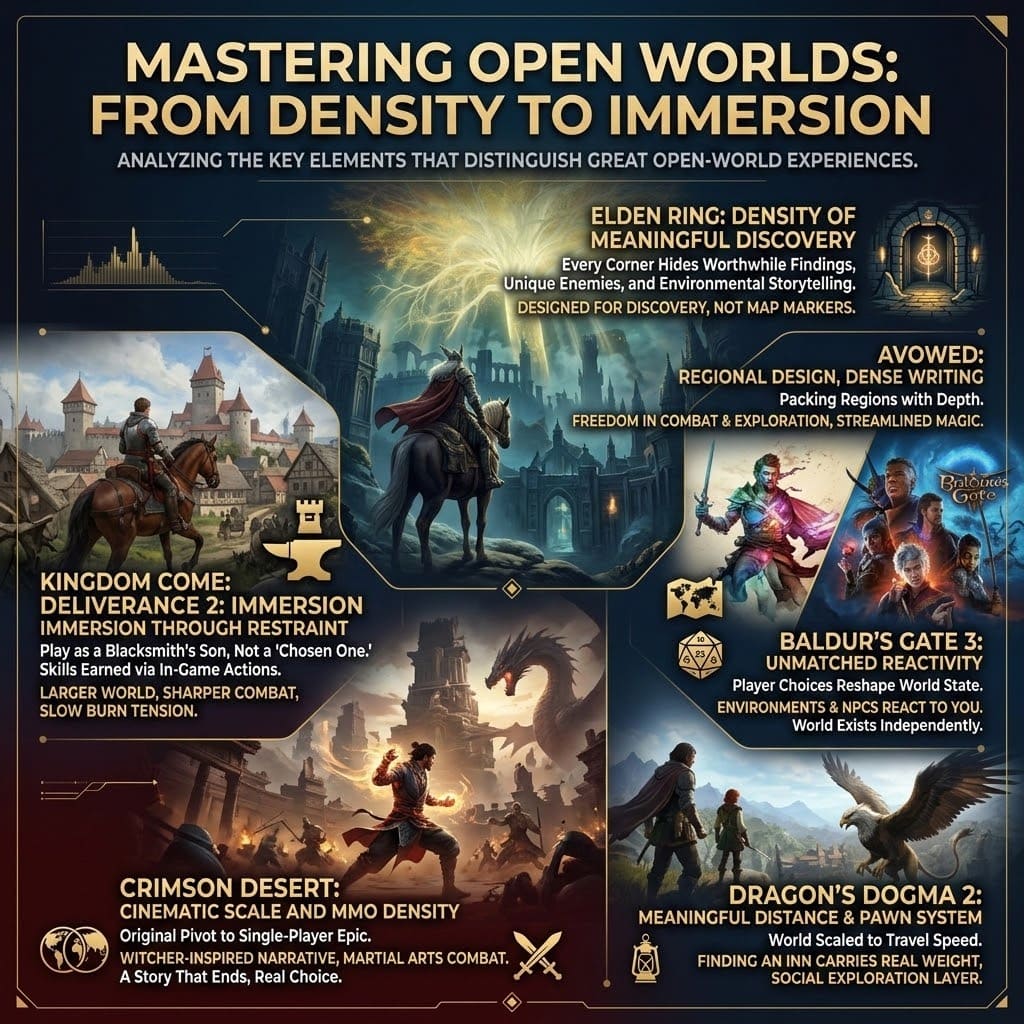
Elden Ring still has not been matched for density of meaningful discovery, three years and one expansion on. Every corner of the Lands Between hides something worth finding. A dungeon nobody pointed you toward. A unique enemy guarding a rare item. An environmental detail that tells a story without a single line of dialogue. Better still, the world is built to be traversed without a quest marker pulling you by the hand. And that one design choice still separates it from almost everything else here.
Kingdom Come: Deliverance 2 is the most immersive open world on PC right now. It earns that through restraint rather than spectacle. There is no magic, no chosen one, and no hero with predetermined qualities. Instead, you play a blacksmith’s son navigating fifteenth century Bohemian politics. Every bit of influence comes from skills built through in game actions, not a leveling screen handing you power. Meanwhile, the sequel expands on the original in every direction. It offers a larger world, sharper combat, and a story confident enough to trust slow burn tension over constant escalation.
Crimson Desert is the newest and most ambitious entry here, and its origin explains a lot. Pearl Abyss originally conceived it as an MMO before pivoting to a single player, Witcher inspired epic. That ambition shows in the scope of the world and the cinematic weight of its martial arts combat. Some critics flagged tonal inconsistency between its grounded political story and its high fantasy spectacle. Even so, the sheer scale and choice driven structure earned it a real 2026 following. In particular, it drew players who wanted MMO level density but a story that actually ends.
Avowed takes a different approach entirely. It divides its world into distinct large regions rather than one seamless map. As a result, Obsidian can pack each region with writing density that first person RPGs rarely reach. And the magic system gives real freedom in how you approach combat and exploration. Best of all, it never demands the encyclopedic system knowledge that the studio’s own Pillars of Eternity games require.
Baldur’s Gate 3 belongs here too, even though most people think of it first as a CRPG. Player choice reshapes the actual world state more here than in almost any other RPG on PC. And environments and NPCs react to your specific decisions. So the world feels like it exists independently of whether you are currently looking at it.
Dragon’s Dogma 2 remains one of the most underrated open worlds in recent memory. Largely, that is down to its pawn system, which adds a social layer that changes how exploration feels moment to moment. Crucially, the world is scaled to travel speed rather than map size. So distances feel genuinely meaningful. And finding a new inn after a long stretch carries real weight, rather than clearing just another marker.
The comparison that actually matters
| Game | World structure | Standout mechanic | Best for |
|---|---|---|---|
| Elden Ring | Seamless, marker free | Environmental storytelling | Discovery driven exploration |
| Kingdom Come: Deliverance 2 | Seamless, historically grounded | Skill based world influence | Immersive realism |
| Crimson Desert | Seamless, MMO scale origins | Cinematic martial arts combat | Scale and spectacle |
| Avowed | Regional, not seamless | Magic driven combat freedom | Accessible first person RPG |
| Baldur’s Gate 3 | Act based, highly reactive | Choice driven world state | Narrative consequence |
| Dragon’s Dogma 2 | Seamless, travel scaled | Pawn based social layer | Emergent party dynamics |
Choosing the right one for how you want to explore
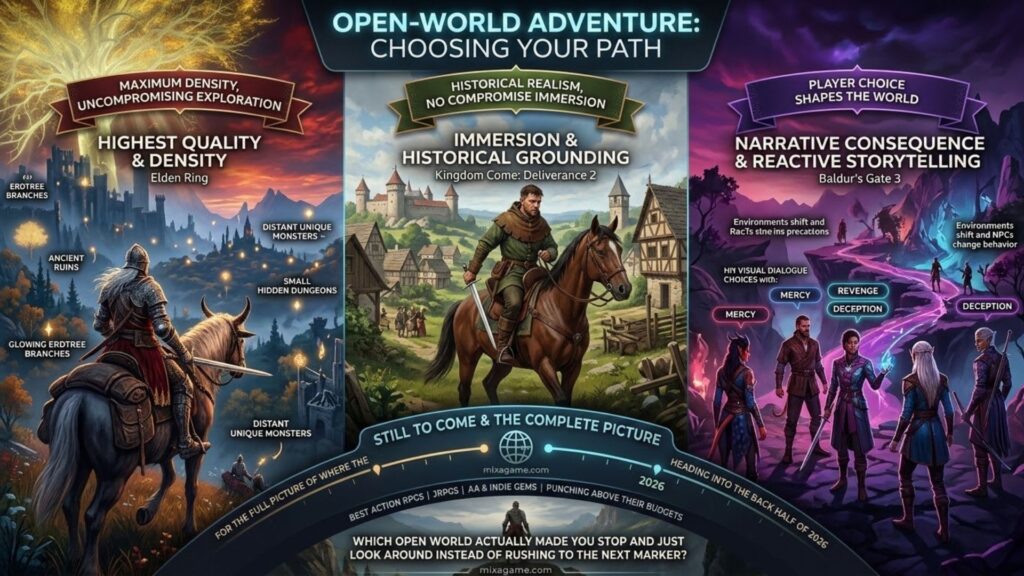
Do you want the highest quality world with no compromise on density? Then Elden Ring is still the answer, even against strong 2026 competition. Does immersion in a historically grounded setting matter more to you than fantasy spectacle? Kingdom Come: Deliverance 2 delivers something no other game here attempts. And if you are chasing narrative consequence and reactive storytelling, nothing currently touches Baldur’s Gate 3.
For the full picture of where the RPG genre stands heading into the back half of 2026, the complete ranking on mixagame.com covers the best action RPGs, JRPGs, and the AA and indie titles punching well above their budgets.
Which open world actually made you stop and just look around instead of rushing to the next marker?