![[decorative]](https://mixagame.com/wp-content/uploads/2025/10/cropped-mixagame-redwhite-logo-1024x256-1.png)
A French studio with no prior track record just did more for the JRPG’s reputation on PC than a decade of AAA marketing managed.
That is the strange, satisfying subtext of JRPGs on PC in 2026. Clair Obscur: Expedition 33 is not technically Japanese. Even so, it absorbed the genre’s DNA completely. Turn based combat, party based storytelling, an emotionally devastating premise: it became the accidental flagbearer for everything the genre does well. And its success did not happen in a vacuum. Publishers who once treated PC as an afterthought now ship day and date ports. Those ports bring native high resolution support, proper ultrawide handling, and smooth framerates. As a result, the genre feels more alive on a gaming PC than it ever did locked to thirty frames on a console.
That shift matters more than it sounds. For years, JRPGs were treated as a console first proposition. They arrived on PC late, poorly optimized, and priced like an afterthought. In 2026, though, that stopped being the default assumption.
What PC actually changes about how these games play
Display quality tends to matter more than raw horsepower here. After all, most JRPGs are not GPU intensive compared to an open world action title. Instead, PC pulls ahead on resolution, framerate stability, and day one visual fidelity. Console versions often get that fidelity months later, if at all. Controller input still suits most of these games best, because their combat is so menu heavy. That said, keyboard and mouse handle the more action oriented entries here without friction.
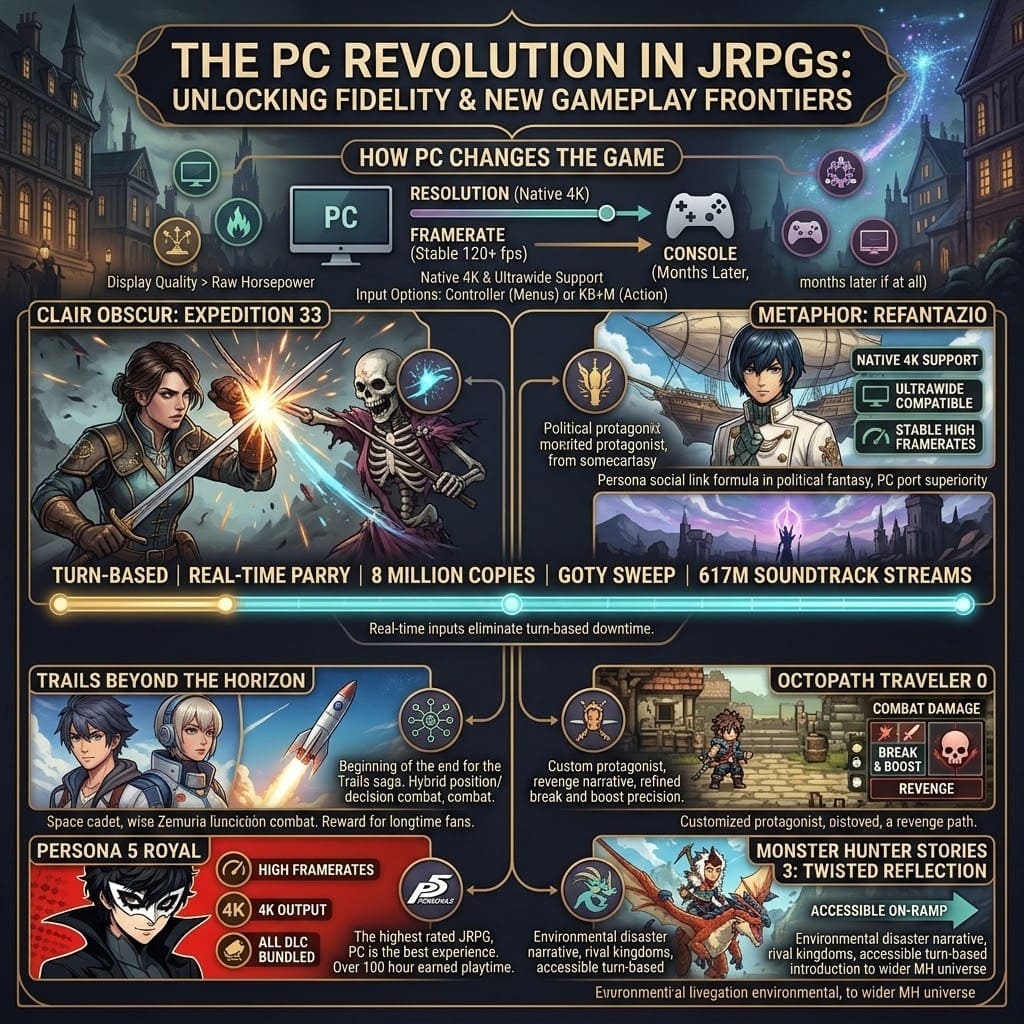
Clair Obscur: Expedition 33 redefined what a turn based JRPG can do commercially and critically at once. Set in a dark fantasy Belle Époque world, it follows a group racing against an entity called the Paintress. Once a year, she erases anyone above a shrinking age threshold. The combat layers real time parry and dodge inputs onto every enemy attack. That sounds like a small addition. In practice, though, it removes the passive downtime that has always been turn based combat’s biggest weakness.
By its first anniversary, the game had sold over eight million copies. It also became only the second title after Baldur’s Gate 3 to sweep Game of the Year at every major ceremony, including the BAFTAs. And the soundtrack alone streamed past 617 million times, charting in the top five of the US Billboard album charts. That is not a sentence anyone expected to write about a turn based RPG this decade.
Metaphor: ReFantazio proved that Atlus could move the Persona social link structure into a fantasy political setting. Crucially, it did so without losing what made the formula work. The battle system blends traditional turn based combat with real time action phases. And the PC port is one of the studio’s best. It offers native 4K support, proper ultrawide compatibility, and stable high setting framerates the console versions cannot match.
Trails Beyond the Horizon reached the West in 2026, after a 2024 Japan only launch. Nihon Falcom frames it as the beginning of the end for the long running Trails saga. The story unfolds from three character perspectives, centered on a first ever space voyage from the world of Zemuria. Meanwhile, the hybrid combat blends real time positioning with turn based decisions. It leans heavily on knowledge of previous entries. So it rewards longtime fans rather than newcomers. Still, for anyone who has followed the series, this is one of its strongest chapters in years.
Octopath Traveler 0 narrowly edged out Octopath Traveler 2 in several 2026 rankings, for a simple reason. It lets you build a custom protagonist on a revenge focused narrative, rather than follow one of eight fixed characters. And its refined break and boost combat rewards reading enemy weaknesses. In fact, it nails a precision the original trilogy took two entries to reach.
Persona 5 Royal remains one of the highest rated JRPGs ever made. And the PC version is still the best way to play it. High framerates, 4K output, and every previous DLC come bundled in. As a result, the hundred hour plus runtime feels earned rather than padded.
Monster Hunter Stories 3: Twisted Reflection takes the sub series’ traditional turn based structure and aims it at an environmental disaster story involving rival kingdoms. Multiple 2026 rankings call it the strongest Stories entry so far. Better yet, it is a more accessible on ramp into the wider Monster Hunter universe. So it suits anyone intimidated by the real time combat of the mainline series.
Where these games diverge from the West
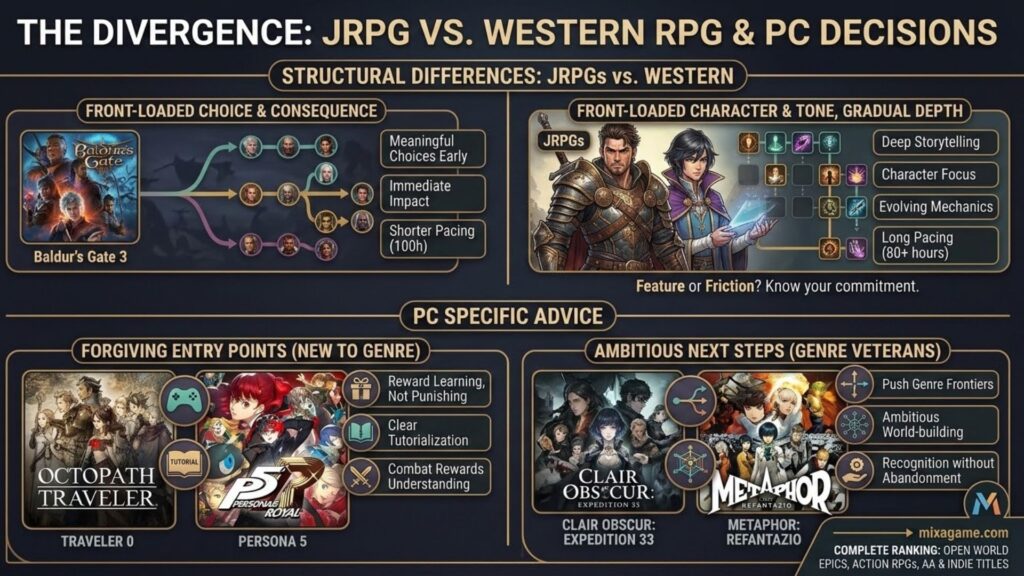
The biggest structural difference between JRPGs and their Western counterparts is pacing. A CRPG like Baldur’s Gate 3 front loads choice and consequence. Most JRPGs here, by contrast, front load character and tone. Then they let mechanical depth unfold gradually across a much longer runtime. That is either a feature or a friction point, depending on what you want. So it is worth knowing which camp you fall into before committing eighty or more hours.
PC specific advice before you pick one up
New to the genre entirely? Then Octopath Traveler 0 and Persona 5 Royal are the most forgiving entry points. Both use clear tutorials and combat that rewards learning rather than punishing unfamiliarity. Already know what you love about JRPGs and want the most ambitious option? Clair Obscur: Expedition 33 and Metaphor: ReFantazio both push the genre somewhere new. Yet neither abandons what makes it recognizable.
For a broader look at where the RPG genre stands across every subgenre in 2026, the complete ranking on mixagame.com covers open world epics, action RPGs, and the AA and indie titles quietly outperforming their budgets.
Which of this year’s JRPGs actually earned its runtime for you, and which one padded it?