![[decorative]](https://mixagame.com/wp-content/uploads/2025/10/cropped-mixagame-redwhite-logo-1024x256-1.png)

Somewhere in a studio right now, an engineer just shipped a change that will alter how your game runs tonight, and it will never appear in the patch notes. This is not a conspiracy. It is simply how software gets made in 2026. Every big update carries a shadow version of itself, a set of undocumented game changes that quietly reshape performance, behavior, and feel while the official changelog stays politely silent. Players who only read the notes are reading half the story, and the missing half is often the part that actually matters.
Why studios leave things out
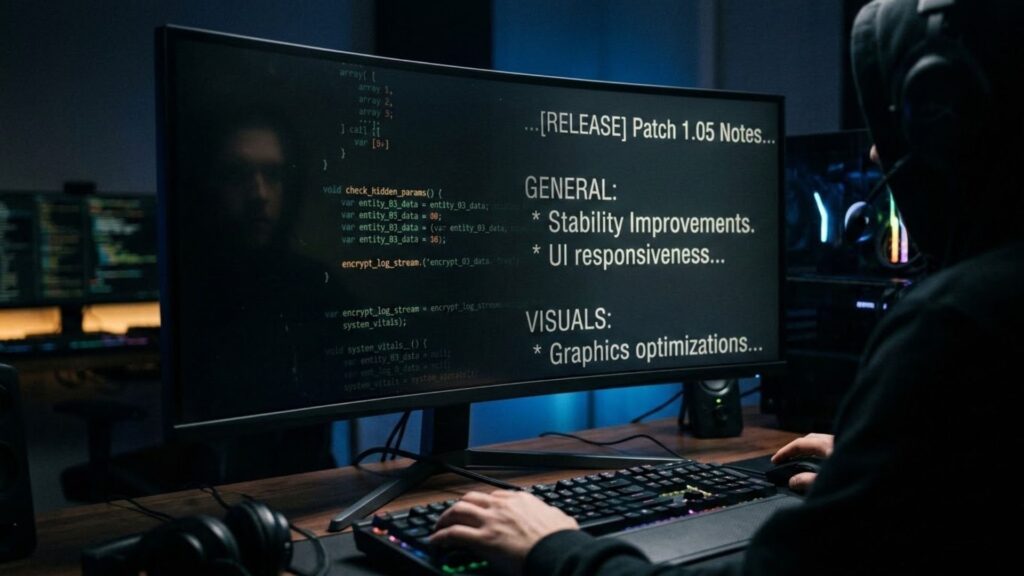
The gaps in patch notes are rarely sinister, and understanding why they exist makes you a smarter player. Most omissions come down to scale and priority. A modern game ships thousands of tiny commits between builds, and no writer documents every one. Studios triage. They highlight what players want to see, the new content and the headline fixes, and let the small stuff slide. Then there is the awkward category. Sometimes a change is embarrassing, like a stealth nerf to a beloved weapon or a quiet rollback of a feature that did not work. Other times, marketing simply prefers you not notice a downgrade. A former community manager once told me, with a shrug, not everything that ships is meant to be a headline. That honesty stuck with me, because it reframes the changelog as a curated message rather than a complete record.
The performance changes nobody announces
The undocumented changes that hit hardest are the ones tied to how the engine runs, and they almost never get a line in the notes. Studios adjust asset streaming, tweak shader compilation, rebalance memory allocation, and retune background processes constantly. Any one of those can add stutter, shift your frame rate, or change how long a level takes to load, all without a single word of warning. Shader compilation is a favorite culprit. After a patch, many games rebuild their shader cache, which can cause brutal stutter for the first hour of play, then vanish once the cache fills. Players panic, blame the update, and post angry threads, when the real fix was simply playing through the rebuild. Knowing that pattern turns a scary regression into a five-minute wait.
Here are the silent changes I watch for most.
| Hidden change | How it shows up | What to do |
|---|---|---|
| Shader cache rebuild | Heavy stutter early, then smooth | Play through it, retest after an hour |
| Streaming rebalance | Pop-in or hitching in new areas | Check texture and streaming settings |
| Memory reallocation | New crashes or steadier frames | Monitor RAM and VRAM usage |
| Background process added | CPU spikes at idle | Watch task manager during play |
| Reset config file | Settings changed on their own | Re-apply your saved profile |
How to catch what the notes hide
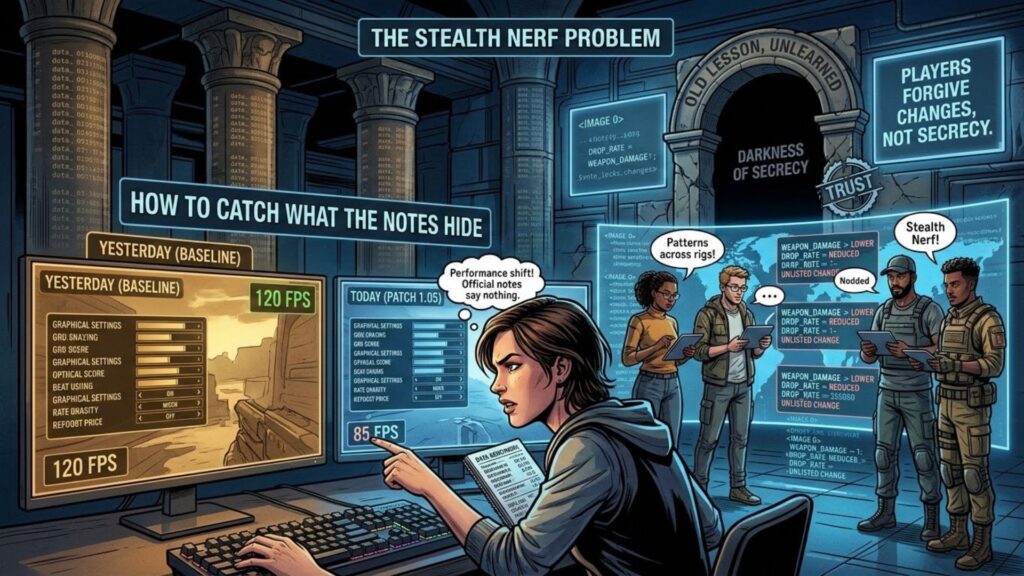
Spotting undocumented game changes is a skill, and it leans entirely on having your own reference point. If you never benchmark or note your settings, you have nothing to compare against, and every mystery stays a mystery. The players who catch stealth changes are the ones who already know what their game looked like yesterday. Start with your settings. After a major patch, open your options menu and actually check them, because config resets happen more often than studios admit. Then run your usual test scene and compare it to your baseline. If performance shifted and the notes explain nothing, you have found a hidden change. Trust that gap. Your measured reality outranks the official document every time.
Community reports help here too, but only the good ones. When dozens of players on different hardware report the same unlisted behavior, you are looking at a real change, not a fluke. Patterns across many rigs carry weight that a single angry post never will.
The stealth nerf problem
Not every hidden change is about performance, and the gameplay ones stir the most drama for a reason. Stealth nerfs, quiet adjustments to weapon damage, drop rates, or enemy behavior, erode trust when players eventually discover them. Data miners and dedicated communities, tracked closely by outlets like PC Gamer, almost always find these, and the reveal often lands worse than an honest note would have. The lesson for studios is old and unlearned: players forgive changes far more easily than they forgive being kept in the dark. For us on the receiving end, the takeaway is practical. When something feels different but the notes say nothing, you are probably right. Your instincts, backed by a quick test, are a legitimate signal, not paranoia.
Turning suspicion into method
The goal is not to distrust every studio. It is to hold two ideas at once: patch notes are useful, and patch notes are incomplete. That balance turns you from a passive reader into an active investigator. You read the notes for the official story, then you test for the unofficial one, and the space between them is where the real understanding lives. That habit pays off far beyond any single game. It makes you the person in your friend group who actually knows why the game feels different, instead of the one guessing in the group chat.
Undocumented changes will always exist, because software will always outrun its own documentation. The question is whether you notice. If you want to see how these silent shifts connect to benchmarks, drivers, and settings across every patch, our complete guide to how game updates affect PC performance maps the whole landscape. So the next time your game feels off and the notes swear nothing changed, will you take their word for it, or go find the truth yourself?