![[decorative]](https://mixagame.com/wp-content/uploads/2025/10/cropped-mixagame-redwhite-logo-1024x256-1.png)
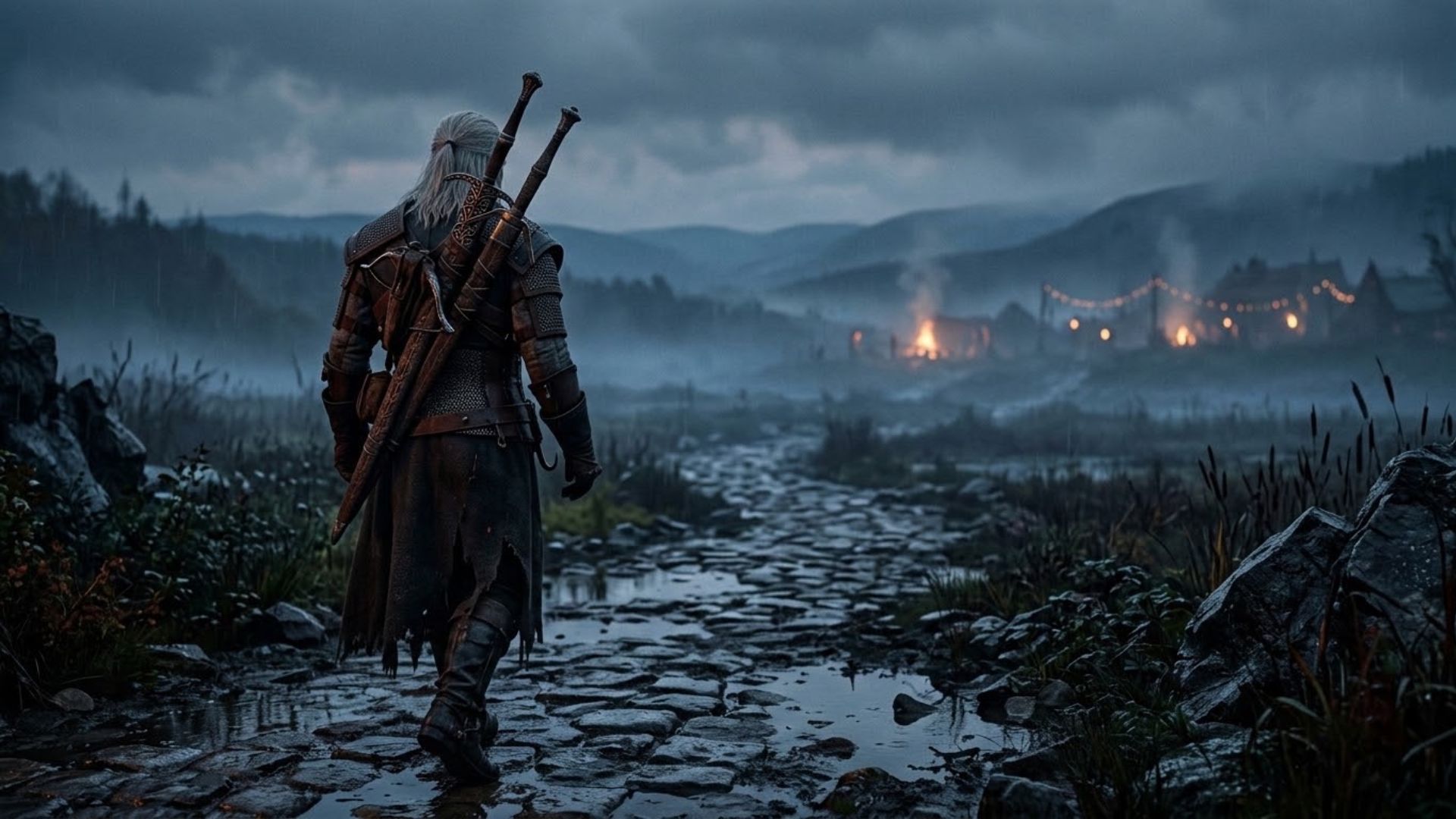
Games are supposed to get easier to run as they age, not harder. Witcher 3 Songs of the Past breaks that rule, and that single fact tells you more about CD Projekt Red’s plans than any trailer will on Tuesday night.
Buried under the announcement noise back in May was a support-page update that most coverage treated as housekeeping. The minimum bar for The Witcher 3 moved to a Ryzen 5 2600 or Core i5-8400, a GeForce GTX 1660 or Radeon RX 5500 XT, 12 GB of system RAM, 6 GB of VRAM, 70 GB of SSD space, and 64-bit Windows 11. CD Projekt Red also confirmed it would stop testing on Windows 10, drop HDD support entirely, and run the game exclusively on DirectX 12. An eleven-year-old RPG just told a chunk of its own audience to upgrade or stay behind.
That is not how studios treat legacy catalog. That is how they treat a live product.
Gamescom Is the Reveal, but the Booth Layout Is the Message
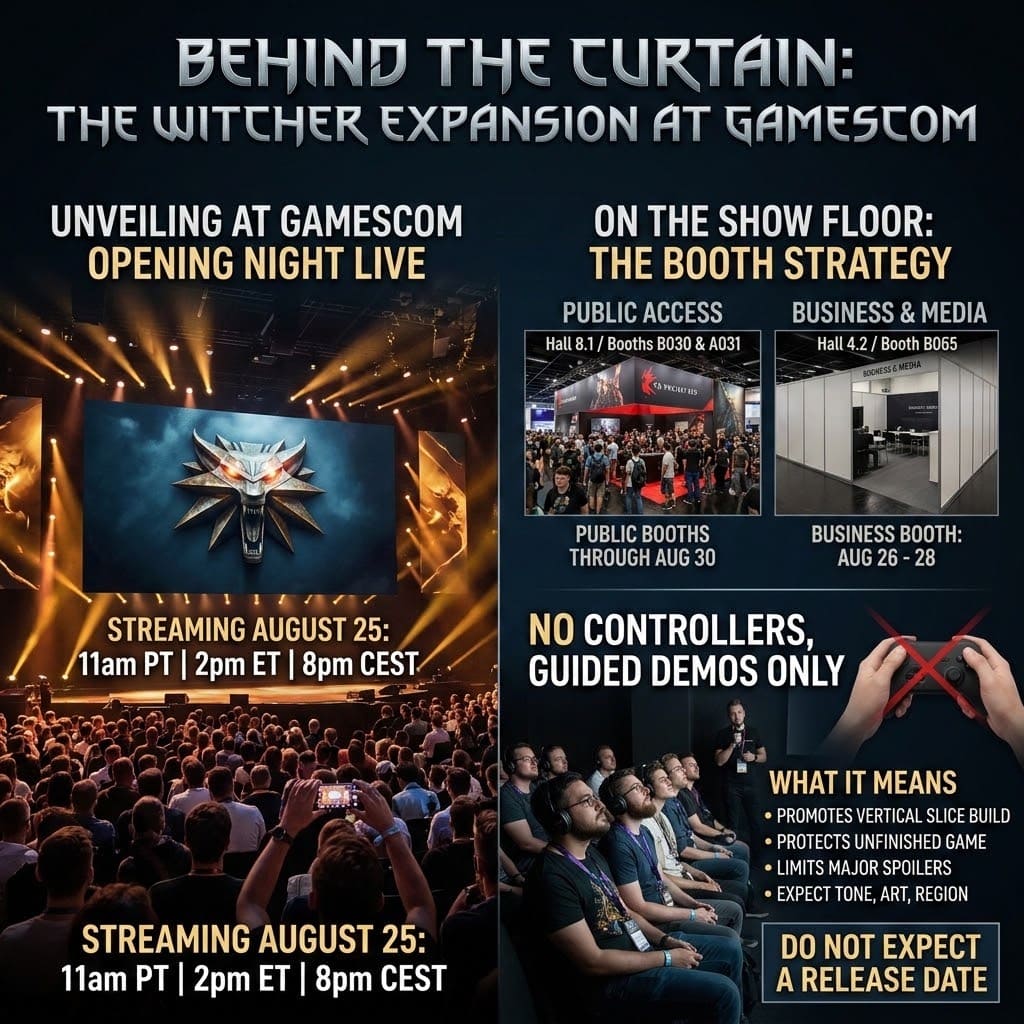
The first real public showing lands during Gamescom Opening Night Live on August 25, streaming at 11am PT, 2pm ET, and 8pm CEST. From there the expansion moves to the show floor: booth B065 in Hall 4.2 for business visitors from August 26 to 28, and booths B030 and A031 in Hall 8.1 for the public through August 30.
Notice what is missing. Attendees get guided presentations, not controllers. That is standard CDPR practice for Witcher reveals, and it is also a tell. Guided demos protect a build that is still eighteen months from shipping. A CD Projekt Red staffer who sat through a private Warsaw screening described the demo as a deliberate balance between showing new content and withholding major spoilers, which is corporate for “we are showing you a vertical slice and nothing past it.”
So temper the expectations accordingly. Tuesday gives us tone, art direction, and maybe a region. It does not give us a release date.
Fool’s Theory Is Auditioning in Front of Millions
Here is where the stakes get interesting. CD Projekt Red is co-developing Songs of the Past with Fool’s Theory, a Polish studio staffed by veterans who worked on the original Witcher 3. That studio also shipped The Thaumaturge in 2024 and provided support work on Baldur’s Gate 3. More importantly, Fool’s Theory is building the Unreal Engine 5 remake of the 2007 original.
Think about that sequencing for a second. Before Fool’s Theory is trusted to rebuild the game that started everything, it gets a public dress rehearsal on the most beloved open-world RPG of the last decade, using CDPR’s own tools, under CDPR’s supervision. If the dialogue lands, if the quest design has that Witcher texture where nobody is clean and no choice feels free, the remake conversation changes overnight. If it feels like fan fiction with a budget, the remake inherits that doubt before a single frame ships.
Nobody at CDPR is calling this an audition. It obviously is one.
The Witcher 3 Songs of the Past PC Requirements Are the Actual Story
Back to the spec sheet, because for PC players this is the part with teeth.
| Component | Original 2015 minimum | Songs of the Past minimum |
|---|---|---|
| CPU | Core i5-2500K | Ryzen 5 2600 / Core i5-8400 |
| GPU | GeForce GTX 660 | GeForce GTX 1660 / RX 5500 XT |
| VRAM | 1 GB | 6 GB |
| RAM | 6 GB | 12 GB |
| Storage | 50 GB HDD | 70 GB SSD |
| OS | Windows 7 | Windows 11 (64-bit) |
The jump from a GTX 660 and 1 GB of video memory to a GTX 1660 and 6 GB is roughly a generational leap compressed into one patch note. CD Projekt Red has separately confirmed to press that Songs of the Past will not be downloadable on Windows 10 at all, even though the current builds of both The Witcher 3 and Cyberpunk 2077 still run on it.
That decision locks out a real population of players, and CDPR made it anyway. Studios do not accept that kind of audience haircut for a nostalgia add-on. They accept it when the underlying game is getting rebuilt around new rendering assumptions. Remember, the 2022 next-gen update already brought ray tracing and photo mode to the modern platforms, and Songs of the Past skips last-gen consoles entirely. Read those together and the picture sharpens: this is a technical refresh wearing an expansion’s clothes.
Keeping a Dead Engine Warm
There is a strategic wrinkle underneath all of it. Songs of the Past runs on REDengine, the proprietary tech CDPR publicly retired when it moved The Witcher 4 and everything after it to Unreal Engine 5. Which means the company is spending real money in 2026 to keep a sunset engine staffed, patched, and shipping new content, at a moment when the rest of the industry has consolidated around off-the-shelf engines.
Why bother? Because the modding ecosystem lives there. Cross-platform mod support, promised for PC, PS5, and Xbox Series consoles, is still in development, with CDPR’s community team saying “we are still working away on it.” REDkit exists. A decade of Nexus mods exists. Halk Hogan’s texture work exists. Torch that foundation and you torch the thing that kept The Witcher 3 culturally alive long after its sales curve flattened.
Then there is the harder question nobody wants to ask out loud. Whatever mod compatibility looks like after the update, thousands of script-based mods will break. The community has been through this before with the 4.0 patch. It was not fun.
Reading the Tea Leaves on Story
CDPR has been unusually disciplined about withholding plot, but the marketing has leaked signals on purpose.
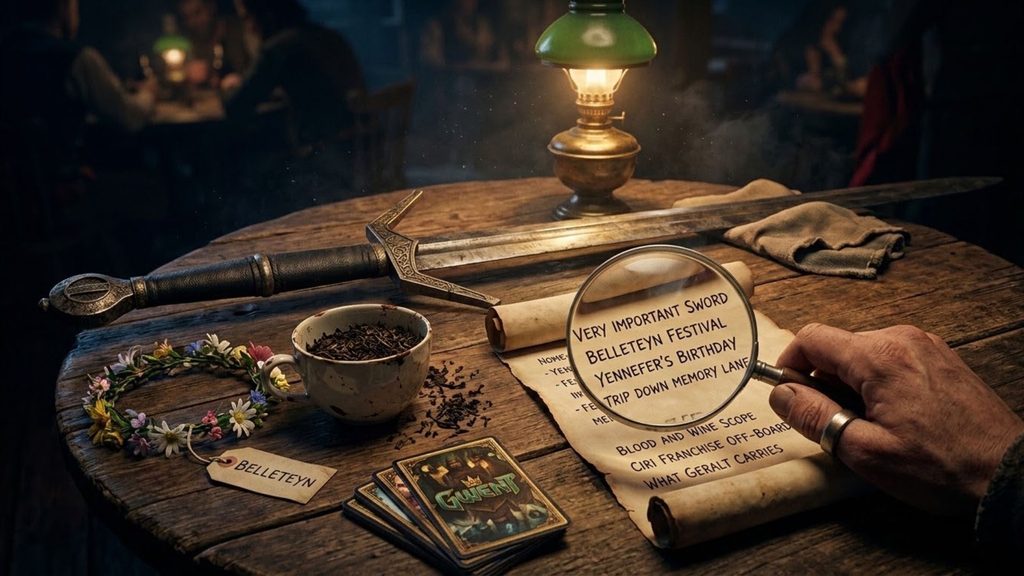
A sword in the key art was flagged by developers as important to the story, with CD Projekt’s Amelia Korzycka saying flatly that “It is a very important sword for the story.” Fan analysis has connected the artwork to Belleteyn, the spring fertility festival that has only ever been mentioned in the games, and which happens to fall on Yennefer’s birthday. Developers confirmed the scope will align with Blood and Wine, which ran 15 to 40 hours depending on how thoroughly you played it. New Gwent cards are coming too.
Joint CEO Michal Nowakowski framed the whole thing as “a trip down memory lane” before the series hands off to Ciri. Given the title, given the festival imagery, given a sword that predates Geralt’s current loadout, the shape is not hard to guess. This is a story about what Geralt carries, told right before the franchise takes him off the board.
The Money Behind the Nostalgia
Polish analyst Mateusz Chrzanowski pegged the expansion’s production budget at 52 million zloty, roughly 14 million dollars, and argued its release would effectively launch the real marketing campaign for The Witcher 4. That reframes everything. Songs of the Past is not a gift to the faithful. It is a customer acquisition instrument aimed at 65 million existing owners, timed to warm up the audience before Ciri’s debut.
CDPR pushed the expansion from 2026 into 2027 and cited quality over speed, which is the polite version. The less polite version is that a rushed Witcher product in 2026 would have poisoned the well for a Witcher 4 launch the company cannot afford to fumble after Cyberpunk 2077. Fourteen million dollars is cheap insurance on a franchise worth billions.
What Tuesday Actually Decides
The trailer will look gorgeous. That part is basically guaranteed, because CDPR does not lose trailers. The real thing worth watching is whether the footage carries the specific weight that made Toussaint feel like a place rather than a level: the ambient dialogue, the way a side quest curdles halfway through, the sense that Geralt is tired in a way that has nothing to do with stamina bars.
Fool’s Theory has to prove it can forge that, not just imitate it. And CDPR has to prove that raising the entry bar on an eleven-year-old classic buys players something more than a bigger install footprint. Both of those questions get their first honest answer in a few minutes of Cologne footage, which is a brutal amount of pressure for a preview reel.
If Songs of the Past really is Geralt’s last playable chapter, would you rather CDPR gave him a quiet, character-driven send-off, or one final monster hunt big enough to rival Blood and Wine?