




Star Trek Fleet Command has lost over 40,000 accounts in six months. That’s not speculation from a disgruntled Reddit thread. That’s a number circulating among the game’s most embedded content creators and community leaders, and it tells you more about the state of STFC than any official blog post ever will.
The game just turned seven. Scopely’s general manager, Connor, recently published a lengthy State of the Game update addressing everything from the G7 expansion to technical stability to the Vengeance sourcing economy. On paper, it reads like a studio acknowledging problems and committing to solutions. In practice, according to the community that’s been living inside this game for years, almost none of it is new.
The Feedback Loop That Isn’t Working
The most revealing problem with STFC’s current trajectory isn’t a specific bug or a bad content update. It’s how the studio collects feedback.
Scopely relies on three primary channels: a Player Advisory Council, community surveys, and conversations with content creators under NDA. Each of these has significant blind spots. The Advisory Council is overwhelmingly composed of high-grade players, G6 and above, in a game where the majority of the player base sits well below that tier. The surveys have been publicly criticized across Reddit, Facebook, and Discord for front-loading positive response options while limiting the ability to express dissatisfaction. And the content creators consulted are largely those within Scopely’s NDA program, which excludes some of the game’s most influential independent voices.
The result is a feedback loop that confirms what management already believes. When your data sources are structurally biased toward positive sentiment, you end up writing blog posts celebrating features that the broader player base finds frustrating.
This isn’t a problem unique to STFC. It’s a pattern across live service games. But STFC’s version of it is especially visible because the community is vocal, organized, and increasingly willing to walk away.
G7 Launched Big but Landed Rough
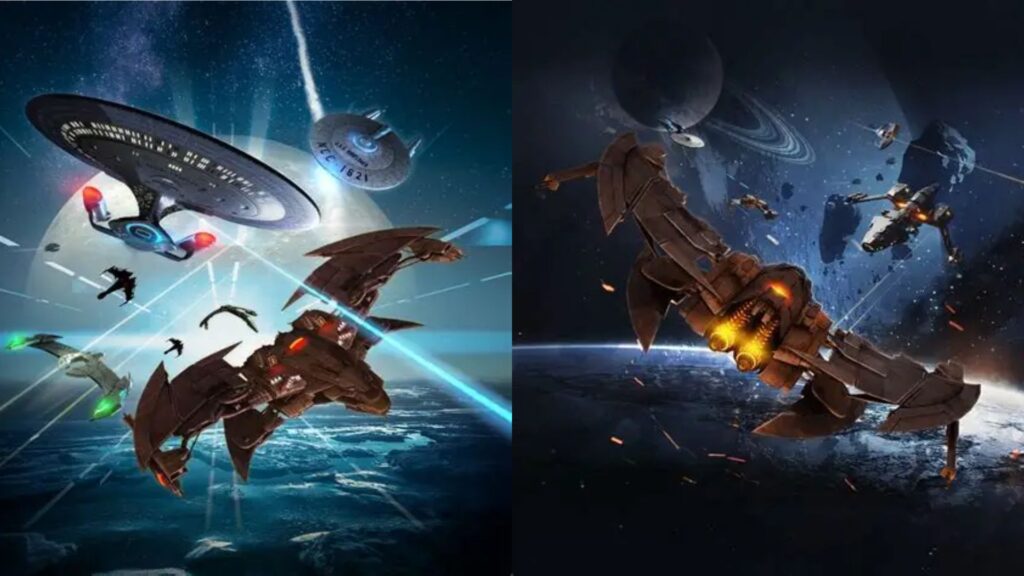
The G7 expansion, which introduced the Veil and a wave of new systems, was STFC’s most ambitious content drop in years. The Veil as a mechanic, a cross-server space that connects players from different regions, has genuine merit. The concept of breaking server isolation and creating shared exploration spaces is the kind of idea that keeps a live service game feeling alive.
But the execution has been rocky. The Surge mode, positioned as a flagship cooperative experience, has been met with widespread indifference. Community polls and live-stream feedback sessions suggest that most alliances aren’t running Surges voluntarily, and the mode’s scaling issues mean early adopters have limited options. Scopely’s proposed near-term fix? Selling Surge starts in special packs. When the solution to a participation problem is a monetization event, the disconnect between studio and player base becomes impossible to ignore.
The expansion also carries a cost problem that the State of the Game post didn’t address directly. Community estimates suggest that reaching the reputation thresholds needed to build G7 uncommon ships can require spending upwards of $10,000. That number, whether precisely accurate or not, reflects a broader sentiment: the late game has become prohibitively expensive for anyone outside the top spending tier.
| Issue | Management Position | Community Response |
|---|---|---|
| Outposts | Designed for new crew variety | Players using old crews; nothing feels new |
| Vengeance sourcing | Broadened through events and outposts | VIP players and moderators quitting over economy |
| Surge mode | Excited about player engagement | Most alliances not participating voluntarily |
| G5 ship scrapping | Targeted for release before July 2026 | Delayed repeatedly; original rewards considered inadequate |
| iOS stability | 97.7% session stability, improving | Below Scopely’s own 99% target |
| Client-side lag | Breakthrough identified, fix in progress | Core issue untouched since early development |
What’s Actually Working
It’s not all bad, and pretending otherwise would misrepresent the situation. The Unity 6 engine migration is a genuine technical step forward, giving the development team access to better tools and the Universal Render Pipeline for improved rendering performance. Android stability sits at 99.7%, which is solid. The team has identified that the core lag problem is client-side rather than server-side, and they’ve outlined a concrete plan to address it involving message queue pruning and communication protocol overhaul. If delivered, these changes could meaningfully improve the moment-to-moment experience.
The split-arc approach for different player grades, introduced in September, has been well received. Designing content that acknowledges the gap between a G3 player and a G6 player is basic live service hygiene, but the fact that STFC is finally doing it consistently is progress worth noting.
And Connor’s commitment to sharing specific dates and deliverables rather than vague intentions is, if followed through, exactly the kind of transparency shift the community has been requesting for years.
The Two-Year Clock
The hardest truth in the source community right now is the quiet acknowledgment that STFC may have roughly two years of viability left before it enters maintenance mode. That’s not a prediction made by people who hate the game. It’s coming from players and creators who have invested thousands of hours and, in many cases, thousands of dollars. They’re watching the player count drop, the feedback channels narrow, and the monetization pressure increase, and they’re doing the math.
Seven years is a respectable lifespan for any mobile game. But STFC isn’t just any mobile game. It carries one of the most valuable entertainment licenses in history. It has a community infrastructure, content creator ecosystem, and cross-server social layer that most mobile titles never develop. The foundation is there for a much longer run. The question is whether Scopely can reverse course quickly enough to use it.
The game is mechanically better than it was a year ago. The Veil is a good idea. The engine upgrade is smart. The arc structure improvements are overdue but welcome. But the experience of playing STFC, the cost of progression, the quality of events, the responsiveness to feedback, has deteriorated faster than the technical improvements can offset.
Connor’s post reads like it was written by someone who genuinely cares about the game’s future. The community doesn’t doubt that. What they doubt is whether caring is enough when the people delivering the feedback are telling you what you want to hear instead of what you need to know.
At seven years old, does Star Trek Fleet Command have enough runway left to fix the trust deficit, or has the gap between what the studio believes and what players experience become too wide to bridge?