![[decorative]](https://mixagame.com/wp-content/uploads/2025/10/cropped-mixagame-redwhite-logo-1024x256-1.png)
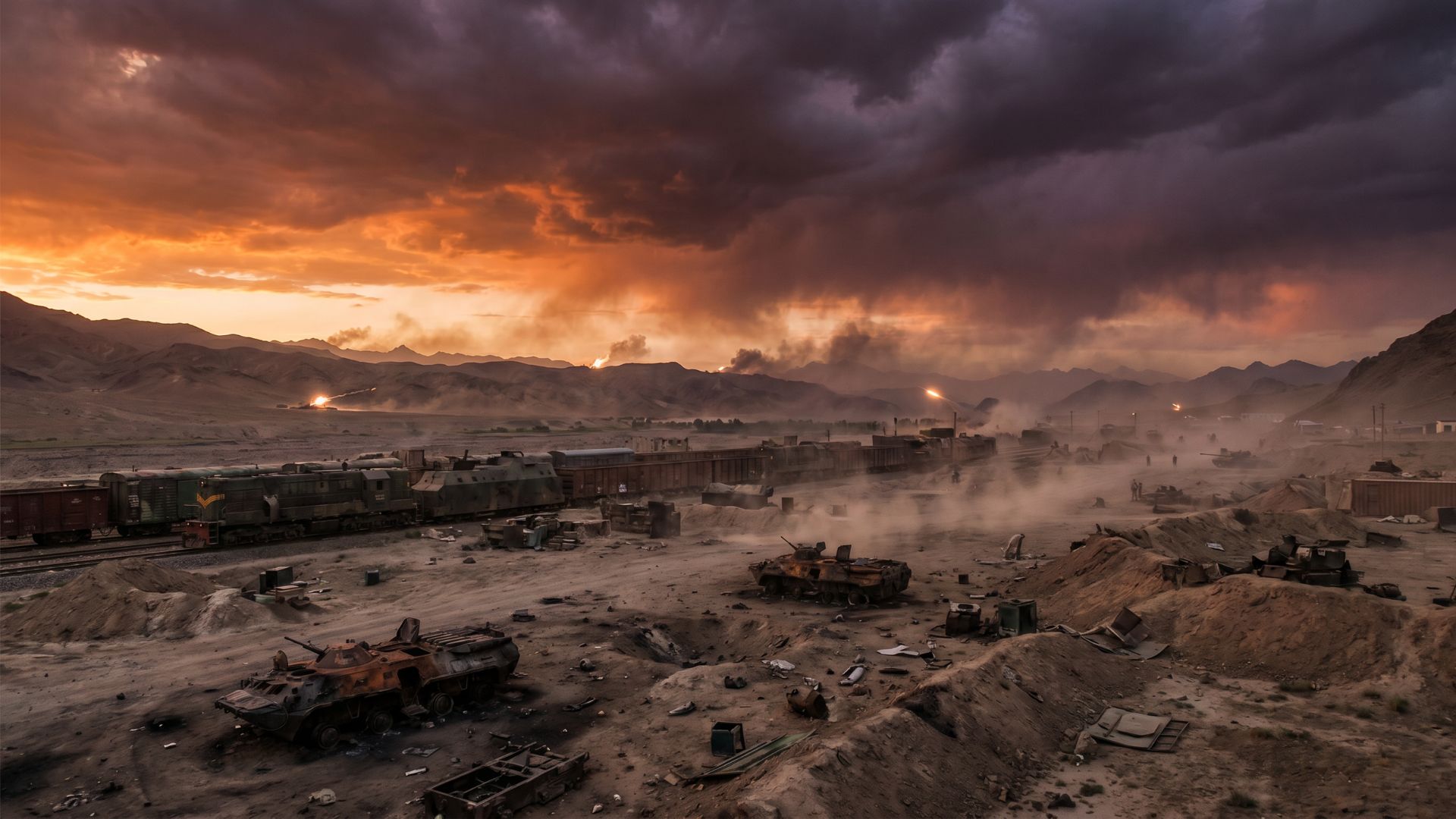
Twenty million copies sold. The best-selling game of 2025. A franchise that critics and fans alike declared a genuine return to form after years of stumbles. On paper, Battlefield 6 should be riding high right now. Instead, it enters Season 3 carrying a different kind of weight, the kind that comes from a player base that feels like the game has not fully delivered on its own promise yet, and a studio navigating one of the most turbulent internal periods in franchise history.
Season 3 of Battlefield 6 launches on May 12, and the stakes around it are real. This is not a routine content drop. It is Battlefield Studios’ clearest opportunity yet to show that the game’s first-year trajectory bends toward something better.
What Season 2’s final patch actually did?
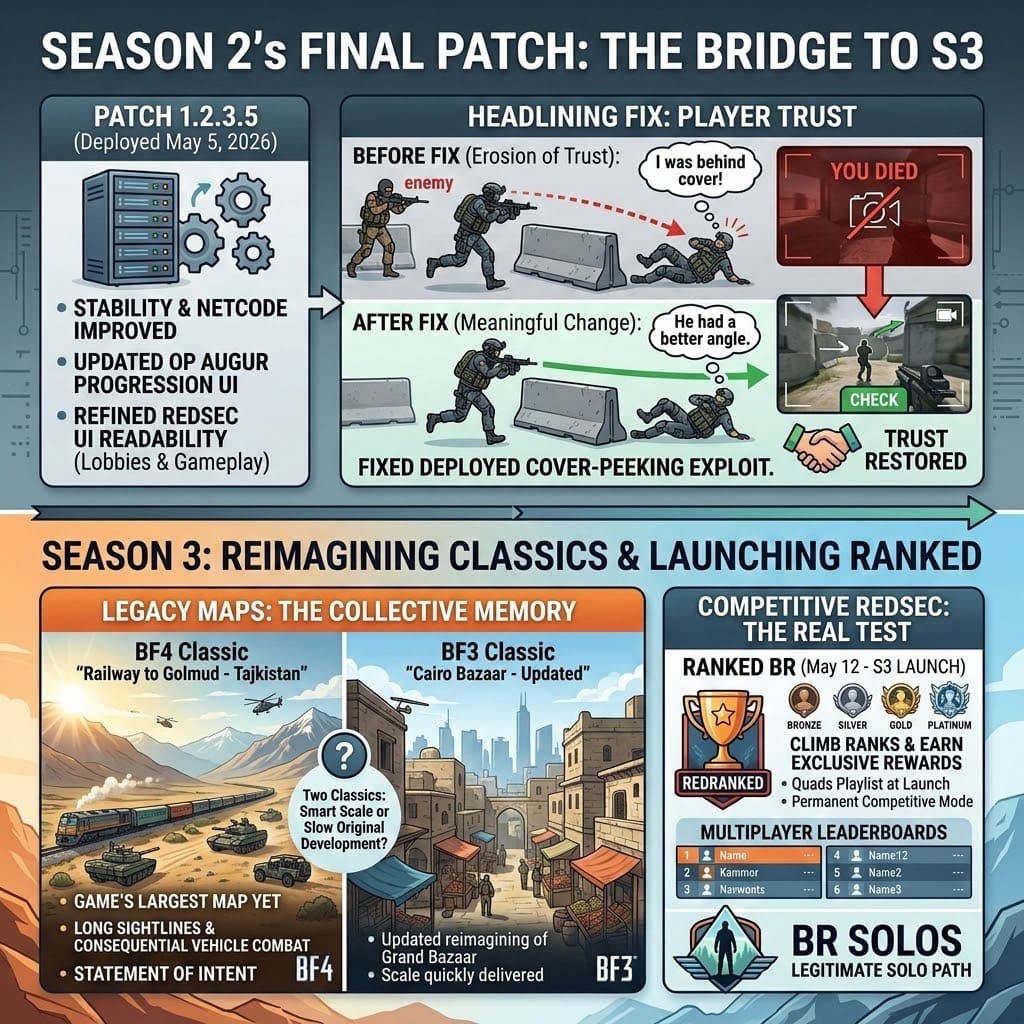
Before Season 3 arrives, it is worth acknowledging what just shipped. Update 1.2.3.5 deployed on May 5, 2026, and improves gameplay stability and netcode, updates Operation Augur’s progression UI, and refines REDSEC’s UI readability in lobbies and various gameplay scenarios.
The headlining fix in this patch is a subtle but meaningful one. One of the most significant changes is the camera transition between first and third person upon a player’s death, which sometimes made it look like a player died while running behind cover. For a game competing at the top of the tactical shooter market, getting shot from behind cover you have already passed is the kind of experience that erodes trust in a game’s core feel. Fixing it is not glamorous, but it matters.
Season 3: legacy maps, ranked play, and a real test of intent
The centerpiece of Season 3 is Railway to Golmud, a reimagining of the beloved Battlefield 4 classic. The map is the game’s largest yet and is set in Tajikistan after the events of Battlefield 6’s campaign.
This is exactly the kind of content the community has been loudest about wanting. Golmud Railway from Battlefield 4 sits in the collective memory of the franchise’s fanbase as one of the great large-scale maps, with long sightlines, vehicle combat that felt genuinely consequential, and enough space for the kind of emergent moments that define Battlefield at its best. Rebuilding it as the biggest map in BF6 is a statement of intent, even if bringing back a legacy map rather than building an entirely new one is a choice that will not satisfy every critic.
Later in Season 3, another legendary map arrives: Cairo Bazaar, an updated reimagining of Battlefield 3’s Grand Bazaar. Two classic-map reimaginings in one season is either a smart way to give players the scale they asked for quickly, or a sign that original map development is moving slower than EA would like to admit. Probably a bit of both.
On the competitive side, Ranked Battle Royale launches on May 12 with Season 3, starting with a Quads playlist, functioning as a permanent competitive mode where players climb through ranks and earn exclusive cosmetic rewards via the new Multiplayer Leaderboards. BR Solos also arrive, completing the mode structure for REDSEC and giving solo players a legitimate competitive path.
The roadmap beyond season 3
Season 4 launches this summer and will add Naval Warfare to both Battlefield 6 and REDSEC. Tsuru Reef, a new naval-focused map, is billed as the biggest warground yet, featuring enormous air and sea spaces, new naval-based vehicles, aircraft carriers with operational flight decks, and a dynamic wave system.
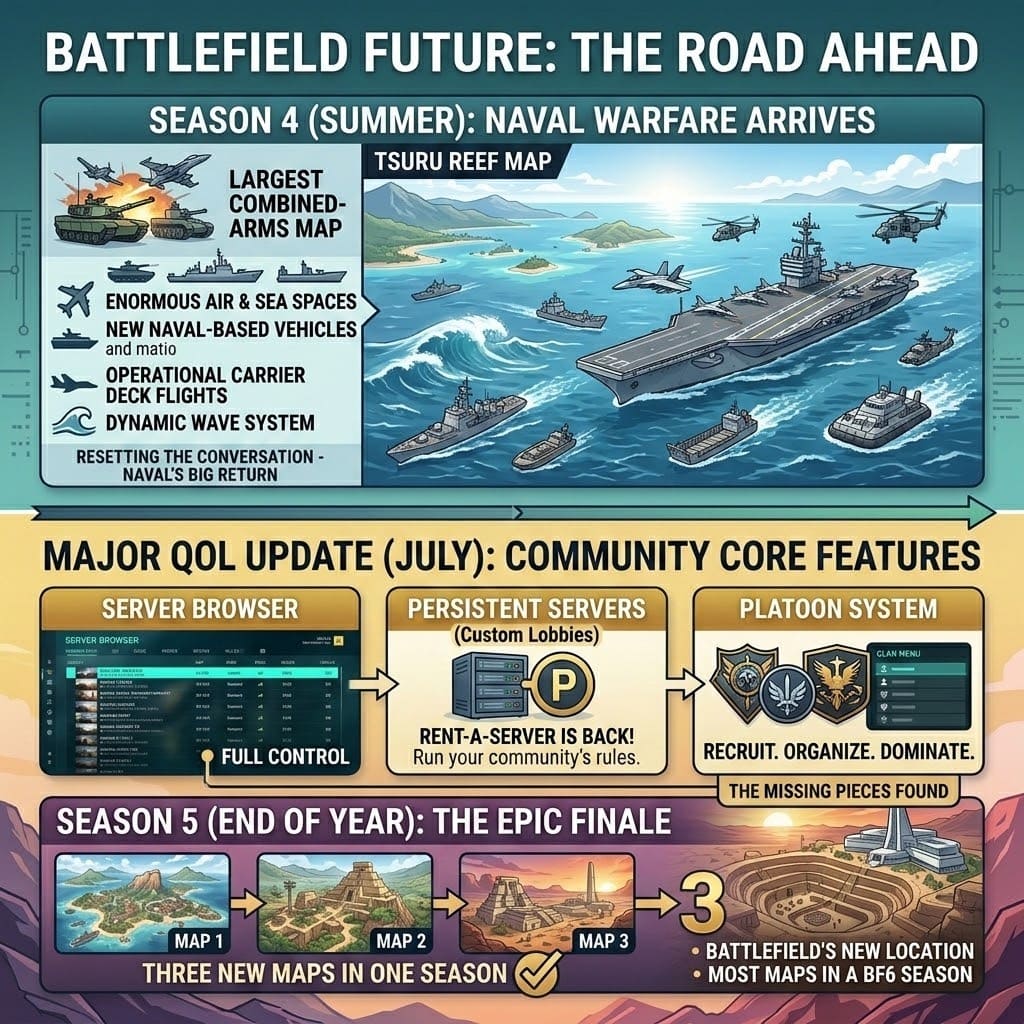
Naval Warfare returning to Battlefield is genuinely significant. It has been absent since Battlefield 4’s era and represents the kind of large-scale combined-arms experience that separates Battlefield from every other shooter on the market. If the implementation is as ambitious as the roadmap suggests, Season 4 could be the moment that resets the conversation around BF6 entirely.
The Server Browser, along with Persistent Servers for custom lobbies and the Platoon system, is confirmed to arrive as a major quality-of-life update around July. These are features the community has treated as non-negotiable since launch, and their absence has been a consistent friction point for players who want more control over their experience.
Season 5 will close out the year and take players to a new location for the Battlefield franchise, with three maps dropping within a single season, the most to drop in a BF6 season so far. Three maps in one season is the kind of commitment that would have silenced most of the map-pool criticism if it had come earlier. Better late than never.
The harder context nobody should skip
The roadmap deserves to be read alongside some uncomfortable facts. Despite Battlefield 6 being 2025’s biggest game, selling 20 million units and outpacing even Call of Duty, Battlefield Studios was still hit with layoffs in 2026. The people building these seasons are doing so in the aftermath of significant workforce cuts.
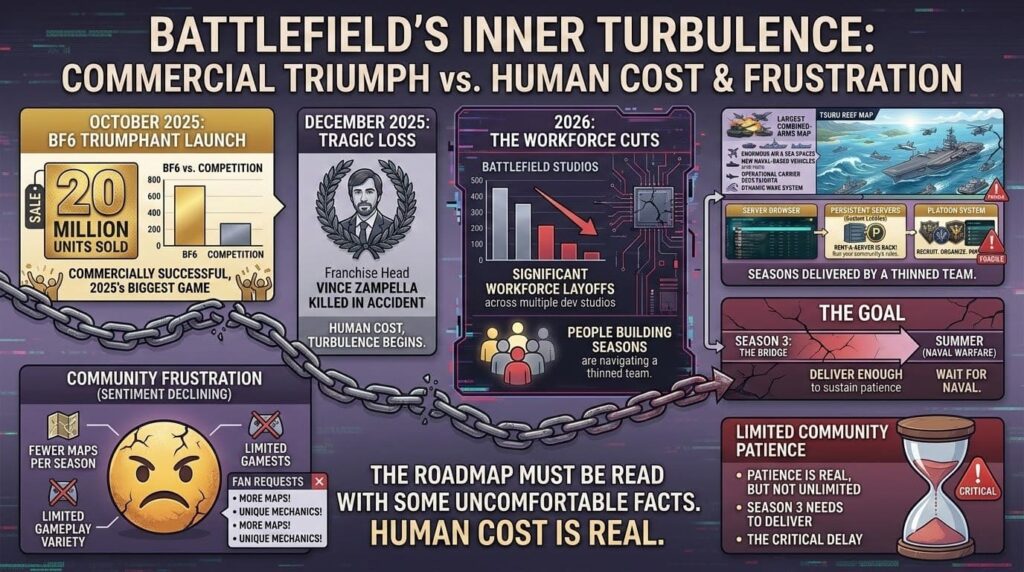
Following Battlefield 6’s successful launch last October, franchise head Vince Zampella was killed in a car accident in December. Last month, Battlefield Studios was hit with layoffs across its multiple development studios. The human cost behind the roadmap is real, and it provides important context for why a game this commercially successful is still navigating turbulence.
Player sentiment has been steadily declining as fans continue to ask for more maps per season and for more gameplay variety in each new map. The community’s patience is real, but it is not unlimited. Season 3 needs to deliver enough to sustain that patience through the summer, when Naval Warfare is supposed to land.
What Season 3 actually needs to prove?
The map count complaint is legitimate. Two maps per season in a game with Battlefield’s scale is genuinely thin for players who rotate content weekly. The roadmap addresses this in Season 5, but that is months away. In the meantime, Railway to Golmud needs to be exceptional, not just large. Size alone does not win back a player base. A map that creates stories wins them back.
The Ranked Play launch for REDSEC is also a test. Competitive infrastructure gives invested players a reason to stay. Without it, the battle royale side of BF6 was always going to feel like a secondary mode with limited replay value for serious players.
Based on community feedback, the lines of the Battlefield are being redrawn, with enhancements of New Sobek City and Blackwell Fields that raise the quality bar for both maps. Map reworks alongside new content suggest Battlefield Studios is trying to lift the floor while also raising the ceiling, a difficult balance to maintain across multiple development tracks simultaneously.
The roadmap is ambitious. The execution window is real. Season 3 launches into a community that wants to believe in the game again but has been asked to be patient more than once. The question now is whether a reimagined Golmud and a competitive ranked mode are enough to reset the mood, or whether the real reset is still waiting somewhere in Season 4’s naval waters.
Related articles
- Once Human 2026 update: year of the monsters roadmap, new island map, and console launch
- Dead by Daylight's Community Chapter Hits a Setback and That's a Good Sign
- Battlefield 6 January Patch: Jets Nerfed, Melee Buffed, and Players Are Divided
- REPO's Latest Update Proves Horror Games Can Have a Heart Too