




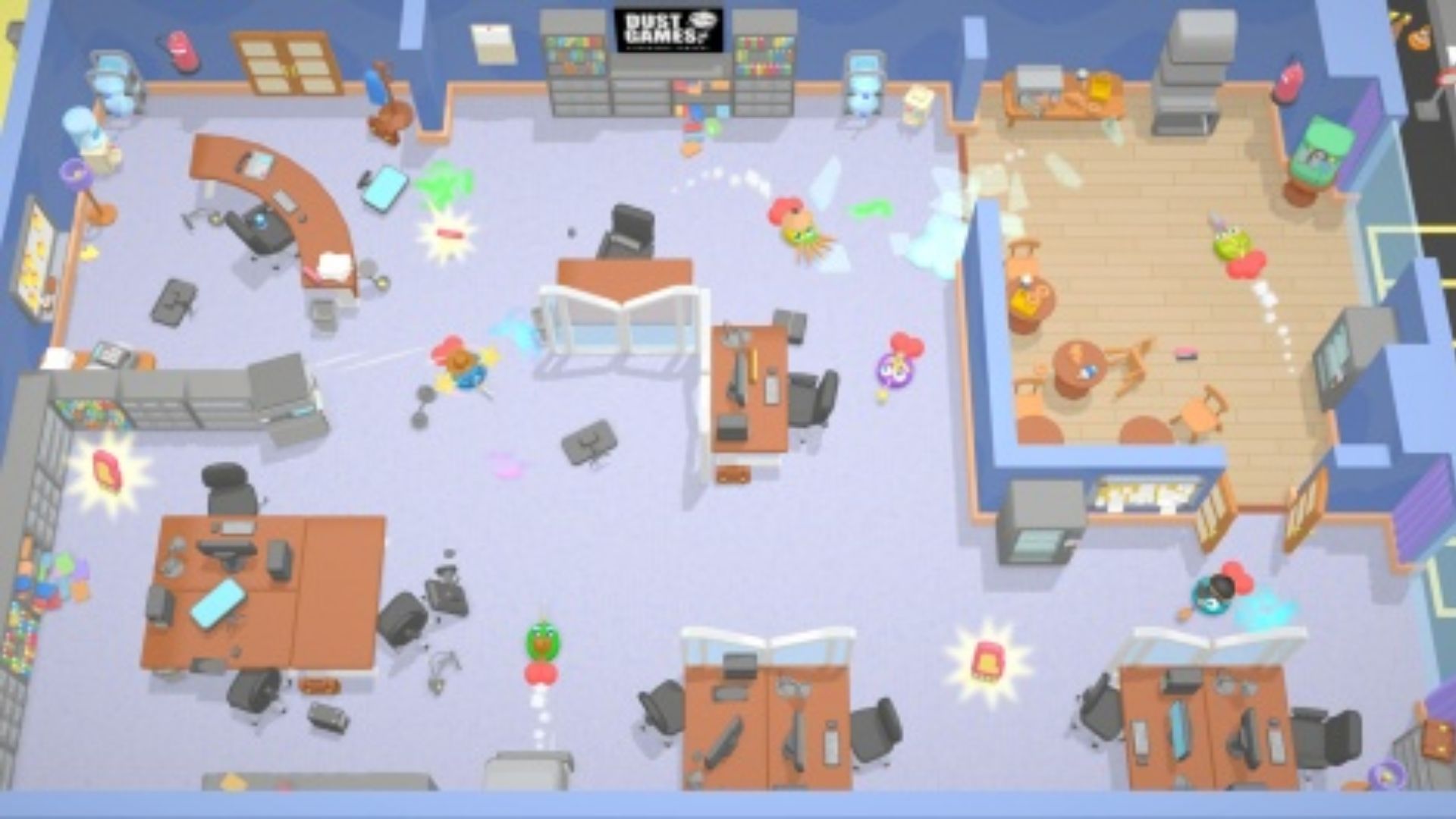
The local multiplayer party game genre has been quietly starving for fresh ideas. Most entries in the space either lean too hard on mini-game collections that feel disposable or try to clone the Fall Guys formula with diminishing returns. Roombattle, which just launched on Steam, does something different. It straps knives onto robot vacuum cleaners and lets six players loose in a living room. And somehow, it works better than it has any right to.
From Indie Pitch Winner to Full Steam Launch
Roombattle isn’t coming out of nowhere. The game earned third place at the Big Indie Pitch during Pocket Gamer Connects Barcelona, which has historically been a reliable signal for party games with genuine multiplayer appeal. That event tends to reward titles that demonstrate instant fun in short demo windows, exactly the quality that defines whether a party game lives or dies.
The concept is straightforward. Each player controls a cute, weaponized home vacuum cleaner. You attach various sharp objects to your Roomba-like device, then battle across offices, houses, and outdoor spaces. The goal is to pop the balloons mounted on the back of your opponents’ vacuums while dodging their attacks in tight, furniture-filled environments. Think Bomberman’s spatial chaos meets the slapstick destruction of Overcooked, but with the physical comedy of watching bladed cleaning robots smash through living room furniture.
Why the Design Actually Works
What separates Roombattle from the flood of party games that show up on Steam every week is its commitment to environmental chaos. The arenas aren’t just backdrops. They’re full of objects to knock over, furniture to destroy, and obstacles that change the flow of each match. Crowded spaces force players into close encounters. Tight hallways create bottlenecks. Open areas turn into sprint-and-dodge arenas. The environment is as much an opponent as the other players.
The customization system reinforces the game’s personality. Players can swap eyes, attachments, and the pointy objects strapped to their vacuums. It’s cosmetic, not strategic, but it adds the kind of visual identity that makes party games memorable. When your vacuum cleaner has googly eyes and a butcher knife taped to its side, the screenshot writes itself.
The mini-game rotation, which includes races, color-matching challenges, and soccer, serves as a pacing tool between combat rounds. It’s a smart structural choice. Pure combat party games tend to burn out quickly in group sessions. The mini-games give players a breather and keep the energy from going stale.
The Couch Co-Op Factor
Roombattle supports up to six players in free-for-all or cooperative modes. That six-player cap is notable. Most couch party games top out at four, which limits their usefulness at larger gatherings. Six players on one screen, all controlling armed vacuums in a cramped kitchen, is the kind of chaos that creates genuine laugh-out-loud moments.
The game has been shown at multiple events during its development cycle, and the consistent feedback from those demos points to something important: it’s equally fun with strangers and friends. That’s a rare quality. Most party games rely on existing social dynamics to generate fun. A game that can make strangers laugh together in a convention hall has a level of mechanical charm that transcends the social context.
| Feature | Details |
|---|---|
| Platform | Steam (PC) |
| Players | Up to 6 (local multiplayer) |
| Modes | Free-for-all, co-op, mini-games |
| Price | Launch price on Steam (demo available) |
| Award | 3rd Place, Big Indie Pitch at PGC Barcelona |
Where Roombattle Fits in 2026
The party game market on Steam is oversaturated. That’s not an opinion. It’s a discovery problem that indie developers have been vocal about for years. Standing out requires either a strong hook, event circuit momentum, or both. Roombattle has both. The Pocket Gamer Connects pedigree gives it credibility with press and curators. The vacuum cleaner premise gives it instant visual identity in a crowded store page scroll.
There’s also a free demo available on Steam, which is a smart move for a game that lives or dies on first impressions. Party games don’t sell on descriptions. They sell on the first five minutes of play. Letting players experience that for free removes the biggest barrier to adoption.
The bigger question for Roombattle is longevity. Party games have a well-documented retention problem. The initial sessions are electric, but without regular content updates, online matchmaking, or community tools, the player base tends to spike and fade. The foundation here is strong. Whether it holds depends on what comes next.
For a genre that’s been coasting on the same formulas for years, a game about weaponized vacuum cleaners fighting in a living room is exactly the kind of absurdity that local multiplayer needs. Sometimes the best party game ideas are the ones that sound ridiculous until you’re actually playing them.
So here’s the real test: can a game built entirely around couch co-op chaos still find a sustainable audience in 2026, or has the shift to online multiplayer made the living room party game a niche that only thrives at launch?
Done With Pay‑to‑Win?
Build a Squad That Actually Matters.
Arknights: Endfield is a real‑time action RPG in the Arknights universe. Explore Talos II, build your base, and lead a four‑operator squad across PC, PS5 and mobile with full cross‑progression.