



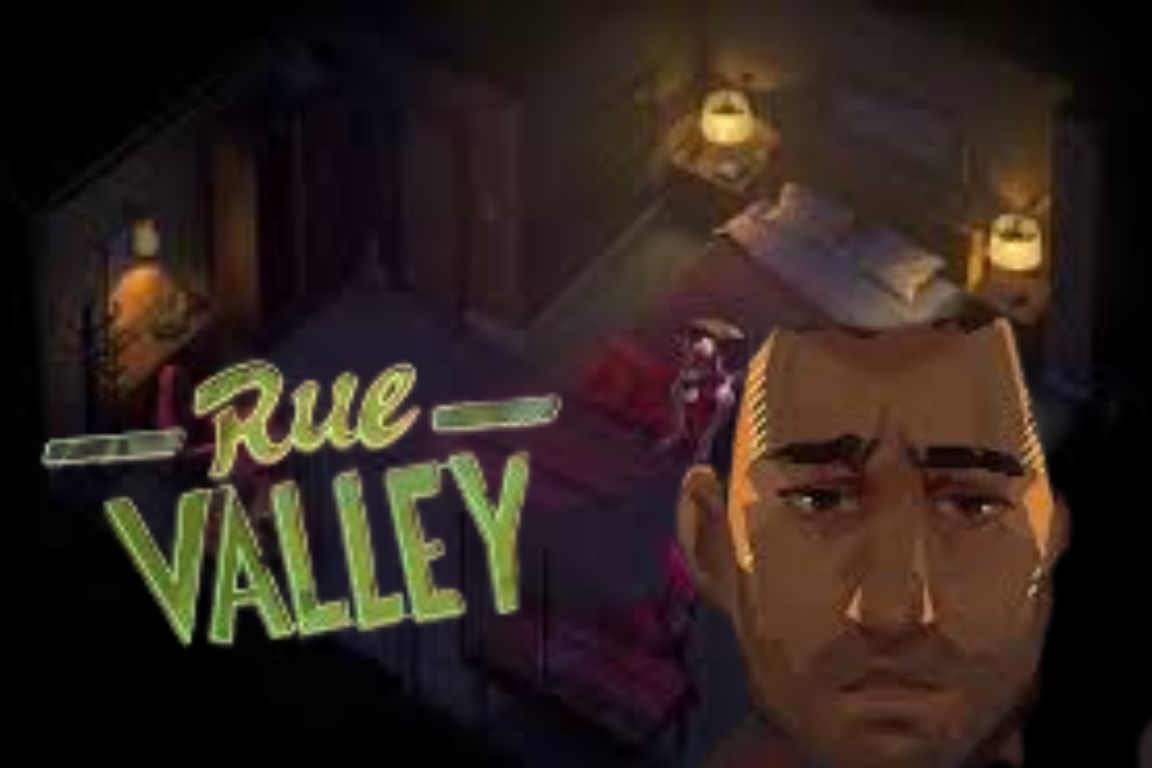
Some games fail because they aim too low, content to rehash familiar formulas without adding meaningful innovation. Rue Valley commits the opposite sin, reaching for profound commentary on depression and mental health while stumbling over its own mechanical foundation. This narrative RPG positions itself as an introspective journey through psychological darkness, wrapped in time loop mechanics that should amplify themes of cyclical despair. Instead, it creates an experience where the gameplay undermines the message, leaving players trapped in monotony that feels accidental rather than intentional.
Developer Emotion Spark clearly studied the Disco Elysium playbook intensely, borrowing its isometric perspective, dialogue-heavy structure, and internalized protagonist approach. The setup holds genuine promise: Eugene Harrow, fresh from a mental breakdown, arrives at a remote motel for involuntary therapy and immediately finds himself caught in a 47-minute time loop. This premise creates natural space for exploring how depression warps perception, how each day feels indistinguishable from the last, and how breaking free from mental patterns requires understanding their roots.
Character building that barely matters
Rue Valley opens with personality sliders asking you to position Eugene between introversion and extroversion, impulsiveness and calculation, sensitivity and indifference. The game promises these choices will meaningfully shape your experience, creating a reactive protagonist whose journey reflects your decisions. This promise evaporates almost immediately.
Eugene’s personality manifests primarily through occasional dialogue interjections when you lean extroverted or grayed-out response options when you choose introversion. Neither approach significantly alters conversation outcomes, quest completion paths, or narrative branches. After several loops, the illusion of choice becomes impossible to ignore. Eugene follows a predetermined trajectory regardless of how you build him, making the entire character creation system feel like window dressing rather than meaningful customization.
This represents a fundamental misunderstanding of why Disco Elysium’s similar systems succeeded. In that game, your skill distribution genuinely opened or closed investigative paths, created unique solutions to problems, and shaped how you experienced the story. Rue Valley mimics the surface-level presentation without implementing the underlying mechanical depth that makes personality-driven gameplay compelling.
Mental health mechanics that lack bite
The game attempts to gamify Eugene’s psychological state through inspiration points and willpower systems. Inspiration activates “intentions” (essentially quests), while willpower functions as renewable inspiration that improves as Eugene’s mental health stabilizes. Conceptually, this creates interesting parallels between game mechanics and depression’s impact on motivation and energy.
In practice, inspiration points scatter liberally throughout the environment, eliminating any meaningful resource management. As long as you possess patience to wander the limited map, you’ll accumulate sufficient inspiration to pursue whatever intentions you want. The system never forces difficult choices about which objectives to prioritize or creates tension around resource scarcity.
More frustratingly, the inspiration requirement creates artificial barriers where Eugene possesses crucial information but cannot act on it until accumulating enough points to activate the related intention. These moments break immersion entirely. Eugene has figured out he’s not trapped in a reality show but needs to gather inspiration before breaking into a car? The mechanical abstraction overwhelms any thematic justification.
Time loops that waste time rather than explore it
Time loop narratives thrive on their central paradox: repetition creates both frustration and opportunity. The best examples use loops to explore causality, consequence, and how small changes compound into major shifts. Rue Valley understands this intellectually but fails implementation.
The 47-minute loop should create urgency and strategic thinking about optimizing each cycle. Instead, excessive travel distances between locations consume massive chunks of each loop, forcing repetitive sequences of waking up, leaving the motel, driving to destinations, and triggering loop resets before accomplishing meaningful objectives. The game occasionally acknowledges this tedium by fast-forwarding through montages of Eugene’s repeated actions, essentially admitting its own gameplay involves too much boring repetition.
If you complete your objectives early in a loop, you’re left killing time on Eugene’s phone until the cycle ends. This might work as deliberate commentary on depression’s empty moments if the game provided any indication you could use that time productively. Instead, it simply feels like padding.
The bland irritation of repetition, which should amplify Eugene’s psychological struggle, becomes irritation directed at the game itself. Rather than experiencing Eugene’s grueling journey alongside him, you’re simply watching a developer stretch limited content across insufficient playtime.
Narrative density without narrative depth
Rue Valley stuffs its background with complex lore about corporate conspiracies, Mars colonization projects, family feuds, and political dynasties. Eugene, as a newcomer with no existing connections to this community, wanders around collecting keywords through conversations and internet searches. This creates an exhausting cycle of dialogue trees leading to more dialogue trees without clear direction or purpose.
The information dump approach might work if Eugene needed to truly understand this history to progress. Instead, you simply follow the single available path forward at any given moment, making all the detailed worldbuilding feel superfluous. Characters explain elaborate backstories that you’ll immediately forget because they never become relevant to Eugene’s actual challenges.
A mysterious loop-resistant figure appears early, generating genuine intrigue until the game explains him, stripping away the mystery without replacing it with compelling answers. Side stories occasionally spark interest before fizzling into forgettable resolutions. The writing demonstrates competence without inspiration, technically functional but emotionally flat.
Missed opportunities for meaningful commentary
Individual moments hint at the game Rue Valley could have been. The opening sequence nails the apathetic disconnection of severe depression, with Eugene stumbling through his first loop afflicted by a “total lack of motivation” status effect. A side quest involving attempting to break the loop through reckless driving ends with appropriately disturbing consequences. When Eugene realizes he must kill someone to progress, the game briefly explores the psychological toll of violence within consequence-free loops.
These fragments demonstrate the developers understood their core themes. The time loop as depression metaphor works conceptually. Surreal elements literalizing mental states offers rich creative possibilities. The 47-minute structure could have created space for layered exploration of isolation, stagnancy, and the incremental work required to escape destructive patterns.
Instead, Rue Valley settles for surface-level engagement with these ideas. It borrows Disco Elysium’s presentation without grasping why that game’s verbose, introspective approach succeeded. It establishes powerful metaphors without developing them into meaningful commentary. It could have been a genuine examination of mental health struggles and recovery.
What we receive instead is a game where very little actually happens and player agency feels largely illusory. The loop becomes an excuse for shallow content rather than a framework for deep exploration. The mental health themes that should drive the experience become decorative elements draped over conventional adventure game structure.
Rue Valley exemplifies a specific kind of indie game disappointment: ambitious ideas compromised by execution that doesn’t match the conceptual vision. The developers clearly possess intelligence and creativity, evidenced by the strong premise and occasional brilliant moments. But intelligence and creativity prove insufficient without the mechanical design expertise to transform concepts into engaging gameplay.
For players seeking narrative experiences that tackle depression and mental health with sophistication, Rue Valley will likely frustrate more than satisfy. The metaphor remains potent in theory while the actual game feels like an endurance test of mundane repetition. Eugene’s total lack of motivation becomes contagious, spreading from protagonist to player as the hours accumulate without meaningful progression or revelation.
The saddest element is recognizing how close this came to working. With tighter pacing, more responsive character systems, and deeper integration between mechanics and themes, Rue Valley could have been genuinely special. Instead, it joins the long list of games that mistook imitation for innovation and confused repetition with profundity.
Have you experienced games that nailed their conceptual ambitions but stumbled on execution, or does Rue Valley’s approach to mental health themes resonate despite its mechanical shortcomings?



me
December 30, 2025Your article helped me a lot, is there any more related content? Thanks!