




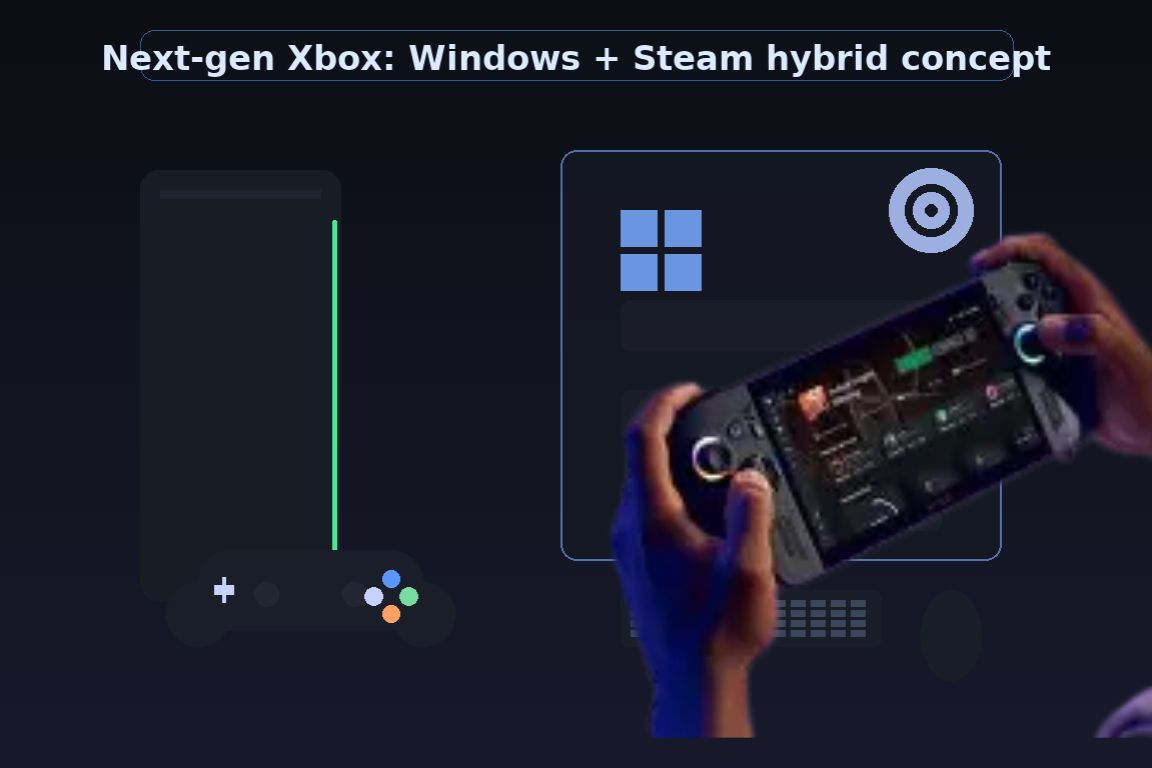
Reports point to Microsoft’s next console behaving like a Windows PC in your living room, complete with a switch to a full Windows mode and native access to Steam and other launchers. If that holds, the box will play PC releases of PlayStation hits like God of War, Spider-Man, and Ghost of Tsushima right beside Halo and Forza. That is not a toe in the water. That is a cannonball.
What this means if you play on PC
- Your Steam library on the sofa
Think of it as a compact gaming PC with an Xbox boot shell. You keep your Steam purchases, mods that do not need external drivers, and a familiar ecosystem. Upside for PC players who want a plug-and-play couch rig without tinkering. - Exclusivity melts faster
If Xbox hardware boots Windows and runs Steam, the platform fight shifts from who has the most exclusives to who delivers the smoothest pipeline, the best services, and the fastest patches. Sony’s PC cadence suddenly matters even more to Xbox owners. - Performance targets get clearer
A Windows baseline inside a console should reduce weird edge cases between Xbox and PC builds. Studios can test one Windows stack for both, which can tighten driver validation, shader precompilation, and anti-cheat parity. - Modding is a wild card
In Windows mode, many single player mods should work. Anything that hooks low level or conflicts with protected environments could still be off limits in the console shell. Expect a split experience: curated in Xbox mode, freer in Windows mode. - Handhelds and mini PCs feel the heat
If Microsoft ships a premium box that sleep resumes like a console yet launches Steam, it aims straight at ROG Ally and mini PC territory. The pitch is simple: console UX when you want it, PC freedom when you need it.
The fine print to watch
- Price signals premium
Microsoft leaders have telegraphed a high end device. That likely means console grade acoustics and industrial design paired with PC-class silicon from AMD. Great for frames, tough on wallets. - Storage math
Dual personas need space. A Windows partition eats dozens of gigabytes. If Microsoft offers quick restore between Xbox and Windows states, users will want 2 TB at minimum to avoid constant housekeeping. - Security and anti-cheat
Toggling between a locked down console shell and open Windows must not become a revolving door for exploits. The experience rises or falls on seamless handoffs that keep multiplayer lobbies safe. - Interface fragmentation
A slick launcher that smartly routes you to the right mode will matter. If players juggle multiple stores, input layers, and overlays, the polish could chip fast.
Big picture
Microsoft is betting that the platform of the future is not a walled garden but a well paved highway. If Xbox becomes the easiest way to run PC libraries on a couch at high refresh with minimal fuss, that is a win for PC gamers who value convenience without surrendering ownership. If the execution stumbles, it risks pleasing no one: too pricey for console loyalists, too constrained for PC tinkerers.
Editor’s take: the move is gutsy and overdue. Consoles have flirted with PCs for years. Calling the shot and shipping a true hybrid could reset expectations across the industry.