


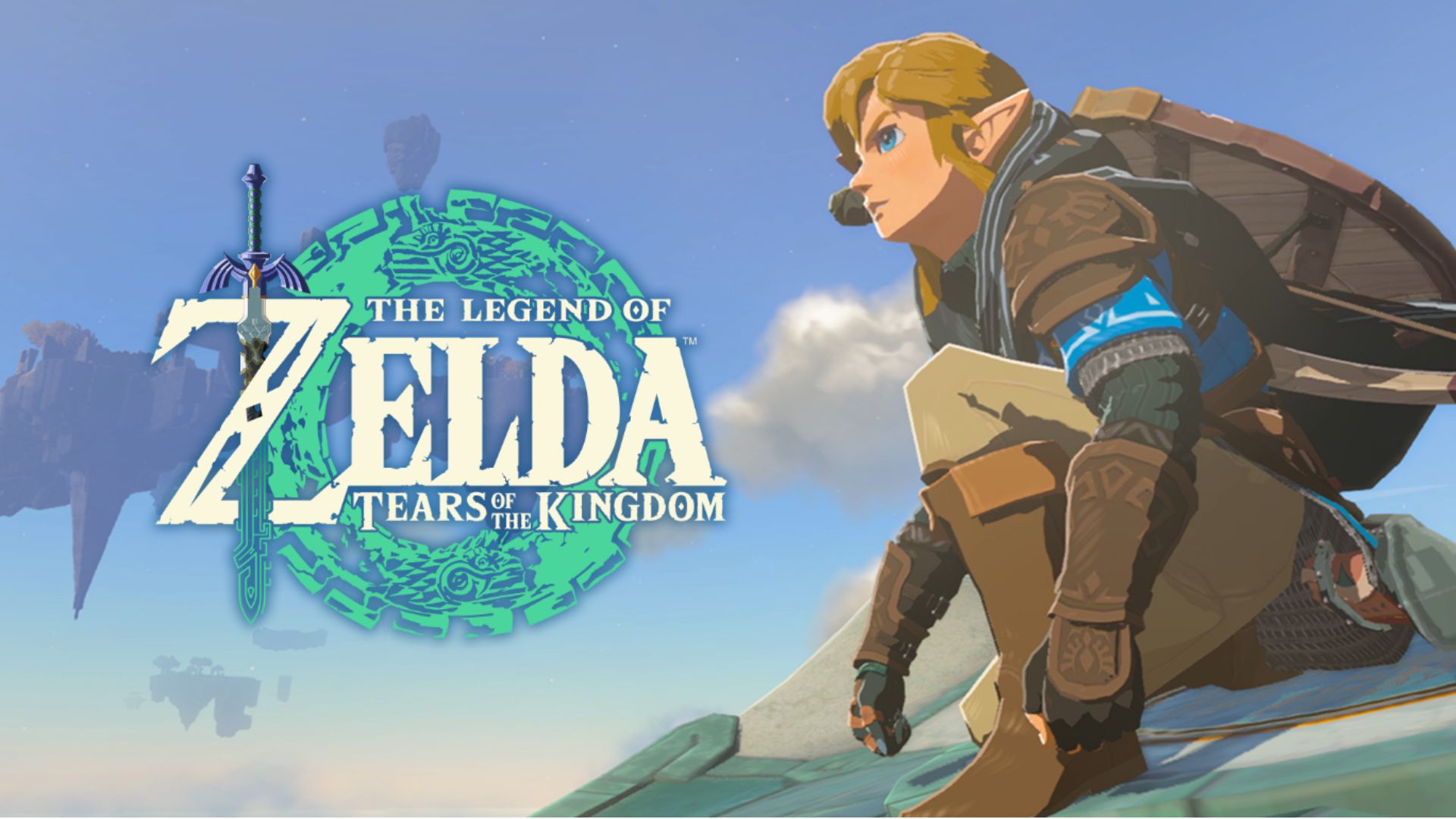
The Legend of Zelda turned 40 yesterday. February 21, 1986: a gold Famicom disk, a green-clad kid, and a world that told you nothing and expected you to figure it out. Four decades later, the series is the undisputed king of high fantasy in gaming. Swords, shields, ancient temples, horse rides through emerald fields. It is the most medieval franchise Nintendo owns.
Except the people who make it keep trying to send Link to space.
On the series’ 40th anniversary, Kotaku resurfaced a thread that runs through Zelda’s entire history, from the very first game to Breath of the Wild. At almost every major inflection point, someone on the development team has pitched a version of Zelda that trades sorcery for science fiction. Every time, Nintendo pulls back. And every time, traces of those rejected ideas end up in the final product anyway. The fantasy won the war, but the sci-fi has been winning small battles for decades.
The Original Zelda Was Supposed to Be About Time Travel
Before the franchise had a single released game, Shigeru Miyamoto was already thinking beyond medieval fantasy. In an interview with the French publication Gamekult, Miyamoto confirmed that the original Legend of Zelda concept revolved around time travel between a medieval world and a futuristic one. The Triforce was not going to be a divine relic left by golden goddesses. It was going to be a set of microchips.
Think about that for a second. The most iconic magical artifact in gaming history was originally a computer component. Link was going to bounce between eras where steel and sorcery collided with advanced technology. The name “A Link to the Past” would have made a lot more sense for a time travel story than for a game about hopping between a light world and a dark one.
Miyamoto eventually pulled the concept back toward pure fantasy, but the instinct was there from day one. The people who created Zelda did not start with a medieval vision. They started with a science fiction one and edited their way into fantasy.
INVASION: The Zelda Game That Almost Had UFOs
The most dramatic example came during the development of Breath of the Wild. At GDC 2017, director Hidemaro Fujibayashi, art director Satoru Takizawa, and technical director Takuhiro Dohta gave a presentation that pulled the curtain back on early concepts for what would become one of the most acclaimed games ever made.
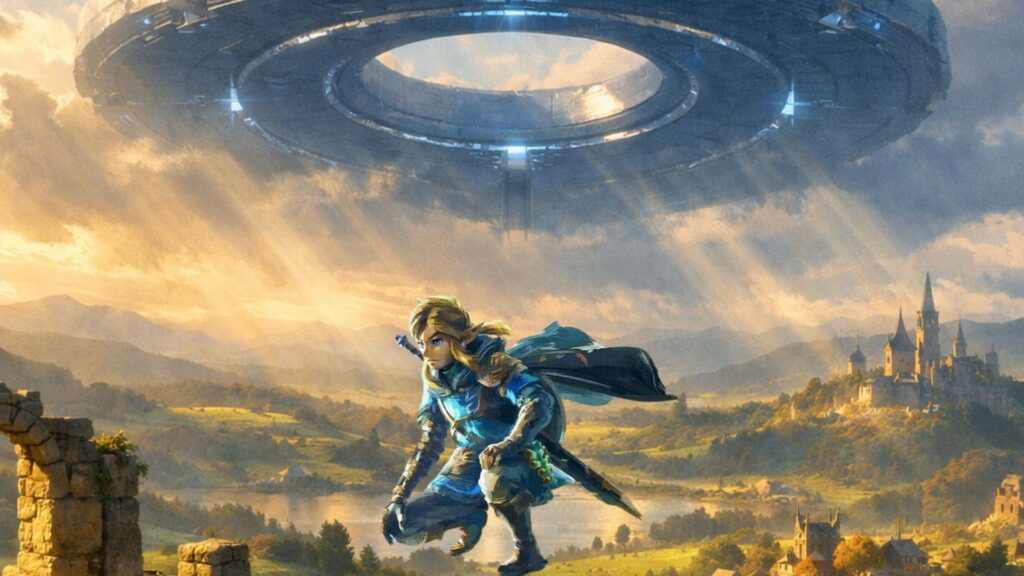
One concept was called The Legend of Zelda: INVASION.
The concept art showed a hooded Link standing in familiar Hyrule grass while a massive circular alien ship descends from the sky, smaller craft breaking off from it as smoke rises on the horizon. Accompanying storyboards depicted an alien autopsy scene. One sketch showed Link in a full spacesuit standing next to a Metroid. Another featured someone who looked suspiciously like Ganondorf wearing a Metallica t-shirt.
Takizawa described it as the point where “things got a bit dodgy.” The GDC audience laughed. The concept was shelved. But here is the thing that makes INVASION more than a funny footnote: its fingerprints are all over the game that actually shipped.
The Sci-Fi Always Leaks Through
Breath of the Wild’s Sheikah technology does not look like anything else in Hyrule. The Guardians are mechanical octopuses with glowing red targeting systems. The shrines are sleek, luminous chambers that feel more like alien architecture than medieval ruins. The Divine Beasts are colossal autonomous machines. And Link’s primary tool for navigating the entire world is, functionally, a smartphone.
Takizawa brought up INVASION specifically while discussing the design of the ancient Sheikah ruins. The connection was not accidental. The alien invasion concept was rejected as a narrative framework, but its aesthetic vocabulary survived and became one of the most distinctive visual elements in modern Zelda. The fantasy world absorbed the sci-fi influence without acknowledging it directly. The technology just became “ancient” instead of “alien.”
This pattern repeats across the series. A Link to the Past had concept art of Link fighting flying cars and a cyberpunk Princess Zelda that surfaced in the 2013 Hyrule Historia book. Skyward Sword featured an entire section built around advanced ancient technology that felt closer to a space station than a dungeon. Tears of the Kingdom’s Zonai devices are essentially modular engineering kits dropped into a sword-and-shield setting.
Every time the developers pull back from full sci-fi, they smuggle pieces of it into the fantasy framework. The result is a series that technically never leaves its genre but constantly stretches what that genre can contain.
Why Nintendo Will Probably Never Pull the Trigger
The Zelda franchise is now far bigger than games. A live-action movie directed by Wes Ball is in production with a target release in 2027. LEGO sets are hitting shelves. Vinyl soundtrack box sets are being pressed. Theme park attractions are in development. The brand has expanded into a multimedia empire, and multimedia empires are conservative by nature.
Nintendo has always been protective of its IP identity. Mario does not suddenly become a horror game. Pokemon does not pivot to hard military strategy. And Zelda, no matter how many UFO sketches its art directors draw during brainstorming sessions, is not going to become a sci-fi franchise. The commercial logic is simple: the fantasy identity is worth billions of dollars in cross-platform licensing, and a genre shift introduces risk that no brand manager would approve.
But the creative tension is real. The people who actually build these games keep reaching for something beyond swords and shields. Miyamoto wanted time travel and microchips. Takizawa’s team drew alien invasions and spacesuits. The Sheikah Slate is a tablet computer in a world of bows and arrows. The impulse to push Zelda toward science fiction is not a one-time curiosity. It is a persistent creative instinct that has surfaced in every era of the franchise’s development.
The Best Version Might Be the One We Already Have
Maybe the smartest thing Nintendo has done is exactly what it keeps doing: reject the full sci-fi pitch but let the ideas seep in around the edges. The tension between Hyrule’s medieval surface and the advanced technology buried beneath it gives the series a texture that pure fantasy lacks. The Guardians are more unsettling because they do not belong. The Sheikah Slate is more interesting because nothing else in the world looks like it. The sci-fi elements work precisely because they are treated as anomalies rather than the norm.
Forty years in, Zelda’s secret is that it has never been purely one thing. The fantasy label is accurate but incomplete. Somewhere underneath every green field and stone temple, there is a rejected pitch about aliens, time machines, or microchip relics quietly shaping the world players actually get to explore.
If Nintendo ever did commit to a full sci-fi Zelda, would it be the creative breakthrough the series needs for its next era, or would it destroy the tension that makes the franchise’s world feel so uniquely layered?
Done With Pay‑to‑Win?
Build a Squad That Actually Matters.
Arknights: Endfield is a real‑time action RPG in the Arknights universe. Explore Talos II, build your base, and lead a four‑operator squad across PC, PS5 and mobile with full cross‑progression.