





Most survival games give you a rock and a prayer and let you figure out the rest. Once Human gives you a rock, a prayer, a talking bird, telekinesis powers, an interdimensional portal, a backpack that warps you between realities, and roughly forty tutorial pop-ups before you even chop your first tree. The onboarding experience is genuinely overwhelming. But underneath all that noise is a game with a surprisingly clean core loop, and the players who understand that loop from the start end up days ahead of everyone else.
This guide cuts through the clutter. Whether you are loading into Once Human for the first time or returning after a few seasons away, these are the decisions and strategies that matter most in your first hours of play.
Picking the Right Scenario
Before you even create a character, Once Human asks you to choose a scenario. This is not a cosmetic decision. Each scenario runs on different rules, different maps, different mechanics, and different durations. Picking the wrong one can leave you frustrated before you ever get to the good stuff.
For new players, two scenarios stand out above the rest.
Way of Winter is a PvE-focused experience with a 22-day cycle. You deal with cold and heat mechanics that force you to think about food, gear, and shelter in ways other scenarios do not. The shorter duration means the world evolves faster. Phases shift quickly, keeping things dynamic. If you like survival games that actually make you survive, this is your pick.
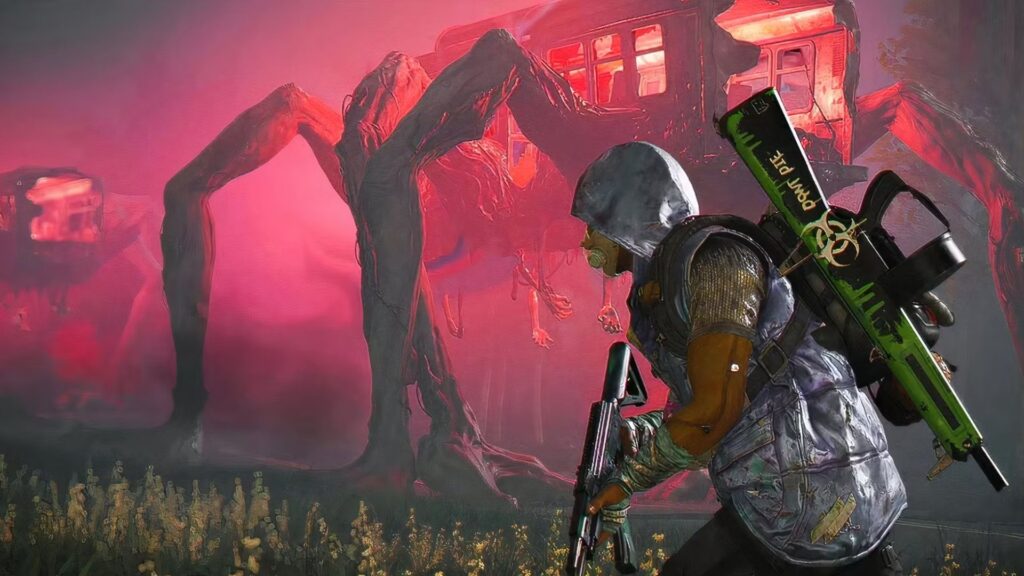
Manabus runs for 40 days and plays more like a traditional Once Human experience. Massive boss encounters, broader progression curves, and a longer timeline that gives you room to breathe. If you want to explore systems without feeling rushed, Manabus is forgiving in the right ways.
Avoid RaidZone unless you specifically want Rust-style PvP from minute one. Evolution Call is clan-based PvP that rewards organized groups. Endless Dream carries a high difficulty tag and is best saved for experienced players. And Deviation: Survive, Capture, Preserve is basically Pokemon inside Once Human, which is a blast but strips out core combat and base building systems that define the rest of the game.
| Scenario | Type | Duration | Best For |
| Way of Winter | PvE | 22 days | Survival-focused players |
| Manabus | PvE | 40 days | New players wanting a full experience |
| RaidZone | PvP | Varies | Aggressive PvP, team play |
| Evolution Call | PvP | Varies | Clan warfare |
| Endless Dream | PvE (Hard) | Varies | Experienced players |
| Deviation: S.C.P. | PvE (Pokemon-style) | Varies | Creature collectors |
Do Not Hit Quick Join
This is the single most important piece of advice in this entire guide. When you select your scenario, do not press the Quick Join button. Instead, manually search for a server that has been live for at least one to two weeks.
Why? Because Once Human uses a commission system. Commissions are weekly tasks that reward massive amounts of XP and Energy Links, both essential for fast progression. A fresh server only has its first week of commissions available. A server that has been running for two weeks gives you immediate access to two full weeks of accumulated tasks. You can complete many of these in minutes and instantly rocket through the early levels.
On a mature server, it is realistic to hit level 25 within your first hour of play just by knocking out stacked commissions. On a fresh server, that same progression takes days. The math is not even close.
Chef Class Is the Move
Once Human offers several class specializations, and they all have their appeal. Beast Master lets you tame creatures and summon three combat pets. Gardener turns your base into a sprawling farm. But for raw efficiency across every scenario and playstyle, Chef is the clear winner.
The key perk is Glutton. It lets you consume more food than normal and stack up to four simultaneous food effects, two from drinks and two from snacks. That sounds modest until you realize how powerful food buffs are in this game.
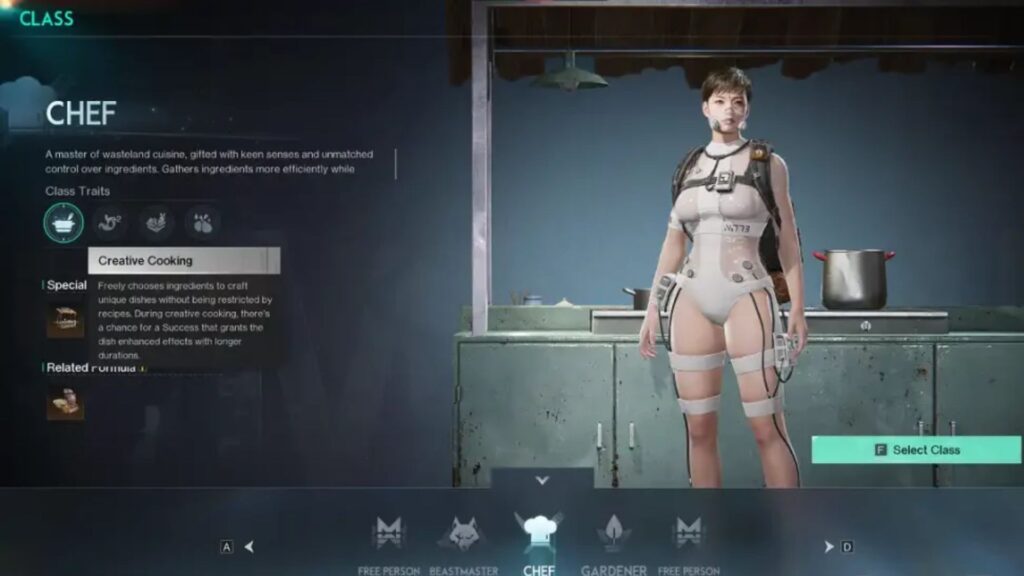
A Salty Roasted Spike Tomato gives you 10% cold resistance. A Cat Steak boosts shrapnel damage. Stardust Ratatouille increases movement speed and cuts stamina consumption. Shellfish Meat raises vulnerability damage. With Chef, you are running four of these at once. Every other class gets two. Over the course of a full scenario, that compounding advantage touches every aspect of your gameplay from combat to exploration to raw survivability.
If you are not sure yet, select Free Person at the start. This lets you try things out before committing. When you are ready, use the conversion item to lock in Chef. You will not regret it.
Commissions First, Combat Second
Your natural instinct when dropping into a new server will be to grab a weapon and start clearing enemies. Fight that instinct. Your first stop should be the commission menu, accessible through V’s interface at your base.
Commissions include tasks like smelting ores, laying foundations, crafting ammo, harvesting plants, taking photos with your camera, and liking other players’ posts at nearby towns. Most of these take seconds to complete. Some do not even require you to leave your base.
The trick is rerolling. If a commission looks time-consuming, refresh it. The pool is large and many of the replacement tasks will be trivially easy. Smelt a few ingots. Place ten foundations and delete them. Craft 200 SMG rounds. Like five player posts at the nearest town. Each completed commission dumps XP and Energy Links into your account.
With two or three weeks of accumulated commissions available on a mature server, you can chain completions back to back and blow through the early levels before you ever set foot in a hostile zone. This is not an exploit. It is how the system is designed. Most players just do not realize how front-loaded the rewards are.
Essential Tech Unlocks in Order
Energy Links fuel your Tech tree, which is the 2026 replacement for the old Memetic system. Techs are no longer tied to your character level, so you can unlock crafting and building capabilities based on what you need rather than waiting for arbitrary level gates.
Prioritize these unlocks in roughly this order:
Furnace and Smelting Essentials come first. You need ingots for almost everything. Primary Supplies Workbench and Primary Gear Workbench open up real equipment crafting. The Stove lets you cook food, which as we covered is one of your strongest tools. Disassembly Bench lets you break down found items into usable materials. Ammunition keeps your guns loaded. Adrenaline Shots give you a self-revive, which saves you a run back from your respawn point during tough fights. And the Vehicle Garage gives you a motorcycle that transforms travel from tedious to enjoyable.
Do not spread your points thin trying to unlock everything at once. Focus on the crafting chain that gets you armed, fed, and mobile as fast as possible.
Your First Weapon Should Be a Crossbow
This might surprise players coming from other shooters, but the crossbow is the strongest early-game weapon in Once Human by a comfortable margin. It hits hard per shot, and the arrows can be retrieved from enemy corpses. That means zero ammo cost after the initial craft. In a game where resources matter and ammo crafting eats into your supply chain, free ammunition is a massive efficiency advantage.

Slot a Power Surge mod onto the crossbow as soon as you can. The damage increase is immediately noticeable, and it scales well into mid-game content. You can comfortably take down enemies ten levels above you with a modded crossbow and decent positioning.
For a deeper look at how weapons and builds scale into the late game, check out our Once Human best weapons and builds guide for full loadout recommendations across scenarios.
Craft Armor With the Right Materials
The 2026 crafting changes mean the materials you use during gear creation directly affect the stats on the finished item. This is easy to overlook because the game auto-selects default resources, but swapping in specific materials can dramatically change your armor’s performance.
Animal hides are the big variable. Cow hides from bison increase maximum carry capacity by 20. Legendary variants of the same hide can add 74 HP, plus 5 sanity, plus 15 cold and frost resistance, and hypothermia immunity when your HP drops below 30%. In Way of Winter, that legendary cow hide chest piece is not a luxury. It is close to a requirement for comfortable exploration in the later phases.
Hunt specific animals. Check the stats before you craft. And always look for legendary hide drops, because the gap between a common and legendary material is enormous.
Returning Players: Inherit These Three Items
If you are coming from a previous scenario, the inheritance system lets you bring a limited number of items into your new server. Do not waste slots on weapons or armor that you will replace within hours. Instead, bring tools that eliminate early-game friction entirely.
The Advanced Electric Rock Drill mines any ore type in seconds, including tungsten, gold, and silver that you normally cannot touch with early tools. The Advanced Logging Chainsaw clears trees almost instantly and doubles as a decent melee weapon. And the Festering Gel deviation is a portable healing station that you can throw on the ground at your base or mid-combat. Prioritize high activity rating on the gel so you can deploy it more frequently.
These three items together remove roughly 80% of the early-game resource grind. You spend less time punching rocks and more time completing commissions, unlocking Techs, and pushing into higher-level zones.
Specialization Notes and Cradle Overrides
Every five levels, you unlock a Specialization Note that lets you roll for a random passive bonus. These rolls are genuinely random, so reroll until you get something that fits your playstyle. Furnace Specification Refining is a strong early pick because it reduces ore processing cost and time, which accelerates your entire crafting pipeline.
Cradle Overrides unlock as you hit level milestones and complete bosses. These are powerful passive combat buffs. Tactical Combo gives you 15% weapon damage for 4 seconds after switching weapons or reloading, which synergizes perfectly with the crossbow since you reload after every shot. Elemental Sense boosts status damage. Deviant Energy Defense gives you a shield every time you deploy your deviation.
Do not sleep on these systems. They are easy to forget in the menu clutter, but they provide real power increases that compound over the course of a scenario.
The Bigger Picture

Once Human front-loads complexity in a way that scares off players who would otherwise love the game. The first hour is chaotic. The menus are dense. The tutorial tries to explain everything at once and ends up explaining nothing well. But once you understand the rhythm of commissions into Techs into gear crafting into world exploration, the whole thing clicks into place.
The game rewards preparation over brute force. Players who pick the right server, choose Chef, and prioritize commissions will be geared and ready for mid-game content while everyone else is still figuring out how to smelt copper. That head start is not about skipping content. It is about spending your time on the parts of Once Human that are actually fun rather than grinding through a slow early game that the systems are designed to let you bypass.
Start smart. Gear fast. And then go explore, because the world is where this game really shines. If you have not already, take a look at our complete guide to Once Human for the full picture of what 2026 has to offer.
With so many scenario types, class options, and seasonal twists available right now, how do you think Starry Studio should handle onboarding for the wave of console players about to experience all of this for the first time?