




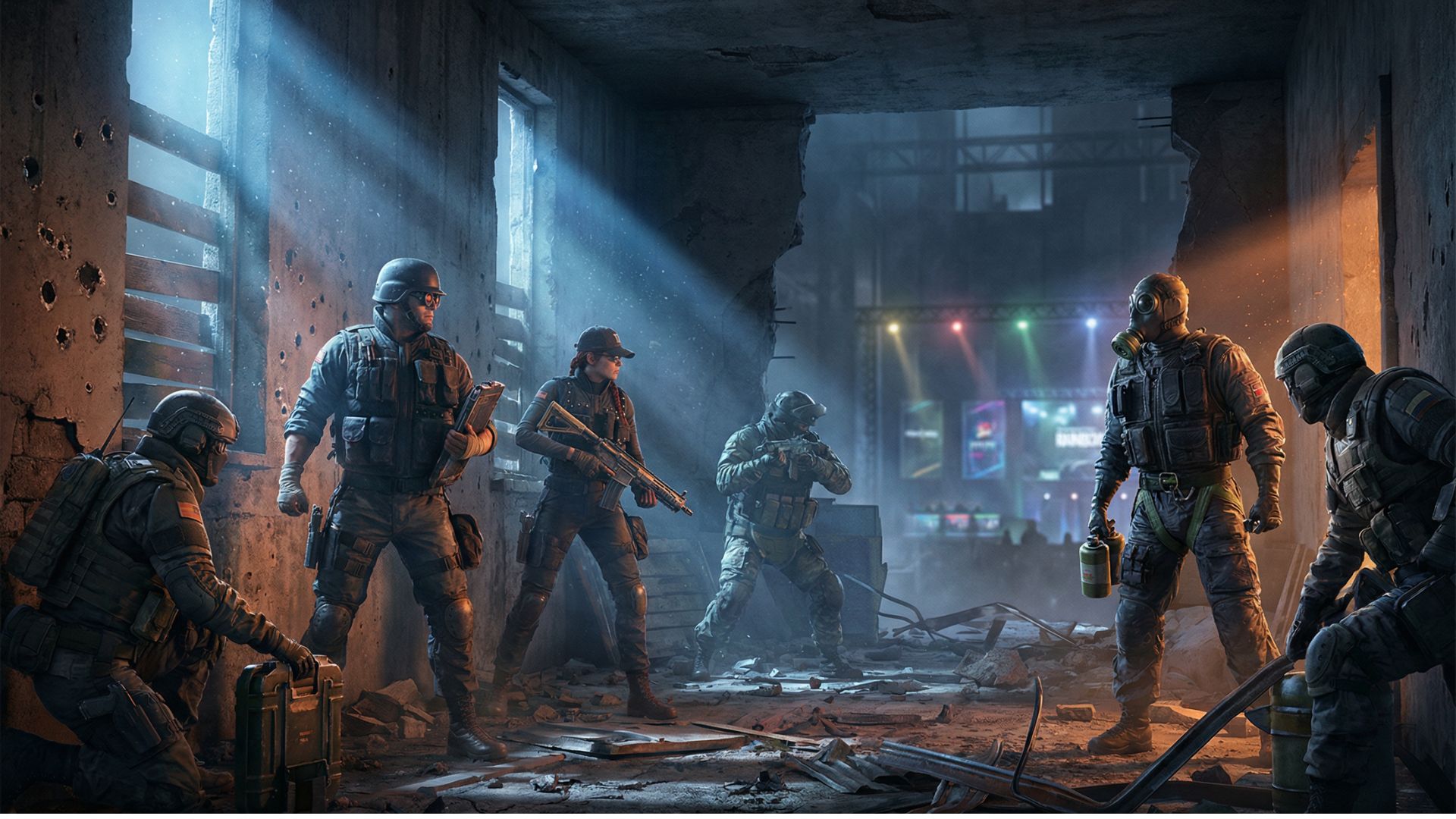
Ten years is a lifetime in the gaming industry. Trends rise and fall, player bases scatter to the next big thing, and even the most successful titles eventually get sunset or replaced by sequels. Rainbow Six Siege has defied every expectation. The tactical shooter that launched in 2015 with no campaign and skeptical fans has become one of the longest-running success stories in competitive gaming.
GameSpot recently visited Ubisoft Montreal to uncover the secrets behind this remarkable longevity. What they found was a studio deeply connected to its community, willing to take bold risks, and obsessed with building systems that evolve rather than expire. The lessons here apply far beyond Siege itself.
The gamble that started everything
Rainbow Six Siege arrived at an awkward moment. The franchise was known for memorable co-op campaigns, but Ubisoft had pivoted toward a multiplayer-only experience that longtime fans did not recognize. The decision to abandon the campaign-focused Rainbow 6 Patriots felt like betrayal to many.
“Not only were players just really accustomed to those amazing co-op campaigns, but we as devs were too,” one developer admitted during the visit. “It was a huge risk that really paid off.”
That risk meant building something entirely new while knowing the audience might reject it. The team bet everything on tactical depth, destructible environments, and operator-based gameplay that rewarded strategy over reflexes. A decade later, those pillars still define what makes Siege special.
Operation Health changed the trajectory
Every live-service game faces a reckoning point. Early Siege struggled to maintain regular content drops while addressing mounting technical problems. The original team was drowning, and something had to give.
Ubisoft Montreal made a controversial call. They delayed an entire season of content to focus exclusively on fixing the game’s foundation. Operation Health was born, and the community initially hated it.
“It was kind of a mea culpa of we know we need to fix things in the game so we need to take the time to do it,” a developer explained. “Looking back now it’s seen as a huge positive whereas that wasn’t the truth during the time.”
The legacy of that decision persists today. Every season now includes dedicated production time specifically for game health. Matchmaking systems overhauled during Operation Health eventually enabled crossplay years later. The lesson was clear: sometimes you need to stop running forward and fix what is broken behind you.
Designing operators that matter
New operators drive Siege’s evolution. Each addition changes how every other character interacts with the battlefield, creating cascading effects that keep the meta fresh. But creating an operator takes enormous effort, and the team approaches it methodically.
“Sometimes there’s like that spark where the team’s like, we have this idea,” one designer shared. “We actually have what we call the fridge of ideas where it can come from anywhere. If it’s that good, we’ll put it in the fridge, see if we can bring it out and make it work.”
Most operators start with a gameplay objective rather than a character concept. The team identifies something missing or needed, then builds a personality around that function. Azami emerged from asking what happens if destruction could be reversed. Thermite answered how to breach reinforced walls. Each operator solves a design puzzle while adding new puzzles for players to solve.
Maps as living mathematics
Siege maps function differently than most shooter environments. They are puzzles designed around navigation and flow, not just aesthetic themes. The team starts with real-world references, studying hundreds of banks or consulates or stadiums before designing their own interpretations.
“A Siege map is mathematics,” explained one level designer. “It’s navigation and flow, and it’s a lot of mathematics, a lot of angles.”
The introduction of new operators constantly reshapes how maps play. Azami specifically was mentioned as a recurring headache for level design, capable of blocking angles and creating exploits that require constant retrofitting. Nothing remains static. Even the most iconic map, House, eventually needed surgical revision.
“It was stressful,” admitted the designer who worked on that rework. “Touching anything that’s that OG Siege, the community is very passionate. Some people are going to love it, some people are going to hate it. You take the rough with the smooth.”
Esports as a living laboratory
Unlike most developers who treat competitive scenes as marketing afterthoughts, Ubisoft Montreal works directly alongside professional players. The relationship is symbiotic. Pros push the game to its limits, revealing balance issues and emergent strategies that eventually trickle down to ranked play.
“When the pros are out there on the stage and they’re running, I’m taking notes,” one developer said. “Because if they do something completely new or wild, that’s hitting ranked in six months.”
The Six Invitational has become more than a tournament. It functions as Siege’s annual heartbeat, drawing thousands of live attendees and hundreds of thousands of online viewers. Major reveals drop during these events, tying the competitive scene directly to the game’s roadmap.
One developer recalled attending their first Invitational when Deimos shot Harry in a cinematic reveal. The entire stadium fell silent. “Everybody just held their breath collectively. It’s that moment to me that popped.”
Why Siege 2 will never happen
After ten years, most franchises would chase a sequel. Fresh engine, reset progression, generate new hype. Ubisoft Montreal has explicitly rejected that path.
“There’s tons of reasons against it,” one developer stated plainly. “We see it where players kind of get the rug pulled out from under them and everything they’ve worked towards changes in an instant when they jump over to a sequel. That’s something we don’t want to do to our players.”
Instead of Siege 2, the team released Siege X, a massive update designed to prepare the game for another decade. New onboarding systems welcome fresh players while preserving the hardcore identity that veterans love. The foundation gets stronger rather than replaced.
The secret ingredient
When asked what truly separates Siege from games that failed despite similar formulas, one developer offered an unexpected answer. He referenced the Disney movie Moana.
“She goes, I am Moana. She knows who she is. She knows where she came from. That has always been the most important thing when we talk about Siege. We don’t need to look in other people’s backyards because we have our own legacy to look at.”
Siege knows its identity. It embraces being a hardcore tactical shooter with punishing mechanics and steep learning curves. It never chases trends that would dilute what makes it special. That clarity of vision, combined with a team willing to admit mistakes and a community passionate enough to stick around through rough patches, explains the decade of survival.
The team recently completed listening sessions with every member of the development staff. Everyone pitched ideas for the next ten years. The catalog of possibilities is enormous. Running out of steam is not a concern.
Rainbow Six Siege is not just surviving. It is still evolving.