




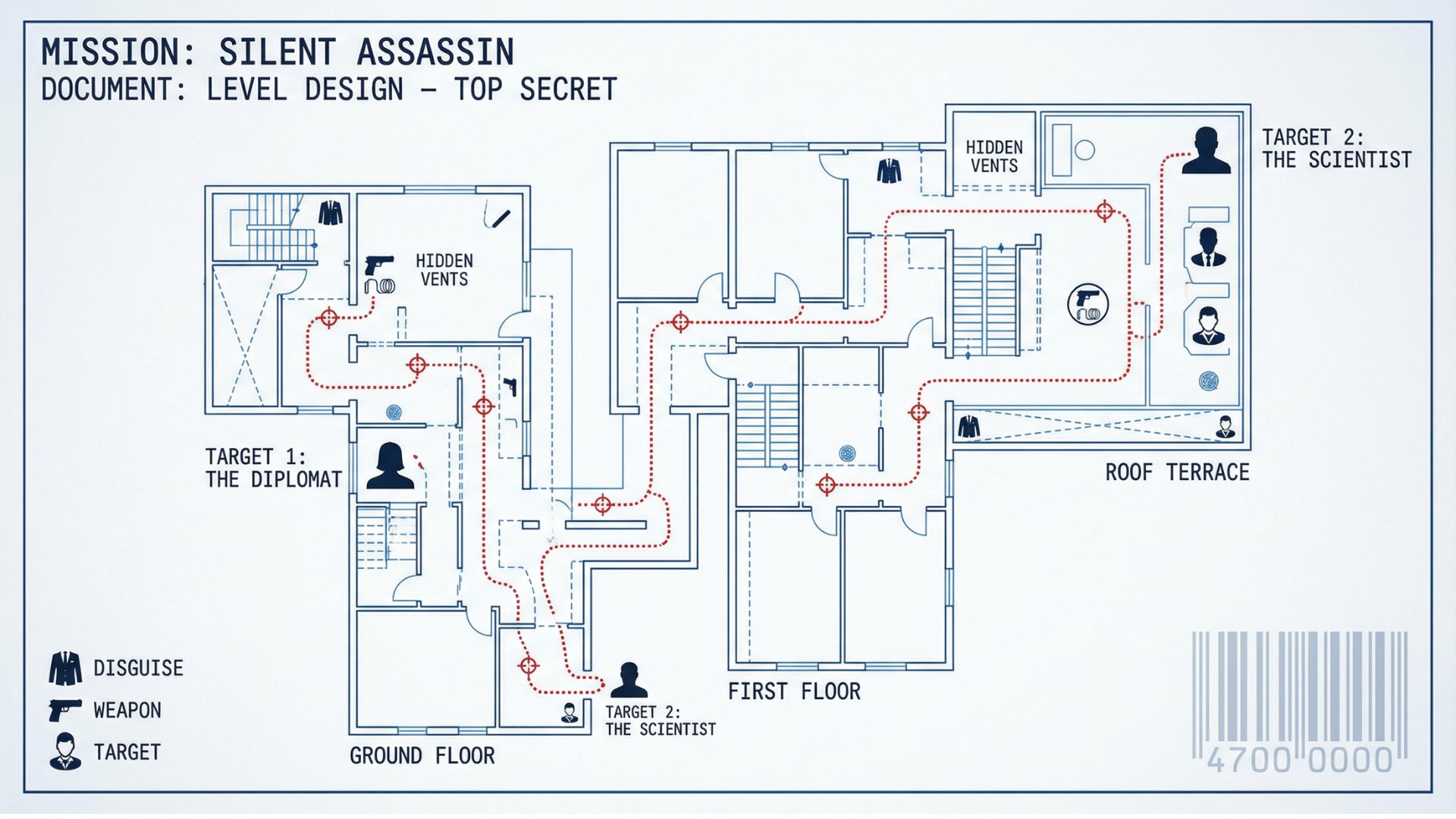
The Hitman franchise lives and dies by its locations. Agent 47 himself remains stoic and unchanging across decades of assassination, but the sandboxes surrounding him determine whether a mission becomes forgettable or legendary. IO Interactive has refined its approach to level design across three World of Assassination games, creating intricate murder playgrounds that reward creativity and punish impatience.
Understanding how these maps actually work reveals why some locations resonate for years while others fade from memory. It also suggests where the series could go next, assuming IO returns to 47 after Project 007 wraps development.
The anatomy of a perfect Hitman sandbox
Every Hitman location begins with a fundamental question: how many ways can a player eliminate targets without repeating themselves? The answer needs to reach double digits before IO considers a map successful. This philosophy shapes everything from architectural layout to NPC routines to item placement.
Paris, the opening mission of Hitman 2016, demonstrates the formula at its purest. The Palais de Walewska offers vertical layers from basement to attic. Multiple target loops create windows of opportunity throughout the mansion. Disguise hierarchies range from catering staff to auction security to celebrity guests. Environmental kills include chandeliers, pyrotechnics, and pushed bodies. Every system interlocks to create emergent possibilities the designers never explicitly scripted.
“We build levels where we know maybe 70% of what players will do,” a former IO developer once explained in a conference talk. “The other 30% surprises us completely, and that’s when we know the sandbox is working.”
Contrast Paris with weaker entries like Colorado from the same game. The militarized compound lacks social stealth opportunities, funneling players toward combat or specific scripted routes. Fewer disguise tiers mean less flexibility. The open terrain offers visibility without corresponding gameplay variety. Fans consistently rank it among the weakest maps precisely because the sandbox restricts rather than enables creativity.
Location density versus location size
Bigger maps do not automatically equal better experiences. Hitman 3’s Chongqing sprawls across neon-lit streets and underground facilities, offering impressive scale but occasionally feeling empty between points of interest. Meanwhile, the compact Mendoza vineyard packs comparable depth into a tighter footprint where every area serves multiple purposes.
IO has learned that density matters more than raw square footage. The best locations feel simultaneously large enough to explore and intimate enough that players learn their rhythms through repetition. Sapienza achieves this balance perfectly, combining a coastal town, mansion interior, underground lab, and church into a cohesive whole where shortcuts emerge naturally through play.
This density also serves replayability. Players return to maps dozens of times pursuing different challenges, unlockables, and self-imposed restrictions. A bloated map with dead zones discourages repetition. A dense map with overlapping systems reveals new possibilities on every run.
Social environments create gameplay opportunities
The most beloved Hitman locations share a common thread: they simulate functioning social spaces. A fashion show has models, photographers, crew, security, and guests all following believable routines. A hospital has patients, doctors, administrators, and visitors occupying distinct areas with logical access restrictions. These social hierarchies become gameplay systems.
Disguises only matter when different outfits grant different access. Blending only works when crowds exist to blend into. Opportunities only emerge when NPCs interact with environments in predictable patterns that players can exploit. Strip away the social simulation and Hitman becomes a generic stealth game about avoiding sight lines.
This insight suggests where future locations should focus. Rich social environments with clear hierarchies and numerous distinct roles offer more gameplay potential than isolated compounds or empty facilities. The question becomes which real-world settings provide that richness while remaining unexplored by the series.
Dream locations that could push the formula forward
Several environments seem tailor-made for Hitman’s sandbox design but have never appeared in the franchise.
A major film studio during production offers incredible potential. Sound stages, backlots, production offices, star trailers, and catering areas create distinct zones with different access levels. Directors, actors, extras, crew, security, and studio executives form clear social hierarchies. Costumes literally define who belongs where. The setting even justifies unusual items and staged violence as props and effects.
A luxury cruise ship mid-voyage solves a design challenge IO has never fully tackled: true isolation. Targets cannot escape, but neither can 47. Every passenger and crew member becomes a potential witness across days at sea. The contained environment forces creativity while varied deck levels, dining halls, engine rooms, and cabin classes provide spatial diversity.
An international airport during holiday travel chaos offers density and social complexity at scale. Passengers, airline staff, TSA officers, retail workers, pilots, and maintenance crews occupy clearly defined spaces with varying access. Security checkpoints create natural chokepoints. Departure gates, lounges, baggage areas, and control towers provide vertical and horizontal variety.
A tech company campus during a major product launch combines corporate espionage themes with Hitman’s existing satirical edge. Keynote auditoriums, server farms, executive suites, cafeterias, and prototype labs create distinct zones. Engineers, marketers, executives, media, and security form social layers. The setting allows commentary on industry culture while providing sandbox density.
What makes locations memorable years later
The maps players remember share qualities beyond mechanical excellence. They transport you somewhere genuinely interesting. Sapienza feels like an Italian vacation interrupted by murder. Miami captures the excess of motorsport culture. Dubai opens with such visual spectacle that players pause just to absorb the view.
Atmosphere and mechanics must align for locations to achieve lasting impact. A technically perfect sandbox set somewhere boring fails to inspire. A gorgeous environment with shallow gameplay frustrates rather than satisfies. IO’s best work nails both simultaneously, creating places players want to inhabit even when they have already exhausted the mission stories.
Future Hitman locations need this dual focus. Mechanical depth enables replayability. Atmospheric richness creates emotional connection. Together they produce sandboxes that define the stealth genre and keep players returning years after release.
The World of Assassination trilogy concluded 47’s current arc, but the character will almost certainly return. When he does, the locations IO chooses will determine whether the next chapter matches or exceeds the high points of recent games. The foundation of sandbox design is well established. Now the question becomes where that foundation takes us next.