




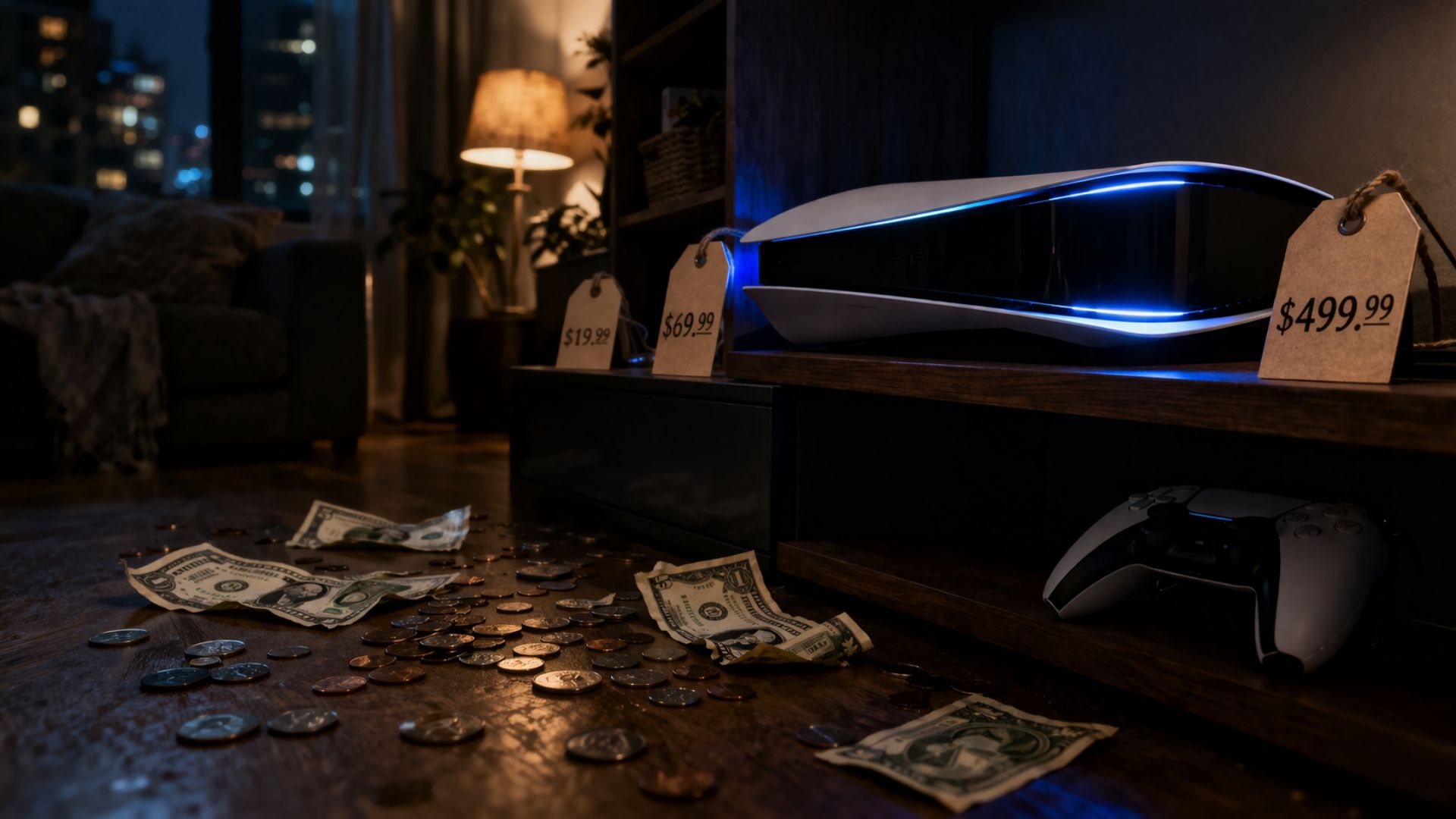
The PS5 Pro just hit $900. Let that settle for a moment. A console that launched two years ago now costs nearly four figures. Sony made it official last week, pushing the entire PS5 lineup up by $100, with the Pro taking a $150 hit effective April 2, 2026. Meanwhile, analysts are openly discussing a $1,000 PlayStation 6. Xbox Project Helix is expected to land even higher. Nintendo may not be far behind. And somewhere in the middle of all this, a new generation of gamers is quietly deciding it might not bother.
This is not just a pricing story. It is a story about who gaming is for.
A Perfect Storm Nobody Planned
To understand why everything is getting so expensive so fast, you have to look beyond the gaming industry itself. Sony blames the PS5 price hike on a global memory chip shortage caused by the massive industry pivot toward AI. Outlook Respawn AI data centers are consuming RAM at a pace the market simply cannot keep up with, and consumer electronics, including game consoles, are paying the price. The memory crisis is not expected to clear up for a long time.
The ripple effects are everywhere. Valve has already delayed its next-gen Steam Machine. Video game market research company Niko Partners warned that the Switch 2 is likely to face an inflated price tag, noting that Nintendo is set to follow Sony and Microsoft’s footsteps with its own price hike driven by tariffs, increased memory costs, and broader macroeconomic conditions. UNILAD Tech Even game prices are shifting. Nintendo announced that beginning in May 2026, new first-party digital Switch 2 exclusives will have a different MSRP from physical versions, with Mario Kart World already sitting at $79.99 at launch.
So we have a situation where every layer of the gaming stack is simultaneously getting more expensive. Hardware up. Games up. Accessories up. And it is all happening at once.
The Numbers Nobody Wants to Say Out Loud
Let us look at where this is heading with some honesty.
| Hardware | Current Price (US) | Analyst Projection (Next Gen) |
|---|---|---|
| PS5 Disc Edition | $649 | PS6: $999+ |
| PS5 Pro | $899 | PS6 Pro: $1,200+ |
| Xbox Series X 2TB | $800 | Project Helix: $1,000+ |
| Nintendo Switch 2 | $449 | Price hike expected by end of 2026 |
Dr. Serkan Toto of consultancy firm Kantan Games told GamesRadar+ that he “would be very surprised if the Switch was still $450 in the US at the end of 2026.” And on the next generation, NYU video games professor Joost van Dreunen argued that the games industry is moving toward a reality where a $1,000 console becomes the expected standard, and that console gaming is on course to become a luxury expenditure rather than the affordable entertainment option it has always been.
That last sentence deserves a moment. Luxury expenditure. Not an entertainment hobby. Not something a working parent picks up on a holiday deal. A luxury item. Like a watch or a weekend trip.
The Casual Player Was Always the Foundation
Here is the thing most industry coverage misses: hardcore gamers do not actually drive the market. They never did. The person who buys five games a year and follows every release is a passionate minority. The real engine of gaming growth over the past two decades was the casual buyer. The person who grabbed a PlayStation 4 because Uncharted looked cool in a commercial. The parent who bought a Nintendo Switch because their kid begged for it. The twentysomething who picked up a used Xbox because game nights with friends seemed fun.
Those people built this industry. And those people are the most exposed to what is happening right now.
Think about what it actually costs to enter gaming in 2026 if you are starting fresh. A base PS5 at $649. A second controller at $79. A decent 4K television at $400 minimum. One AAA game at $70, heading toward $80 or $100. You are at roughly $1,200 before you have even sat down to play. That is not a gaming purchase. That is a major financial decision. For a huge portion of the global middle class, it is simply off the table.
The Entry Point Has Disappeared
There is a concept that used to quietly underpin gaming’s growth: the accessible entry point. The Xbox 360 Arcade edition. The smaller-hard-drive PS4. The Nintendo Switch Lite. These were not premium products. They were doors. Imperfect, sometimes frustrating products that said: “You can participate in this hobby too, even if you cannot afford the full thing.”
That philosophy is eroding fast. The Switch Lite at $199 was one of the last great examples of it. Nothing on the current market offers a comparable gateway. The current generation of consoles has almost no budget-friendly variant, and the next generation promises to start even higher.
Furthermore, the industry has quietly stopped making space for casual engagement in its pricing strategy. Nintendo’s first-party games launched at $79.99 for Mario Kart World, with retailers free to set their own prices above that. Across the board, the $60 game is a memory. The $80 game is becoming normalized. The $100 game may arrive with GTA 6, possibly as soon as 2027.
GTA 6, AAA Budgets, and the Math That Does Not Work
Rockstar’s upcoming blockbuster is the one title everyone keeps pointing to as a potential flashpoint. The game is widely expected to be the most expensive production in entertainment history, possibly exceeding $2 billion in development and marketing costs. To break even, it would need to sell somewhere around 60 to 70 million copies. The entire installed base of PS5 and Xbox Series X combined is estimated at roughly 70 to 80 million units worldwide, many of which belong to existing fans who already own the game on older platforms.
The math is brutal. And GTA 6 is the anomaly that can actually survive it. Most games cannot.
This is why studio closures and layoffs have become the defining story of this generation. The cost of making AAA games has exploded while the addressable audience has failed to grow at the same pace. The result is a market where even commercially successful games miss internal targets, and entire studios disappear in the aftermath. That pattern will only get worse as hardware prices shrink the pool of potential players.
Mobile Is Not the Answer, But It Will Try to Be
Inevitably, when this conversation happens, someone points to mobile as the safety valve. The thinking goes: if consoles get too expensive, people will just play on their phones. And the platforms will chase them there.
This is partially true and mostly depressing. Mobile gaming is already the largest segment of the market by revenue, driven by free-to-play monetization that is, in most cases, predatory and designed around compulsive behavior rather than quality experiences. Migrating the mass-market gamer to mobile does not save the industry. It just shifts the exploitation.
Additionally, the idea that mobile represents a cheap alternative is increasingly misleading. Premium smartphones cost $1,000 or more. The devices people use to play are not cheap. The costs have simply been bundled into a different category of spending that feels normal because everyone already has a phone.
Is There a Way Out?
Realistically, there are a few paths forward, and none of them are guaranteed.
First, the memory crisis could resolve faster than analysts expect. If RAM prices stabilize by late 2027, next-gen hardware costs could be more manageable than current projections suggest. That is a hopeful outcome, but not a certain one.
Second, subscription models could absorb some of the hardware pain. Game Pass and PlayStation Plus already offer a way to access large libraries without buying individual titles at full price. If those services expand meaningfully and the value proposition holds, they could become the primary way casual players engage with gaming.
Third, mid-range devices like the Steam Deck and its successors represent a genuine alternative to the console market. A $300 to $400 device that runs the majority of modern games, even at reduced settings, is arguably a better deal than a $650 console with a limited library. Valve’s positioning here may prove more important in the next few years than most people currently realize.
None of these paths are as satisfying as simply having affordable consoles. But the industry rarely prioritizes satisfaction over margin.
The Generation That Lost Its Casual Core
The PlayStation 4 and Nintendo Switch era looks, in retrospect, like peak gaming. Not in terms of graphical power or technical achievement, but in terms of reach. More people were playing games than ever before. The hobby was expanding into demographics that had never taken it seriously. It felt like gaming was finally becoming a universal form of entertainment, the way film and music had become.
That expansion has stalled. The current generation has a smaller active user base than the previous one. Record numbers of studios have closed. Games are taking longer to make, costing more to buy, and reaching fewer people than the games they replace. The trajectory is moving in the wrong direction.
Pricing is not the only cause. Cultural fragmentation, streaming competition, social media, and the endless pull of free-to-play games all play a role. But price is the variable that affects the widest group of people. It is the first filter. And right now, that filter is becoming a wall.
Gaming built its cultural relevance on the idea that almost anyone could participate. The question hanging over the next five years is whether the industry remembers that, or whether it continues pricing as if only a shrinking group of devoted fans will always be there to absorb whatever it charges.
Will the next generation of consoles mark the moment gaming became a hobby for the few, or will the industry find a way to keep the door open for everyone else?