




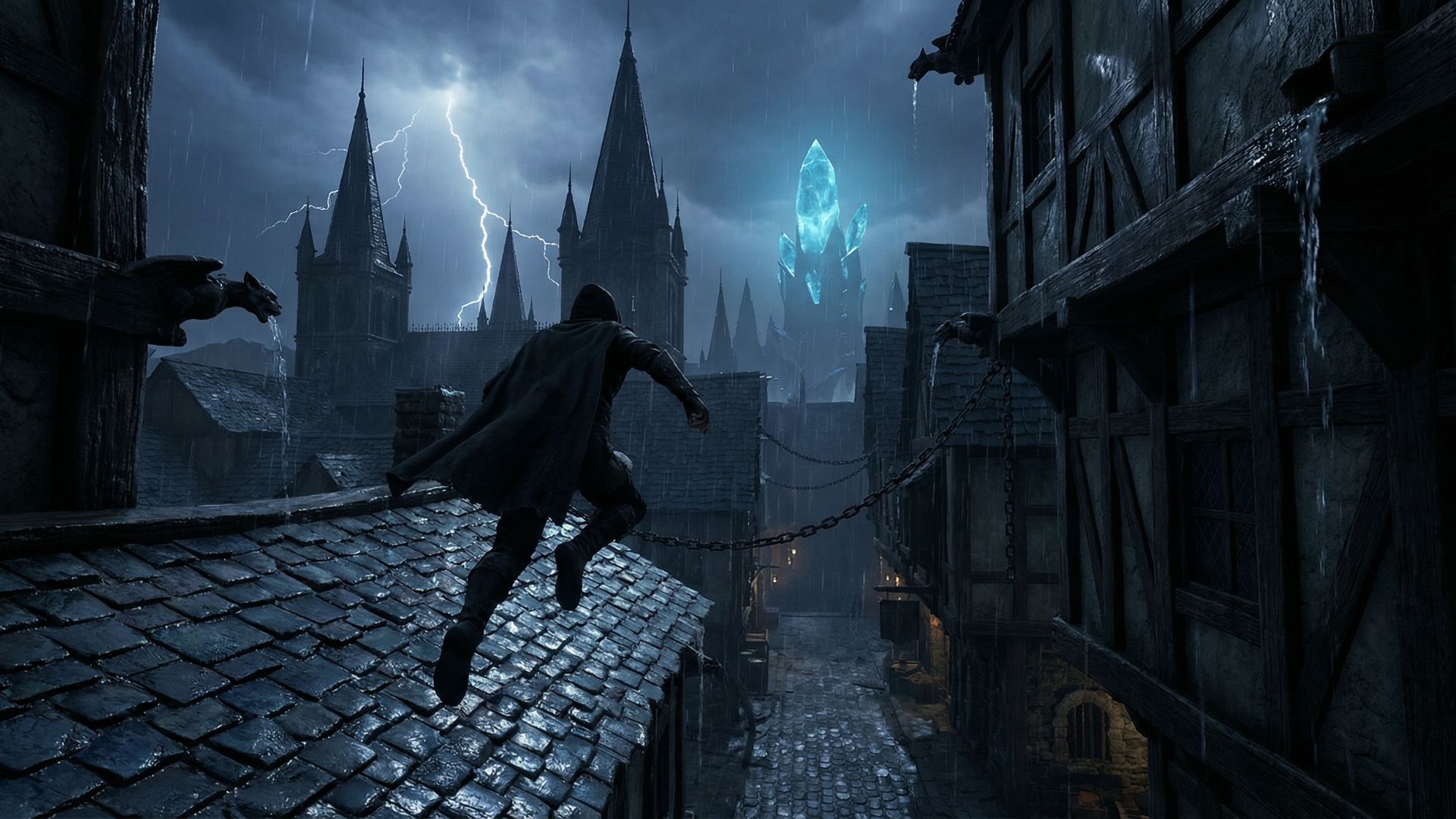
Some gaming moments stick with you for years, and then there are sequences so perfectly crafted that they fundamentally change how you think about what first-person games can accomplish.
Dark Messiah of Might and Magic released back in 2006, yet its legendary rooftop chase sequence continues to influence how developers approach environmental storytelling and player momentum nearly two decades later. While modern games often pad their runtime with repetitive content, this Arkane Studios gem demonstrated something radical: sometimes the best ideas are the ones you use once and leave behind.
When chaos becomes choreography
The setup sounds simple enough. A ghoul steals a magic crystal right in front of you, and suddenly you’re racing across rain-slicked rooftops in pursuit. What unfolds over the next several minutes represents some of the tightest level design the first-person genre has ever produced.
Every jump feels intentional. Every chain you grab serves a purpose. Every collapsing timber beneath your feet creates genuine panic without feeling cheap or unfair. The glowing crystal leaves a visual trail that draws your eye forward, ensuring you never lose track of your quarry while still maintaining the frantic energy of a genuine pursuit.
This isn’t a scripted cutscene masquerading as gameplay. You’re making real decisions, timing actual jumps, and occasionally plummeting to your death when you misjudge a gap. The succubus companion living in your head offers guidance about when to jump and climb, functioning like a supernatural GPS that somehow never feels intrusive.
The jackie chan philosophy of game design
What makes this sequence transcend typical chase missions is how it treats the player as an action hero capable of improvising with the environment. When the ghoul crawls straight up a wall, leaving you seemingly stranded, the game trusts you to frantically scan your surroundings and spot the chain or platform that keeps the pursuit alive.
That moment of panic followed by environmental problem-solving creates an experience that feels genuinely cinematic. You’re not watching someone else perform stunts. You’re the one making split-second decisions, and the camera angle you choose determines whether you spot your escape route or tumble into the darkness below.
The comparison to Jackie Chan’s filmmaking style feels apt. His movies work because he incorporates whatever happens to be nearby into his fight choreography. A ladder becomes a weapon. A shopping cart transforms into a vehicle. Dark Messiah applies this philosophy to traversal, treating rooftops as playgrounds rather than corridors.
Feet matter more than you think
Here’s something that sounds trivial but dramatically impacts immersion: you can look down and see your character’s feet in Dark Messiah. This small detail transforms first-person platforming from an exercise in spatial guesswork into something grounded and physical.
Modern games still struggle with this. How many times have you missed a jump because you couldn’t tell exactly where your character’s body ended and the void began? Dark Messiah understood that embodiment matters, especially during sequences demanding precise timing and positioning.
The rooftop chase benefits enormously from this design choice. When you’re leaping across gaps between buildings during a thunderstorm, seeing your legs dangle over empty space adds visceral tension that floating camera perspectives cannot replicate.
Sandbox meets linear brilliance
Dark Messiah earned its reputation primarily through combat sandboxes where creative violence flourished. Kicking orcs into spike walls, setting oil slicks ablaze, and exploiting physics to turn environments into death traps became the game’s signature appeal.
But the rooftop chase demonstrates that linear sequences can be equally compelling when designed with care. The key lies in density of experience. Every moment during the pursuit serves the core fantasy of chasing down a supernatural thief across dangerous terrain. Nothing feels padded or repetitive.
| Design Philosophy | Modern Open World Games | Dark Messiah Approach |
|---|---|---|
| Content Strategy | Repeat mechanics across dozens of similar activities | Use ideas once at maximum impact |
| Player Guidance | Minimap markers and quest logs | Environmental storytelling and visual cues |
| Pacing | Self-directed with variable intensity | Tight authorial control with constant escalation |
| Replayability | Quantity of content | Quality of individual moments |
What follows the chase proves equally impressive. You transition into a warehouse infiltration that plays like a condensed Thief level, complete with guards who can be handled through stealth, combat, or creative environmental manipulation. The tonal shift works because both sections share commitment to player agency within carefully designed spaces.
The blacksmithing nobody asked for
Tucked inside that warehouse sits a forge where you can craft your own sword. Not a menu-driven abstraction but an actual process involving bellows, molten metal, and water cooling. This minigame exists for one sequence and never returns.
Modern game design logic would demand this system appear repeatedly. Tutorial, then progression, then mastery, then trivial repetition. Dark Messiah treats blacksmithing as a neat surprise you encounter once and remember forever.
This philosophy permeates the entire experience. Ideas appear fully formed, deliver their impact, and gracefully exit before overstaying their welcome. The rooftop chase doesn’t spawn a ghoul-hunting sidequest chain. The blacksmithing doesn’t unlock a crafting progression tree. These moments exist to enrich a singular playthrough rather than extend playtime metrics.
Lessons the industry forgot
Nearly twenty years after Dark Messiah’s release, the rooftop chase feels more relevant than ever. The games industry has largely moved toward live service models, content quantity metrics, and endless recycling of mechanical loops designed to maximize engagement time.
Dark Messiah represents the road not taken. What if games prioritized memorable moments over measurable hours? What if developers trusted players to appreciate quality without demanding quantity? What if chase sequences existed as crafted experiences rather than procedurally generated filler?
Arkane Studios continued exploring these ideas in subsequent titles like Dishonored and Prey, but something about Dark Messiah’s willingness to throw ideas at players with reckless abandon remains unique. The rooftop chase captures that spirit perfectly: a sequence designed to thrill rather than extend, to surprise rather than satisfy checklist expectations.
Why this matters now?
Retro appreciation isn’t just nostalgia. Examining why older games succeeded helps understand what modern design sometimes sacrifices in pursuit of different goals. Dark Messiah’s rooftop chase succeeds because every element serves the player fantasy of being an action hero in pursuit of a supernatural thief.
The rain creates atmosphere. The glowing crystal provides visual guidance. The collapsing environments generate urgency. The succubus companion adds character and assistance without breaking immersion. The visible feet ground your perspective in physical space. Everything works together toward a unified experience.
This level of intentionality requires restraint. You cannot design moments this dense if you’re also trying to fill fifty hours with content. Dark Messiah chose intensity over duration, and players who experienced it remember the results decades later.
The game remains available on Steam for anyone curious about experiencing this legendary sequence firsthand. Just be prepared: the rooftop chase rarely goes right on the first attempt. That’s part of what makes finally nailing it feel so triumphant.
Few gaming moments capture the pure joy of first-person movement like chasing that ghoul across rain-soaked rooftops while timbers creak beneath your feet. Dark Messiah understood something essential about game design that too many modern titles have forgotten.
What classic gaming moment do you think deserves more recognition for its design innovations?