




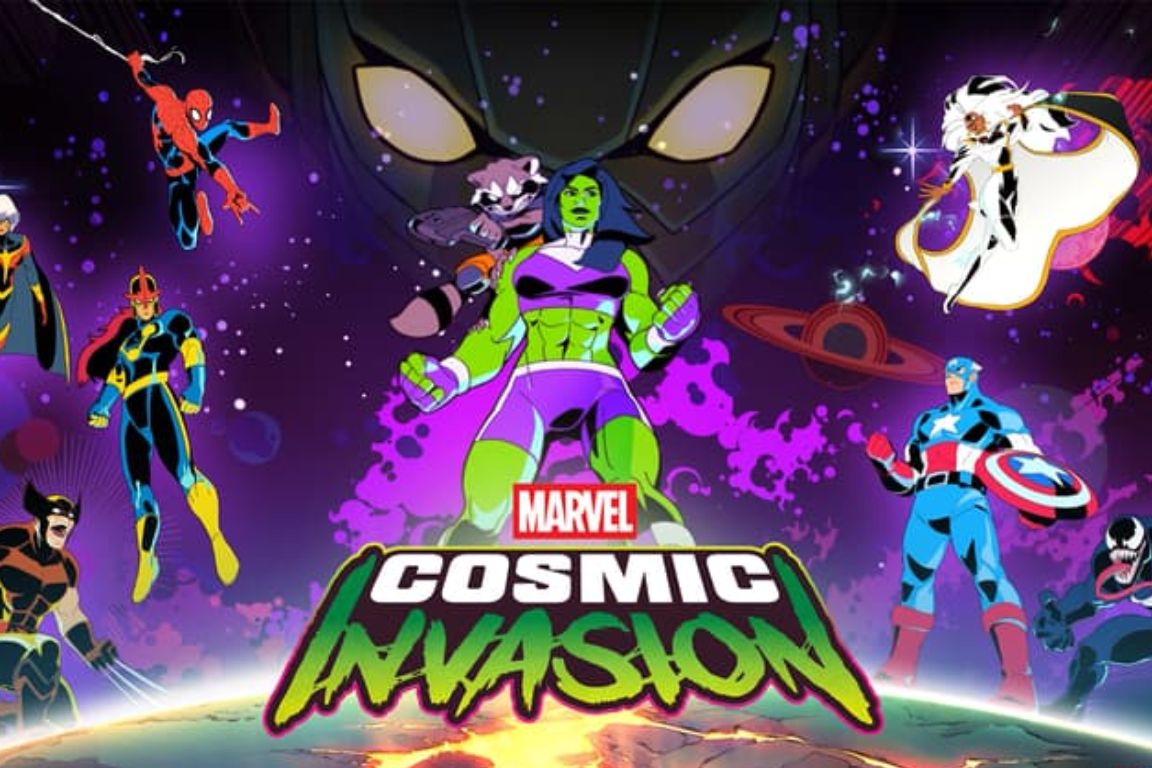
Annihilus has spoken his twisted gospel, and reality trembles. The living embodiment of death from the Negative Zone has unleashed an assault so catastrophic that cosmic entities and street-level champions must unite or watch creation crumble. Tribute Games and Dotemu, the dream team behind critically acclaimed beat ’em ups, have partnered with Marvel Games to deliver this sprawling brawler that spans from Manhattan’s concrete canyons to dimensions where physics surrenders.
A roster that bridges realities
MARVEL Cosmic Invasion assembles 15 playable characters, creating a bridge between Earth’s mightiest defenders and the galaxy’s most powerful cosmic entities. Nova and Spider-Man fight alongside Wolverine and Phyla-Vell, while Captain America brings tactical leadership to battles against interdimensional horrors. This deliberate mixing of terrestrial heroes with space-faring champions reflects the narrative’s core premise: no single realm possesses sufficient strength to repel the Annihilation Wave alone.
The character selection philosophy accommodates both franchise veterans and newcomers discovering Marvel’s vast mythology for the first time. Each fighter brings distinct capabilities designed to complement various playstyles, ensuring that button-mashing enthusiasm and calculated strategy both find rewarding expression. Whether you gravitate toward raw power, agility, or technical precision, the roster contains options that resonate.
The cosmic swap revolution
Traditional beat ’em ups lock players into single-character commitments for entire levels, forcing restarts when that choice proves suboptimal. Tribute Games shatters this convention through their cosmic swap tag-team mechanism, allowing instantaneous switches between two pre-selected heroes during any level. This innovation transforms combat from linear progression into dynamic problem-solving.
The system encourages experimentation with character pairings, as each combination unlocks unique synergies. Transitioning between heroes mid-combo creates devastating chains impossible with solo fighters, while strategic swapping preserves health by rotating damaged characters to recovery. Boss encounters particularly benefit from this flexibility, permitting tactical adjustments when specific abilities prove more effective against particular enemy patterns.
Beyond mechanical advantages, the tag-team structure introduces genuine decision-making. Selecting complementary skillsets versus doubling down on preferred playstyles creates meaningful pre-level choices. Do you pair a ranged specialist with a close-quarters brawler for versatility, or maximize damage potential through aggressive character stacking? These considerations add strategic depth typically absent from the genre.
Pixel perfection meets Marvel mythology
MARVEL Cosmic Invasion’s visual identity draws inspiration from specific periods when Marvel’s cosmic narratives reached creative peaks. The full-color pixel art doesn’t simply mimic retro aesthetics; it captures the energy and composition of classic comic panel layouts translated into animated sprite work. Background details reference deep-cut Marvel lore, rewarding franchise knowledge while maintaining visual clarity during chaotic combat.
The artistic direction serves dual purposes. For longtime enthusiasts, the presentation evokes nostalgia for both 16-bit era gaming and specific comic storylines that defined characters like Annihilus. Simultaneously, the vibrant pixel work attracts modern audiences through its craftsmanship and stylistic cohesion, proving that dated technology doesn’t mandate dated execution when wielded by skilled artists.
Environmental variety complements the character designs. New York City’s recognizable landmarks provide grounding before levels transport players through cosmic anomalies into alien geometries. The Negative Zone sequences particularly showcase the art team’s range, depicting antimatter realms where conventional physics collapse and visual rules rewrite themselves. Each location maintains distinct identity while preserving gameplay readability, a difficult balance many retro-inspired projects fail to achieve.
Accessibility without compromise
Multiplayer implementation often divides communities between hardcore coordination seekers and casual couch co-op enthusiasts. MARVEL Cosmic Invasion refuses this binary through its adaptive drop-in/drop-out system supporting both local and online configurations. Friends can join mid-level without disrupting pacing, while departures scale difficulty appropriately rather than punishing remaining players.
This accessibility philosophy extends beyond connection options. The game accommodates skill disparities within groups, allowing experienced players to challenge themselves while less practiced participants contribute meaningfully. Family gaming scenarios particularly benefit, as younger players can engage without dragging down veteran beat ’em up fans who crave mechanical depth.
The multiplayer structure also respects modern gaming realities. Not everyone can gather physically for gaming sessions, yet online-only solutions sacrifice the spontaneous energy of shared-screen cooperation. By supporting both configurations with equal robustness, Tribute Games acknowledges that different situations demand different solutions while maintaining experience quality across all options.
The Annihilation Wave looms
Annihilus represents more than a final boss waiting at the campaign’s conclusion. As the living embodiment of the Negative Zone’s hostility, his Annihilation Wave transforms entire levels into existential battlegrounds where defeat means universal extinction. This threat scale differentiates the narrative from typical beat ’em up premises where villainy remains geographically contained.
The cosmic stakes justify the hero assembly’s unusual composition. Spider-Man’s neighborhood protection instincts and Wolverine’s personal vendettas matter little when reality itself faces erasure. This forced collaboration between characters who rarely share panel space creates narrative opportunities for unexpected interactions and relationship dynamics, assuming Tribute Games invests in story presentation beyond mission briefings.
Fighting across multiple planets and dimensions promises environmental variety that keeps visual engagement high throughout the campaign. Repetition plagues many beat ’em ups as asset reuse becomes obvious during extended play sessions. The premise’s scope provides natural justification for constant location shifts, potentially maintaining freshness that similar games struggle achieving.
Conclusion
MARVEL Cosmic Invasion positions itself as more than another licensed beat ’em up trading on recognizable characters. The cosmic swap system introduces legitimate innovation to genre conventions, while the artistic vision demonstrates respect for both gaming history and comic mythology. Tribute Games and Dotemu have proven their ability to honor classic formulas while modernizing outdated elements, suggesting this collaboration could define how future brawlers approach character variety and cooperative play.
Whether MARVEL Cosmic Invasion achieves its cosmic ambitions depends on execution details not yet revealed: enemy variety, campaign length, difficulty balance, and narrative integration all determine if the foundation supports a memorable experience or merely competent homage. But will the innovation of instant character swapping fundamentally change how we approach team-based beat ’em ups, or will it remain a clever gimmick overshadowed by traditional gameplay?