
Table of Contents

Point-and-click adventures set in the Wild West typically arm players with revolvers and righteous vengeance, but Rosewater hands you something far more subversive: a fountain pen and genuine curiosity about the world around you. Grundislav Games’ spiritual successor to Lamplight City reimagines the Western genre through the lens of journalism rather than justice, creating one of 2025’s most quietly revolutionary adventure games that proves you don’t need gunfights to tell compelling frontier stories.
This isn’t your grandfather’s Western, and that’s precisely the point. While most frontier narratives glorify rugged individualism and violent confrontation, Rosewater builds its entire foundation on community, conversation, and the power of documenting lived experiences. The result feels refreshing in a gaming landscape oversaturated with violence as the default solution to every problem.
A protagonist armed with curiosity instead of bullets
Journalist Harley Leger arrives in the town of Rosewater to work for the local newspaper, immediately tasked with interviewing Gentleman Jake Ackerman, a Wild West showman whose presence kicks off a treasure hunt spanning the entire frontier. What could have devolved into standard adventure game fetch quests instead becomes a masterclass in character-driven storytelling.
Harley represents everything this game does right. Her weapons are stubbornness, sharp wit, and an insatiable nose for truth. She pursues stories rather than outlaws, uncovers mysteries through interviews rather than interrogations, and documents the West’s transformation through her remarkably well-written diary entries. Playing as someone whose job literally involves asking questions and listening to answers creates natural justification for the genre’s traditional dialogue-heavy gameplay.
The choice to center a journalist proves inspired on multiple levels. It contextualizes why Harley constantly engages with strangers, investigates seemingly mundane situations, and collects information that initially appears tangential to main objectives. More importantly, it positions the player as observer and chronicler rather than conqueror, fundamentally shifting how we engage with Western settings in games.
Steampunk sensibilities breathe fresh air into dusty trails
Rosewater continues the alternate history established in Lamplight City, presenting a West transformed by catastrophic developments in “aethericity” (this universe’s steampunk energy source). This isn’t just aesthetic window dressing. The technological and societal shifts created by aethericity fundamentally alter what the frontier means and who populates it.
Instead of lone gunslingers and cattle barons, this West teems with refugees displaced by industrial disasters, scientists escaping scandals, inventors seeking fresh starts, and communities grappling with rapid technological change. The steampunk elements never overwhelm the Western foundation but rather enhance it, creating space for stories that traditional frontier settings couldn’t accommodate.
This alternate history framework also allows Grundislav Games to address the Western genre’s deeply problematic legacy without simply ignoring it. The game spends considerable time exploring consequences of imperialist brutality against Native tribes and New Spanish populations, but frames these discussions through characters actively grappling with this history rather than treating it as background flavor. The approach feels respectful and thoughtful without becoming preachy.
Road trip structure transforms pacing into strength
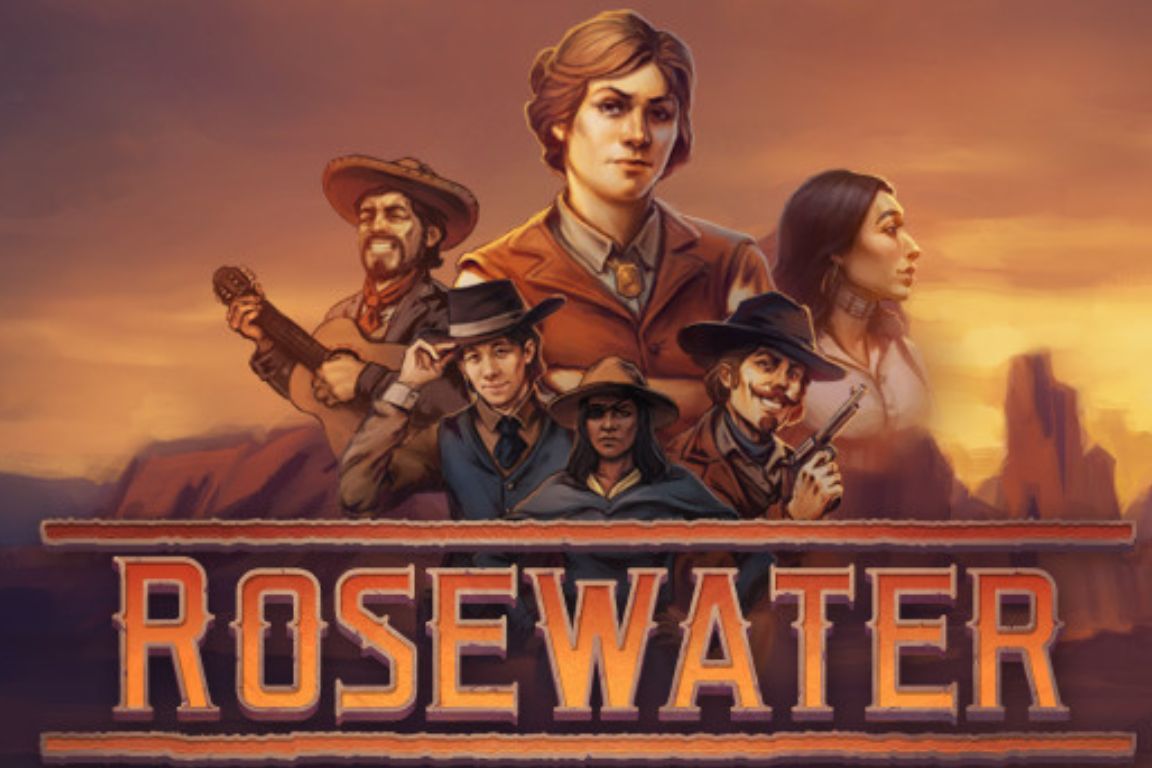
Most of Rosewater unfolds inside Lola Johnson’s wagon as your ragtag crew travels toward El Presidio. This mobile hub transforms traditional adventure game structure into an extended road trip populated by memorable companions: boastful showman Jake, his talented assistant Danny Luo, charming rebel leader Filomeno Marquez, soft-spoken aspiring doctor Nadine Redbird, and hard-as-nails caravan driver Lola herself.
The genius of this setup lies in how it justifies the game’s deliberately unhurried pace. There’s never urgency to rush toward the next objective because the journey itself contains the story. Your crew stops constantly to help travelers, investigate interesting situations, poke around settlements, and simply talk with the people they encounter. What might feel aimless in other games becomes Rosewater’s defining characteristic and greatest strength.
The road segments present themselves as extended vignettes varying wildly in complexity. Some encounters are randomized and skippable, creating replay value and the sense that this frontier contains countless untold stories beyond your direct experience. Others develop into elaborate setpiece scenes featuring companion-focused puzzles where Harley directs and assists her friends while learning about them.
These companion interactions provide consistent highlights. Watching Danny get scammed by a fraudulent psychic feels authentically embarrassing. Lola’s attempts to hide her affection for a neglected puppy deliver genuine warmth. Phil confronting former friends who became refugees because of his past choices cuts surprisingly deep for a point-and-click adventure. The writing understands these characters as fully realized people rather than quest dispensers or comic relief.
Puzzle design that respects player intelligence
Adventure game puzzles walk a treacherous tightrope between too obvious and completely obtuse. Rosewater generally finds excellent balance, providing challenges that require thought without descending into pixel-hunting frustration or moon logic solutions.
Puzzles escalate in complexity as the journey progresses, mirroring both Harley’s growing familiarity with her companions and the player’s developing understanding of the game’s internal logic. The standout sequence involves a retired sea captain whose home becomes temporary refuge during a storm. Multiple layered puzzles scattered throughout his house reward thorough exploration while building toward a delightfully goofy seance where everyone dresses as figures from the captain’s past. The payoff justifies the investigative work leading to it.
Less successful are occasional minigames that mostly serve as time-wasters before Harley admits defeat and delegates to more capable companions. Simple fishing mechanics prove forgivable, but sharpshooting sequences involving clicking rapidly moving targets feel unnecessarily frustrating. A late-game map mechanic suffers from the art style’s simplicity, rendering it nearly illegible. Fortunately, these detours appear infrequently enough that they don’t significantly damage the overall experience.
Writing that elevates atmosphere above action
Rosewater’s greatest triumph lies in its exceptional writing, particularly Harley’s narration and diary entries. The rarely-referenced journal contains some of the game’s finest prose, lending incredible atmosphere to this interpretation of the frontier. Harley’s dry humor and general competence carry much of the experience, keeping bizarre or extraordinary situations grounded through her unflappable reactions.
Whether dealing with mad scientists, military patrols, pseudo-Pinkerton ambushes, or overly friendly religious cultists, Harley maintains composure while providing sharp observations that enhance rather than undermine the absurdity. This tonal balance prevents the game from collapsing into either po-faced seriousness or constant jokes that would trivialize its themes.
The writing also excels at environmental storytelling and world-building through conversation. Every encounter, whether major plot point or random roadside meeting, contributes to the sense that this West exists as living, breathing space filled with people pursuing their own goals rather than simply awaiting the protagonist’s arrival.
Thematic depth that interrogates Western mythology
Rosewater interrogates what the West means as concept and mythology. Rather than embracing expansionism and settlement narratives, the game positions the frontier as refuge for those escaping traumatic pasts or seeking undefined futures. This shift in perspective allows for stories centered on survival, community-building, and healing rather than conquest and violence.
The contrast becomes most apparent during the climactic sequences when the crew approaches El Presidio. The return to urbanity creates claustrophobia after hours spent in open spaces. The narrowing focus and sense that the eyes of the world have returned generates genuine tension precisely because it threatens the freedom and anonymity the frontier provided.
Throughout the journey, there’s persistent sense that grand historical events have already occurred elsewhere, that the places and people Harley encounters exist outside the march of empires and progress. They’re not building toward some predetermined future but rather creating their own possibilities. This framing allows the game to acknowledge Western genre’s problematic elements while finding empathy in stories beyond bloodshed.
The treasure hunt driving the plot reinforces these themes beautifully. The fortune they seek belongs to a scientist fleeing scandal following a distant city catastrophe. It represents escape from old world consequences rather than conquering new territories. Without races to gold or hunts for killers, there’s space for Harley to seek her own story while helping others find theirs.
Rosewater succeeds because it understands that point-and-click adventures thrive on observation, conversation, and piecing together information. These mechanics align perfectly with journalism and exploring a frontier populated by people trying to figure out how to live. The game presents a West we recognize but not quite, familiar enough to resonate while different enough to surprise.
For players seeking action-heavy thrills, Rosewater’s sun-baked lethargy might prove frustrating. But for those willing to embrace its contemplative pace and character-focused storytelling, this journey offers one of the most thoughtful interpretations of Western themes gaming has produced. It proves that sometimes the most revolutionary act is choosing the notebook over the revolver.
What Western game conventions would you most like to see other developers subvert or reimagine in future titles?